TL;DR: This comprehensive guide outlines the critical variables of Australian solar adoption, from Sydney's microclimate variations (such as Penrith's 3°C temperature gap) and precise panel tilt requirements (33.9°), to next-generation hybrid inverter technologies and progressive revolving community fund structures like CORENA and the CEFC's Infradebt program.
Introduction to the Australian Energy Transition
Australia is currently undergoing a significant energy transition. Large-scale government projects, such as the South-West Renewable Energy Zone, are designed to generate up to 3.56 gigawatts (GW) of clean energy using wind, solar, and battery storage. This single zone is projected to generate enough electricity to power up to 1.6 million homes across New South Wales. However, the transition to clean energy does not rely solely on utility-scale developments. Residential solar installations, commercial systems, and community-funded renewable energy projects play an equally vital role in decentralizing Australia's energy base and lowering emissions.
Residential Solar in Greater Sydney: Penetration Rates and Housing Dynamics
According to data from the Clean Energy Regulator, residential solar adoption in Greater Sydney has reached significant milestones. Over 500,000 households (specifically 508,683 homes) have installed solar panels, which represents 26.44% of all households in the region. Since the introduction of the state's solar battery rebate in July 2025, battery storage systems have also seen steady growth, with 88,118 batteries installed, representing 4.58% of households in Greater Sydney.
This means that approximately 17% of all solar-equipped homes in Sydney now incorporate integrated battery storage. Despite these positive numbers, the overall solar penetration rate in Greater Sydney is slightly lower than in neighboring areas like Newcastle. This difference is largely driven by Sydney's higher density of townhouses and apartment buildings, where installing rooftop solar systems presents greater logistical and structural challenges than in lower-density suburbs.
Analyzing Sydney's Microclimates and Solar Output Capacity
Sydney enjoys an average of 6.8 hours of sunshine every day, outperforming Melbourne, which averages 6 hours of daily sunlight. This climate makes the region highly suitable for solar power generation. However, local weather patterns and regional temperatures are not uniform across the metropolitan basin. Bureau of Meteorology data reveals a substantial microclimate temperature differential between Sydney's coastal City Centre and inland Western suburbs like Penrith. On average, Penrith is 3°C warmer than the City Centre throughout the year. The table below details this seasonal temperature gap:
| Season | City Centre Average | Penrith Average | Temperature Difference |
|---|---|---|---|
| Summer | 25.7°C | 30.1°C | 4.4°C |
| Autumn | 22.3°C | 24.5°C | 2.2°C |
| Winter | 17.1°C | 18.7°C | 1.6°C |
| Spring | 22.0°C | 25.7°C | 3.7°C |
| Annual Average | 21.8°C | 24.8°C | 3.0°C |
This temperature gap has two direct consequences for solar owners in Western Sydney. First, the higher summer temperatures in Penrith (averaging 30.1°C, a 4.4°C increase over the City Centre) slightly reduce solar panel operating efficiency, as photovoltaic cells produce less voltage when they get too hot. Second, these warmer temperatures increase the electrical load requirements of households in the west due to greater air conditioning and cooling demands during peak hours.
System Geometry: Optimal Sizing, Angles, and Orientation
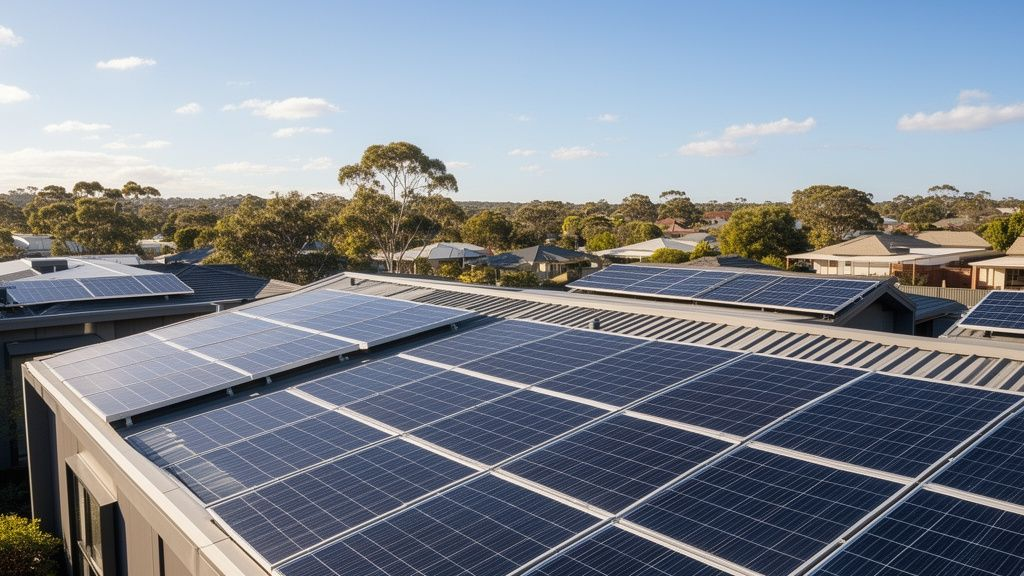
To maximize the electrical output of a residential solar system in Greater Sydney, homeowners must align their installations with precise physical parameters. The optimal mounting angle for solar panels in Sydney is 33.9°, which matches the city's latitude. If panels are installed on a flat roof, they should be mounted on angled tilt frames. This tilt allows rainfall to naturally wash away dust and debris, preserving generation efficiency.
For optimal generation across the entire day, panels should face true North. If a property's roofline only allows for an East/West orientation, the system can still produce highly effective yields, provided the household's peak energy usage aligns with the morning and late afternoon hours when these panels receive direct sunlight.
System sizing directly dictates the amount of daily electricity a home can expect to generate. The following table highlights the average daily energy output for standard residential system sizes in Sydney:
- 3kW System: 12.0 kWh per day
- 4kW System: 16.0 kWh per day
- 5kW System: 20.0 kWh per day
- 6.6kW System: 26.4 kWh per day
- 8kW System: 32.0 kWh per day
- 10kW System: 40.0 kWh per day
- 13kW System: 52.0 kWh per day
Next-Generation Solar Hardware: Inverters, Batteries, and Storage Ecosystems
To convert raw solar energy into usable household electricity, high-quality hardware is required. Companies like Solar Link Australia, an established Australian-owned solar seller operating since 2010, deploy a range of CEC-approved and NETCC-approved technologies. These include:

- GoodWe Inverters: The GoodWe GW9.999KEHA-G20 is a 10kW single-phase hybrid inverter featuring 200% oversizing capabilities and 4 Maximum Power Point Trackers (MPPTs) to optimize solar intake across different roof sections. It pairs with the GW8.3-BAT-D-G21 battery series for energy storage.
- Neovolt Hybrid Systems: Neovolt provides single-phase and three-phase hybrid inverters alongside modular lithium-iron-phosphate (LiFePO4) storage batteries, including the BW-INV-SPB5K, BW-INV-SPH5K, and BW-BAT system models.
- Walara G4P Series: Designed and engineered by a local team based in South Australia, the Walara G4P series is built to handle harsh Australian weather conditions.
- DEYE ESS Storage Solution: This scalable high-voltage system features 7.68 to 15.36 kWh of modular storage, real-time data tracking, smart load control, and a 10-year warranty.
- SAJ Hybrid HS2 Series: A three-phase hybrid all-in-one storage solution utilizing safe LiFePO4 battery cells and AI-motivated Arc Fault Circuit Interrupter (AFCI) safety systems.
- AlphaESS AC Coupled Solutions: The G3-S5 and G3-B5 solutions allow homeowners to integrate scalable battery storage into existing solar setups without redesigning their current inverter configuration.
These systems are crucial for off-grid Stand-Alone Power Systems (SAPS). Off-grid systems operate by using solar panels to generate electricity, which is then stored in batteries as Direct Current (D.C.). Inverters then convert this stored energy into Alternating Current (A.C.) for use in standard wall outlets.
Financing the Clean Energy Shift: Concessional Debt and Community Loans
Overcoming upfront installation costs is one of the primary hurdles to solar adoption. To address this, various financial structures have emerged to support residential, commercial, and community installations:
-
Zero-Interest Community Loans: CORENA (Community Revolving Energy Fund) is an Australian non-profit organisation that takes public donations and converts them into zero-interest loans for other community groups, non-profits, and social enterprises. As these loans are paid back, the funds are returned to the revolving pool to fund new projects. As of August 2026, CORENA has achieved the following milestones:
- Total Project Donations: $1,023,302
- Total Project Loans Granted: $2,003,268
- Total Solar Capacity Funded: 1,383 kW
- Total Battery Capacity Funded: 168 kWh
- Avoided Grid Electricity: 8,443 MWh
- Avoided Carbon Emissions: 5,902 tonnes
-
Concessional Debt for Mid-Scale Projects: The Clean Energy Finance Corporation (CEFC) has committed $100 million to a specialized debt fund manager, Infradebt, to support the Distribution Connected Accelerator Program (DCAP). This program targets the "missing middle" by providing concessional senior debt financing to mid-scale renewable projects (up to 5MW in capacity). It aims to fund up to 16 hybrid solar, battery, and battery retrofit projects, helping them connect directly to local distribution networks and begin construction by 2027.
-
Retail and Commercial Financing: Private providers offer payment flexibility to assist households. For instance, Solar Link Australia offers "Install Now Pay Later" financing packages with payments starting from $1.99 per day, allowing homeowners to reduce utility bills immediately without a large upfront capital outlay.
Case Studies in Social Impact: Community and Not-for-Profit Projects
The financial benefits of solar and battery storage extend beyond simple balance sheets, particularly when applied to community service organizations. For example, Barnardos South Coast Children’s Family Centre implemented solar through CORENA's zero-interest loan model. According to Manager Maria Corsiglia, the transition away from coal-fired power cut the organization's operating costs, allowing them to redirect those funds to support local children and families.
Similarly, the Lockington Community Care Committee used a CORENA loan to reduce energy bills for its low-income residents, significantly lowering greenhouse gas emissions in the process. The historic Capri Theatre, a volunteer-run not-for-profit, has also taken steps to curb its environmental footprint. Faced with rising commercial electricity tariffs, the organization upgraded to LED lighting, adopted compostable consumables, and is transitioning to solar and battery power to manage its operational costs.
Key Takeaways
- High Regional Adoption: More than one in four Greater Sydney households have solar panels (26.44%), and battery storage has reached 4.58% penetration since July 2025.
- Varying Local Microclimates: Penrith averages 3°C warmer than the City Centre, which slightly lowers solar efficiency in summer while increasing cooling energy demands.
- Precise Physical Parameters: Solar systems in Sydney generate optimal yields when pitched at a 33.9° angle and oriented toward true North.
- Proven Technology Partners: Equipment from major brands like GoodWe, Neovolt, and DEYE offers high-performance components, including 200% oversizing, smart load control, and 10-year warranties.
- Innovative Funding Models: Financial barriers are being overcome through CORENA’s zero-interest community loans, CEFC's $100 million mid-scale senior debt fund, and retail "Install Now Pay Later" programs starting at $1.99 per day.
Related Guides
- Solar Inverter and Battery Storage Technologies: A Technical Examination of Australian Residential Systems
- Unlocking the Missing Middle: Mid-Scale and Community Renewable Infrastructure in Australia
- Funding Clean Energy: A Guide to Australian Solar Incentives, Zero-Interest Loans, and Financing
- Engineering the Optimal Home Solar System: Sydney Sizing, Alignment, and Climate Guide