TL;DR: Residential energy storage is evolving rapidly, driven by Sydney's post-July 2025 battery rebates (leading to 88,118 installations) and next-generation systems from manufacturers like GoodWe, Neovolt, DEYE, SAJ, and AlphaESS. This technical guide explores scalable storage capacities, inverter oversizing, and off-grid Stand-Alone Power Systems.
Urban Battery Demographics in Australia
As of August 2026, home battery adoption has grown significantly in metropolitan areas across Australia. In Greater Sydney, 88,118 solar batteries have been installed, representing 4.58% of all households in the region. Since 508,683 households have solar panels (a 26.44% penetration rate), this means that over 17% of residential solar systems in Sydney now operate with integrated battery storage.
While high-density housing formats like townhouses and apartments have kept Sydney’s overall solar adoption rates below regions like Newcastle, the steady uptake of home batteries shows that homeowners are increasingly focused on energy self-reliance. This trend has been supported by new financial incentives and the introduction of next-generation hybrid inverters.
Inverter Innovations: Oversizing and MPPTs
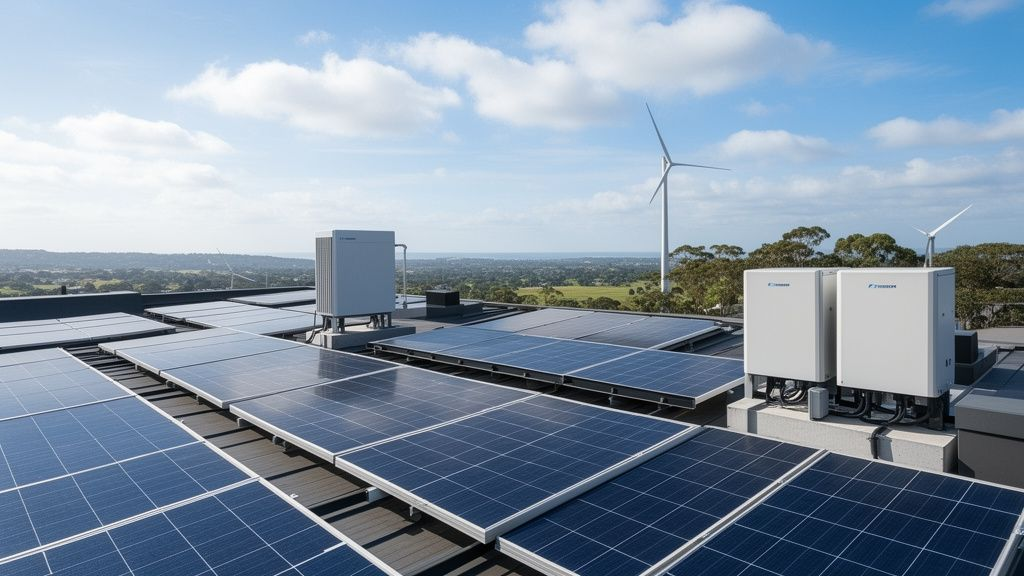
Modern solar systems rely on advanced inverters to convert Direct Current (D.C.) from solar panels into usable Alternating Current (A.C.) for household appliances. Leading hardware brands, such as those installed by Solar Link Australia, have introduced highly efficient inverter platforms designed to maximize energy capture.
An example of this is the GoodWe GW9.999KEHA-G20, a 10kW single-phase hybrid inverter. This inverter features 200% oversizing capability, which allows homeowners to install a solar array up to double the rated capacity of the inverter. This design ensures the system can generate power even in low-light conditions.
To manage this extra capacity, the GoodWe system is equipped with 4 Maximum Power Point Trackers (MPPTs). MPPTs dynamically adjust the electrical operating point of the panels, allowing the system to run at peak efficiency even if different sections of the roof face different directions or experience partial shading.
Scalable Storage Systems and Brands
To match varying household energy demands, battery manufacturers have developed scalable, modular storage systems. These models allow homeowners to start with a smaller setup and add more capacity as their budget or energy needs grow:
- DEYE ESS Storage Solution: This system offers scalable high-voltage storage capacities ranging from 7.68 kWh to 15.36 kWh. It includes real-time data tracking, smart load control, and is backed by a 10-year warranty.
- Neovolt Range: Neovolt offers single-phase and three-phase hybrid inverter and battery combinations, such as the BW-INV-SPB5K, BW-INV-SPH5K, and modular BW-BAT battery packs.
- SAJ Hybrid HS2 Series: A three-phase hybrid all-in-one system that uses safe Lithium Iron Phosphate (LiFePO4) cell chemistry. It features AI-motivated Arc Fault Circuit Interrupter (AFCI) safety systems to protect against electrical fire hazards.
- AlphaESS AC Coupled Solutions: Designed as retrofits, the G3-S5 and G3-B5 AC-coupled systems allow homeowners to add battery storage to an existing solar array without replacing their original solar inverter.
Stand-Alone Power Systems (SAPS) and Off-Grid Dynamics
For remote properties or homeowners seeking complete independence from the grid, off-grid systems—also known as Stand-Alone Power Systems (SAPS)—offer a practical solution. These systems generate energy via solar panels to charge a local battery bank.
Within a SAPS system, electricity is stored as D.C. power in the batteries. When a household appliance is turned on, a dedicated off-grid inverter converts this stored D.C. energy into standard A.C. electricity to run wall outlets. This continuous cycle of generation, storage, and conversion requires careful system sizing to ensure power remains available during periods of low sunlight.
Key Takeaways
- Growing Battery Market: In Greater Sydney, 17.3% of solar-equipped households have added integrated battery storage, totaling 88,118 installations.
- Advanced Inverter Features: Hardware like the GoodWe 10kW inverter supports 200% panel oversizing and utilizes 4 MPPTs to maximize solar energy capture.
- Modular and Scalable Options: Brands like DEYE and AlphaESS offer flexible battery systems ranging from 7.68 kWh to over 15 kWh, making future upgrades simple.
- Safe Cell Chemistries: Modern batteries rely on safe Lithium Iron Phosphate (LiFePO4) chemistry and built-in safety features like AI-motivated AFCI protection.
- Reliable Off-Grid Systems: Stand-Alone Power Systems (SAPS) provide complete grid independence by storing solar energy as D.C. and converting it to A.C. for household appliances.