Why Businesses Are the Cleanest Use Case for Solar Power in Australia
Australia is blessed with abundant sunshine, making it a prime candidate for solar power generation. While residential solar has boomed, often seen as the face of the renewable energy revolution, it's Australian businesses that truly represent the cleanest, most efficient, and economically compelling use case for solar power. From manufacturing plants to office blocks and retail outlets, businesses are uniquely positioned to maximise the benefits of solar, driving down costs and significantly reducing their carbon footprint in the most impactful way.
The Business Advantage: Peak Solar Meets Peak Demand
The fundamental reason businesses are the ideal solar adopters lies in their energy consumption patterns. Most commercial operations run during daylight hours – precisely when solar panels are generating electricity at their peak. Think about it: a bustling office from 9 AM to 5 PM, a factory whirring from dawn till dusk, or a shopping centre open all day. These enterprises have a consistent, high demand for power when the sun is shining brightest.
This perfect alignment between solar generation and consumption means businesses can utilise almost all the electricity their panels produce directly. Unlike residential homes, where peak electricity usage often occurs in the evening when the sun has set (requiring significant battery storage or grid reliance), businesses typically consume solar power as it’s generated. This maximises self-sufficiency, drastically reduces reliance on grid electricity – often purchased at higher peak rates – and minimises the need for expensive battery storage solutions, leading to faster payback periods and higher overall savings.
Economic Benefits and Rapid ROI
For Australian businesses, installing solar isn't just an environmental statement; it's a shrewd financial decision. By generating their own power, businesses significantly reduce their operational costs, often by tens of thousands of dollars annually for a medium-sized enterprise. This provides a crucial hedge against the ever-increasing and volatile grid electricity prices that have plagued Australian businesses in recent years.
Government incentives further sweeten the deal. The Small-scale Technology Certificates (STCs) provide an upfront discount on solar installations, effectively reducing the initial capital outlay. Additionally, eligible businesses can benefit from accelerated depreciation rules, allowing them to write off the asset quickly. These financial mechanisms, combined with substantial daily energy savings, mean that many commercial solar systems in Australia achieve a return on investment (ROI) in as little as 3 to 5 years. After this payback period, the business essentially enjoys free, clean electricity for the remainder of the system's 25+ year lifespan, translating into millions of dollars in savings over the long term.
Environmental Leadership and Brand Image

In today's market, consumers, employees, and investors increasingly value sustainability. Adopting solar power allows businesses to visibly demonstrate their commitment to environmental responsibility. This isn't just about 'greenwashing'; it's about genuine action that translates into tangible reductions in greenhouse gas emissions.
By showcasing their solar investment, businesses can enhance their brand image, attract eco-conscious customers, and improve employee morale. Being seen as a leader in sustainability can provide a significant competitive advantage, differentiating a brand in a crowded marketplace and opening doors to new partnerships and opportunities. It’s a powerful statement that resonates with modern values, proving that profitability and planetary care can go hand-in-hand.
Scalability and Optimal Space Utilisation
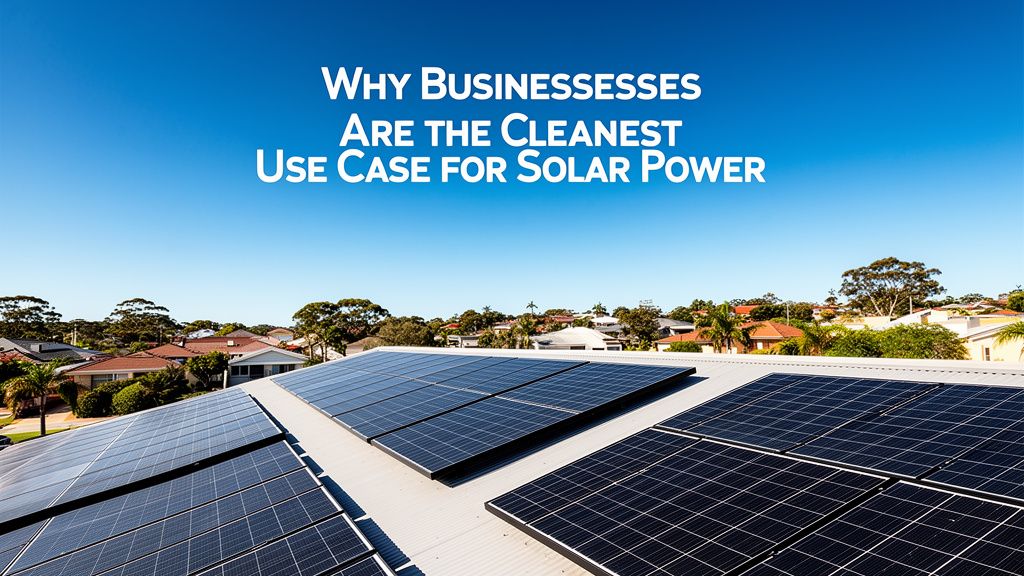
Commercial buildings often boast vast, unobstructed roof spaces – warehouses, factories, office blocks, and shopping centres provide enormous canvases for solar arrays. These large areas are perfect for installing extensive solar systems, far exceeding the capacity typically seen on residential properties. This scalability allows businesses to generate a substantial portion, if not all, of their electricity needs.
Furthermore, these rooftops are often otherwise unused space. Converting them into productive energy-generating assets is an incredibly efficient use of existing infrastructure, transforming a passive asset into a value-adding one without requiring additional land acquisition or significant structural changes beyond the installation itself. For businesses with ample land, ground-mounted systems offer even greater capacity.
Energy Independence and Reliability
For any business, energy reliability is paramount. Unplanned power outages can lead to significant financial losses, disrupting operations and impacting productivity. While grid-connected solar still relies on the grid, it significantly reduces a business's dependency on it. By generating a large portion of their power in-house, businesses gain greater control over their energy supply.
Pairing solar with a commercial battery storage solution further enhances energy independence, providing a buffer against grid outages and allowing for energy arbitrage (storing cheap solar power for use during expensive peak times). This resilience not only protects against financial losses but also ensures business continuity, a critical factor for long-term success.
A Bright Future for Australian Businesses
Australian businesses are undoubtedly the cleanest, most efficient, and most impactful use case for solar power. Their consumption patterns align perfectly with solar generation, leading to unparalleled self-consumption rates and rapid returns on investment. Beyond the substantial financial benefits, embracing solar offers a powerful opportunity for environmental leadership, enhanced brand reputation, and greater energy independence.
As Australia continues its transition to a cleaner energy future, it’s the commercial sector that stands to make the biggest strides, proving that sustainable practices are not just good for the planet, but brilliant for the bottom line. It's time for every Australian business to look up at their roof and consider the brilliant potential that sunshine holds.
Read More
For a comprehensive overview, check out our master guide: Read the Full Guide Here.