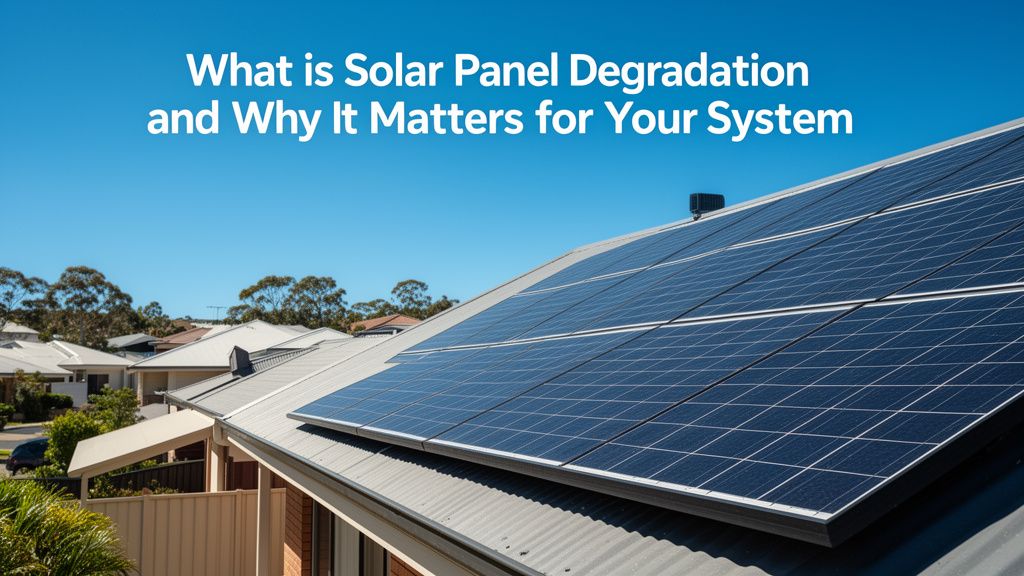
What is Solar Panel Degradation and Why It Matters for Your Australian System
G'day, Aussies! We all know Australia is a sunburnt country, and harnessing that abundant sunshine with solar panels has become a no-brainer for many households and businesses. The promise of reduced electricity bills, a smaller carbon footprint, and energy independence is incredibly appealing. But as with any technology, solar panels aren't immune to the passage of time. They don't last forever at peak performance, and understanding why is crucial for maximising your investment.
This brings us to a key concept: solar panel degradation. It's a natural, inevitable process that affects every solar panel system, and knowing what it is and why it matters can help you make smarter decisions about your solar journey.
What Exactly Is Solar Panel Degradation?
In simple terms, solar panel degradation refers to the gradual, natural loss of power output that your solar panels experience over their operational lifespan. Think of it like a new smartphone battery – it holds its charge perfectly on day one, but after a few years of daily use, it won't last quite as long. Solar panels are similar; they produce slightly less electricity year after year.
This isn't a sign of a faulty panel (initially, at least). It's a normal characteristic of the materials used in photovoltaic (PV) technology. Most quality solar panels are designed to degrade at a very predictable and slow rate, usually between 0.5% to 1% per year. Manufacturers even provide performance warranties that guarantee a certain percentage of the original output after a specified number of years – typically 80% to 85% of their original capacity after 25 years.
The Forces Behind Degradation: What Causes It?
Several factors contribute to solar panel degradation, some of which are more pronounced under Australia's intense climate:
-
Light-Induced Degradation (LID): This is often the first type of degradation experienced. In the very first few hours or days of exposure to sunlight, some silicon cells undergo a small, initial drop in efficiency, typically around 1-3%. Modern panel technologies, especially PERC (Passivated Emitter Rear Cell) cells, have significantly reduced or even eliminated this effect.
-
Potential-Induced Degradation (PID): This occurs when a high negative voltage difference between the PV cells and the grounded frame of the panel causes a leakage current. Over time, this current can corrode the cells and reduce their performance. High humidity and temperature can exacerbate PID. Fortunately, reputable manufacturers use advanced cell encapsulation and module design to mitigate PID.
-
Thermal Cycling and Temperature: Our scorching Aussie summers followed by cooler nights mean significant temperature fluctuations. This constant expansion and contraction of the different materials within the panel (glass, silicon, aluminium frame) can put stress on the connections and cells, potentially leading to micro-cracks over many years.
-
UV Exposure: The sun's ultraviolet (UV) radiation is a powerful force. Over decades, intense UV exposure can degrade the encapsulant material (the clear layer protecting the cells) and the backsheet (the protective layer on the rear of the panel). This can lead to yellowing, delamination (layers separating), and reduced light transmission.
-
Humidity and Moisture Ingress: High humidity, especially in coastal areas, can facilitate moisture ingress into the panel. This can cause corrosion of electrical components and delamination, further accelerating degradation.
-
Physical Wear and Tear: While not strictly "degradation" in the chemical sense, long-term exposure to harsh weather events like hail, strong winds, and even accumulated dust can cause microscopic damage or wear down the panel's surface, impacting its ability to capture sunlight efficiently. It's also worth distinguishing true degradation from "soiling," which is simply dirt and dust accumulating on the surface that can be cleaned off.

Why Solar Panel Degradation Matters for Your Australian System
Understanding degradation isn't just an academic exercise; it has real, tangible impacts on your solar system's performance and, crucially, your hip pocket:
-
Financial Returns and Payback Period: Your solar system's primary goal is to generate electricity, reduce your bills, and potentially earn you feed-in tariffs. If your panels are degrading faster than expected, they'll produce less electricity. This means fewer savings on your power bill, a longer time to recoup your initial investment (the payback period), and less income from exporting surplus power back to the grid. Over 20-25 years, even a slight difference in annual degradation rates can amount to thousands of dollars in lost savings.
-
System Performance and Expectations: When you invest in a solar system, you're usually given projections for its output. Degradation means your system will not be performing at its initial peak capacity after a few years. While this is expected, an accelerated or higher-than-average degradation rate could mean your system consistently underperforms compared to what you were promised.
-
Warranty Protection: This is where understanding degradation truly pays off. Manufacturers' performance warranties are designed around expected degradation rates. For example, a warranty might guarantee 90% of original output after 10 years and 80% after 25 years. If your panels degrade faster than this, you have grounds for a warranty claim, which could mean replacements or financial compensation. Without understanding degradation, you might not realise your system is underperforming relative to its guarantee.
-
Resale Value and Future Planning: Should you ever decide to sell your property, a well-performing solar system with a clear history of output and minimal degradation will add more value than one that has visibly aged or significantly underperforms. It also helps you plan for potential future upgrades or replacements down the line.
Mitigating Degradation and What to Look For
While degradation is unavoidable, you can definitely minimise its impact:
-
Invest in Quality Panels: This is paramount. Reputable Tier 1 manufacturers often use superior materials and advanced technologies (like those that combat PID and LID) that are designed to withstand harsh conditions, including the Australian sun, for longer. They also back their products with robust performance warranties.
-
Professional Installation: A well-designed and professionally installed system is less prone to issues that can accelerate degradation. Correct grounding helps prevent PID, and careful handling during installation minimises micro-cracks.
-
Regular Monitoring: Keep an eye on your system's output data. Many modern inverters and monitoring apps allow you to track daily, weekly, and monthly generation. If you notice a significant drop in output that can't be explained by weather or shading, it might be worth investigating.
-
Regular Cleaning: While not true degradation, dust, bird droppings, and grime can significantly reduce your panels' output. Regular cleaning, especially after long dry spells, will ensure your panels are always capturing as much sunlight as possible.
The Bottom Line for Australian Solar Owners
Solar panel degradation is a fundamental aspect of owning a solar power system. It's not a flaw, but a natural process that needs to be factored into your long-term energy planning. By choosing high-quality components, ensuring professional installation, and monitoring your system's performance, you can ensure your Australian solar investment continues to deliver clean, affordable energy for decades to come, living up to the promise of our glorious sunburnt country.
Read More
For a comprehensive overview, check out our master guide: Read the Full Guide Here.