TL;DR: Canadian Solar offers high-efficiency panels well-suited for Australian conditions, with current residential models often exceeding 21% efficiency. This allows for greater power generation from smaller roof areas. The company also achieves world records in solar cell efficiency, which drives future improvements in the panels available to Australian households and businesses.
How Efficient Are Canadian Solar Panels for Australian Homes?
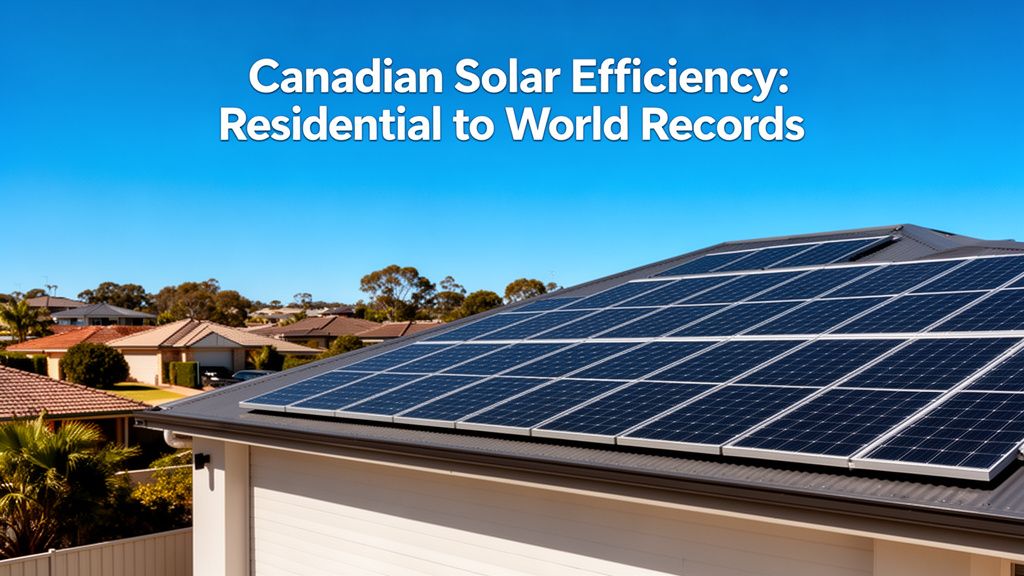
Canadian Solar's current residential modules typically achieve efficiencies over 21%, offering excellent performance for most Australian roof spaces. This high efficiency translates directly to more kilowatt-hours (kWh) generated per square metre of panel, which is particularly useful when roof space is limited or when homeowners want to maximise their system's output. For example, a common 6.6kW system in Perth using Canadian Solar HiKu7 panels, rated at 415W each and around 21.3% efficiency, would only need 16 panels, covering roughly 32 square metres. This system could produce 26-30 kWh per day on average, significantly reducing electricity bills for a typical Australian family.
Residential Panel Series and Typical Output
Canadian Solar’s main residential series, such as the HiKu7 and BiHiKu7, feature modules rated between 400W and 450W, with efficiencies often reaching 21.5% to 22%. These panels use half-cut cell technology to minimise resistive losses and improve shade tolerance, making them robust performers in varying conditions across Australia. For an average Sydney home, a 6.6kW system using 415W Canadian Solar panels could cost between $5,500 and $7,500 after government rebates, translating to roughly $0.83 to $1.14 per watt for the panels themselves as part of the total system cost. The actual output depends on factors like tilt, orientation, and local sunlight hours. A well-installed system in Brisbane could generate over 10,000 kWh annually, offering substantial savings against electricity prices often exceeding 30 cents per kWh.
Why High Efficiency Matters on Smaller Roofs
High efficiency panels maximise energy production when roof space is a constraint, a common issue for many urban Australian homes. If a homeowner wants a 10kW system but only has 40 square metres of usable roof, higher efficiency panels become essential. Panels with 22% efficiency deliver more power in that fixed area than panels at 19%, allowing the homeowner to install a larger overall system and generate more electricity. This means a quicker payback period and greater long-term financial benefits. For instance, a home in Melbourne with limited north-facing roof area might choose 22% efficient panels to squeeze more capacity into a smaller footprint, preventing the need for less optimal east or west-facing installations.
What World Records in Efficiency Does Canadian Solar Hold and How Do They Impact Future Panels?
Canadian Solar has set multiple world records for n-type TOPCon cell efficiency, demonstrating the company's advanced research and development and indicating the future direction for their commercial products. In late 2023, the company announced a new world record of 26.9% for n-type TOPCon solar cells in a laboratory setting. This achievement, validated by the National Solar Energy Centre of China, shows the company’s commitment to pushing the boundaries of solar technology. While these are lab results, they preview the performance levels consumers will eventually see in mass-produced panels.


The TOPCon Technology Edge
TOPCon (Tunnel Oxide Passivated Contact) technology is an advanced cell design that significantly improves efficiency and power output compared to older p-type PERC (Passivated Emitter Rear Contact) cells. N-type TOPCon cells offer advantages such as lower degradation over time, better performance in high temperatures, and superior output in low-light conditions. These improvements are particularly beneficial for Australian installations, where intense heat and early morning/late afternoon light can impact conventional panels. The 26.9% record indicates a substantial leap from the 21-22% efficiency of today’s common residential panels. This technology means less power loss over the panel's 25-30 year lifespan, providing more consistent energy generation and better returns for system owners.
From Lab to Australian Roofs: The Timeline
Moving a solar cell efficiency record from the laboratory to mass-produced panels for Australian roofs typically takes several years. Researchers achieve lab records under ideal, controlled conditions using small, specialised cells. Scaling this technology for volume manufacturing involves optimising processes, reducing material costs, and ensuring consistent quality across large panel formats. Historically, it takes 3 to 5 years for a significant lab breakthrough to become widely available in commercial products. Australian homeowners can expect future Canadian Solar panels to feature these higher efficiencies, potentially reaching 23-24% for residential models, within the next few years. This will mean even more power from the same roof space, further driving down the cost of solar energy and making systems even more attractive financially.
Key Takeaways
- Canadian Solar's current residential panels exceed 21% efficiency, delivering strong performance for Australian homes.
- Higher panel efficiency allows for greater power output from limited roof space, making solar accessible to more properties.
- Canadian Solar holds world records for n-type TOPCon cell efficiency, reaching 26.9% in laboratory settings.
- These record-breaking technologies indicate future commercial panels will offer even greater efficiency, improving long-term value for Australian solar owners.
- Homeowners can expect future panels to incorporate advanced TOPCon technology, providing better low-light performance and lower degradation rates.
Read More
For a comprehensive overview, check out our master guide: Read the Full Guide Here.