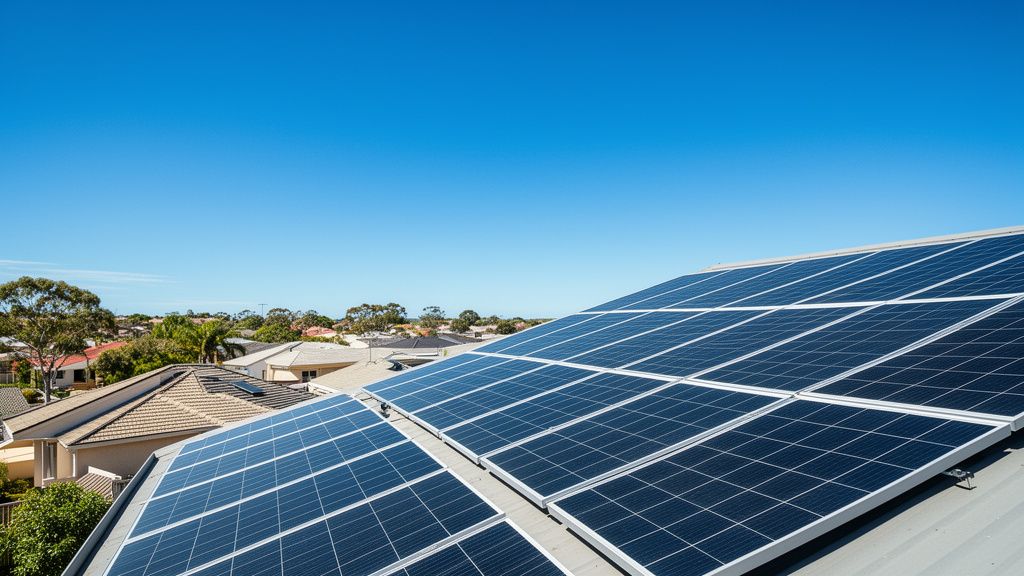
TL;DR: A large, financially stable manufacturer making competent mid-range panels at a fair price. 20.5% to 22.0% efficiency, $4,500 to $6,500 for a 6.6kW system installed. The thing to check before buying: the product warranty is 12 to 15 years, not 25, and that gap matters more than the price difference.
Are Canadian Solar panels a safe choice for Australian homes?
Yes, with one qualification worth understanding before you sign.
Canadian Solar has been manufacturing since 2001 and consistently ranks among the largest panel makers by global shipments. That scale matters for a 25-year asset in a way that specifications do not: a warranty is only worth what the company is worth in year twenty, and LG's exit from solar in 2022 stranded a lot of Australian claims from a brand nobody expected to leave.
There is an Australian presence, so warranty claims and technical support go through a local channel rather than an overseas queue. Installers know the product, which means parts and familiarity when something needs attention.
The warranty gap
Here is the qualification.
Canadian Solar panels sold in Australia typically carry a 12 to 15 year product warranty against manufacturing defects, and a 25-year performance warranty guaranteeing around 84.8% of original output at year 25, which sits in the usual 80-85% band for this price bracket.
Premium brands now offer 25 years on both. That is a real difference and it is the main thing you are trading away for the lower price.
The performance warranty running longer than the product warranty is standard across the industry and confuses people. They cover different things. Performance covers gradual output decline; product covers the panel actually failing. In year eighteen, a failed panel is your problem.
Whether that matters depends on how long you intend to own the house. Over ten years it is close to irrelevant. Over twenty-five it is the difference between a covered replacement and a bill.
What do they actually offer?
Monocrystalline PERC construction across the main ranges, with the HiKu, HiKu6, BiKu and TopHiKu series covering most Australian installations.
Panels use 120 or 144 half-cut cells, which reduces resistive losses and limits how far shade on one part of the panel drags down the rest. Output typically runs 400W to 450W, with efficiency between 20.5% and 22.0%.
That efficiency is genuinely competitive. It is not class-leading, and it is close enough that on most roofs the difference against a premium panel is one or two fewer modules rather than a system that will not fit.
A 6.6kW system takes roughly 16 panels at 415W, which suits a typical Australian household and offsets a substantial share of daytime consumption.
How do they perform in Australian heat?
Better than older technology, and behind heterojunction panels.
The temperature coefficient runs 0.35% to 0.37% per degree above 25C. At a 60C cell temperature, which an Australian roof reaches routinely in summer, that costs around 12 to 13% of rated output.
For comparison, heterojunction panels from REC and others sit nearer 0.26%, losing roughly 9%. That three to four point gap is real and it is the clearest technical argument for paying more.
Mechanical load ratings are high, resisting strong winds and moderate hail. The panels have passed salt mist corrosion and sand abrasion testing, which matters for coastal installations and for dusty inland sites respectively. Frame and glass design sheds dirt reasonably well, though no panel is genuinely self-cleaning in a dry climate.
What do they cost?
A 6.6kW system with Canadian Solar panels, a standard string inverter and installation typically runs $4,500 to $6,500 after Small-scale Technology Certificates.
That places them below premium brands such as SunPower or REC, and above unknown budget-tier alternatives.
The range is wide because the panel is not the biggest variable in the price. Roof type, storey height, switchboard condition, inverter choice and installer overheads move the total more than the module does. Three quotes on the same house with the same panels routinely differ by two thousand dollars.
State rebates apply on top in some jurisdictions, mostly for batteries rather than panels.
Who should buy them?
Buy Canadian Solar if you want an established brand at a fair price, your roof has enough area that you do not need maximum efficiency, and you are optimising for payback period rather than for the longest possible service life.
Look at premium panels if roof area constrains you, you intend to stay in the house for twenty years or more, or the temperature coefficient gap matters to you in a hot climate.
Compare against mid-tier N-type panels before deciding. Jinko Tiger Neo and Trina Vertex sit at a similar price point, use N-type cells with better degradation characteristics, and now carry 25-year product warranties. That comparison is more informative than Canadian Solar against a premium brand, because it is the same money.
Ask any installer quoting Canadian Solar what the same system costs with an N-type alternative, and what the product warranty term is on each. Those two answers usually settle it.
Key Takeaways
- Canadian Solar is a large, financially stable manufacturer with Australian support, making warranty claims more practical than with smaller brands.
- The product warranty runs 12 to 15 years against 25 for premium brands, and that gap matters most to long-term owners.
- Monocrystalline PERC panels at 20.5% to 22.0% efficiency and 400-450W output, competitive without leading.
- Temperature coefficient of 0.35% to 0.37% per degree is respectable and behind heterojunction panels, costing a few percent of output on hot days.
- Expect $4,500 to $6,500 for a 6.6kW system, and compare against mid-tier N-type panels at the same price before committing.