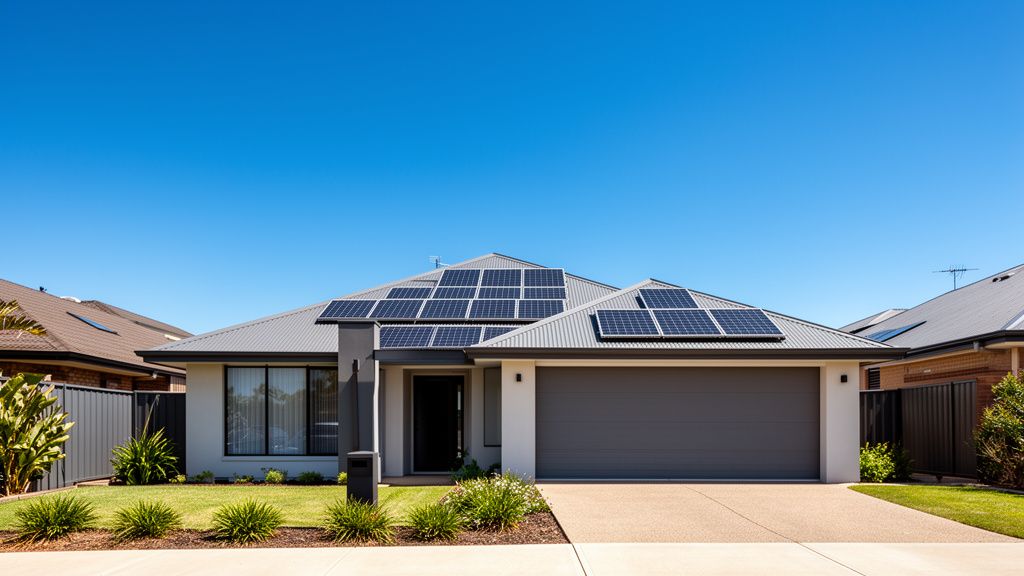
TL;DR: ALDI Solar sells fixed solar-and-battery bundles from $7,499 to $10,999 installed, which is thousands below a custom quote. The price comes from the federal battery rebate, a rebadged hardware brand called Altius, an undersized inverter, and a one-size-fits-all design with no installer choice. For a small single-storey home with modest evening loads it is genuinely good value. For anyone running ducted air conditioning or wanting whole-home backup, the inverter is the thing that will bite.
The pricing looks wrong the first time you see it. Nearly 8kW of panels and a 20kWh battery, installed, for $10,999. Most Australians who have collected battery quotes in the last two years have seen numbers two or three times that, and the natural reaction is to assume something has been left out of the ad.
Something has been left out, but probably not what you expect. The hardware is real, the install is real, and the price is real. What you give up sits in the specification sheet and the contract structure rather than in any hidden fee. Here is what ALDI Solar actually sells, the five specific things that produce that price, and the households it suits.
Who Actually Sells ALDI Solar, and What Is in the Packages?
ALDI Stores does not sell, install or warrant these systems. The disclaimer on aldisolar.com.au states that products promoted by ALDI Stores are offered and supplied by Tempo (Aust) Pty Ltd trading as ALDI Solar, along with independent installers. Tempo is the same supplier behind ALDI private-label goods such as Stirling and Ambiano. Finn Peacock of SolarQuotes put it plainly: "You are buying it from a seemingly unrelated company that is licensing the name Aldi Solar from Aldi."
As of September 2026 the advertised packages are:
| Package | Price installed |
|---|---|
| 7kW solar + 5kWh battery | $7,499 |
| 7kW solar + 10kWh battery | $8,499 |
| 7kW solar + 15kWh battery | $9,499 |
| 7.9kW solar + 20kWh battery | $10,999 |
| 15kWh battery + 6kW hybrid inverter (existing solar) | $5,499 |
| 20kWh battery + 6kW hybrid inverter (existing solar) | $6,499 |
Each bundle includes the hybrid inverter, installation, a monitoring app and blackout protection on one circuit. Availability is limited to selected postcodes across Queensland, New South Wales, the ACT, Victoria, Western Australia and South Australia, with the WA and SA launch on 5 August 2026.
Set against the market, the gap is large. CHOICE costed a battery and inverter installation at $7,000 to $11,000 for 10kWh, or $14,000 to $19,000 for 20kWh, after rebates and without any panels in the package. ALDI Solar puts 7.9kW of solar panels on the roof as well and still lands under the bottom of that range.
| Attribute | ALDI Solar 7.9kW + 20kWh | Typical custom-quoted equivalent |
|---|---|---|
| Price installed | $10,999 plus site extras | $14,000 to $19,000 for the battery alone |
| Panel brand | Altius | Your choice from the approved-module list |
| Panel product warranty | 10 years | 20 to 25 years |
| Inverter capacity | 6kW | Sized to the system, commonly 8 to 10kW |
| Blackout backup | One circuit | Essential circuits or whole home, by design |
| Installer | Assigned by Tempo | Chosen by you |
| System design | Two or three fixed options | Built around your roof and usage |
Why Is ALDI Solar So Cheap? Five Things That Come Out of the Price
The discount is not a loss leader. Each element of the package has been chosen to strip a specific cost out of a normal installation.
The federal battery rebate is doing a lot of the work
The Cheaper Home Batteries Program has funded roughly a 30% discount on eligible home batteries since 1 July 2025, paid through Small-scale Technology Certificates. From 1 May 2026 the discount became tiered by capacity: the first 14kWh attracts 100% of the STC rate, capacity between 14kWh and 28kWh attracts 60%, and anything from 28kWh to 50kWh attracts 15%. The rebate factor for May to December 2026 is 6.8 STCs per kWh, and it steps down every year until it reaches 2.1 in 2030.
ALDI Solar advertises prices with both the battery rebate and the panel STCs already deducted, which is standard practice, and you assign the certificate rights after installation. A meaningful slice of the headline saving is therefore public money rather than any purchasing advantage Tempo has found. The same subsidy is available through any accredited installer.
Altius is a rebadged brand with no Australian track record
The panels, inverter and battery all carry the Altius name. Finn Peacock, who has reviewed hundreds of solar products since 2009, said he had never heard of Altius before the ALDI Solar announcement, and SolarQuotes review pages still show zero customer ratings for Altius panels, inverters and batteries despite a growing number of installations. SolarQuotes research points to the hardware being rebranded Afore New Energy equipment from Shanghai.
Buying an unknown brand removes the price premium that established manufacturers charge for a support office in Australia, a spare-parts pipeline and a warranty history you can check. That premium buys something real. On the Whirlpool forums, one contributor described an Afore inverter failing after four years with no response from the manufacturer. Whether Altius support in Australia is better than that is unknowable right now, because the brand has not been here long enough for anyone to find out.
The inverter is undersized because inverters are not subsidised
This is the most consequential trade-off in the package, and it follows directly from how the rebate works. Batteries attract the subsidy. Inverters do not. The cheapest route to an eye-catching kWh figure is therefore to bolt a large battery onto a small inverter, and SolarQuotes has observed a run of offers doing exactly that since the federal rebate launched.
A 6kW hybrid inverter caps how fast the battery can charge and how fast it can discharge, whatever the storage figure on the box says. Nineteen usable kilowatt-hours delivered through a 6kW ceiling is a little over three hours at full output. The same inverter is also handling your solar generation and your house load, so on a hot afternoon it is being asked to do several jobs at once.
One design fits every roof
A normal installer sends someone to look at your roof, models the shading, checks your switchboard and sizes the system against your bills. That engineering time costs money, and ALDI Solar has removed most of it by offering two or three fixed configurations. Peacock's objection is straightforward: "A system designed for your specific home will save you more." A north-facing unshaded roof and a split east-west roof with a neighbouring gum tree get the same panel count and the same string layout.
You do not choose the installer, and the contracts are split
Tempo assigns an installer based on your location and their availability. Your contract for the hardware is with Tempo, and your contract for the installation work is with the installer, which are two separate relationships. If a fault later turns out to sit on the boundary between bad hardware and bad workmanship, you have two parties to chase rather than one.
One point commonly held against ALDI Solar is fair to correct. The site advertises SAA certified installers rather than Clean Energy Council accreditation, which reads like a dodge. It is not. Solar Accreditation Australia took over installer and designer accreditation from the CEC after the Clean Energy Regulator appointed it Accreditation Scheme Operator on 29 February 2024, and SAA accreditation is now the requirement for STC eligibility. On that specific point ALDI Solar is compliant.
Does the Undersized Inverter Actually Matter in a Real House?
Yes, and it shows up on ordinary evenings rather than in edge cases. A 6kW inverter is the total the system can deliver to your house at any instant. Ducted air conditioning on a 35-degree afternoon can draw 4kW on its own. Add an oven at 2.4kW and you are over the limit before anyone has boiled a kettle, so the shortfall comes from the grid no matter how full the battery is.
The same ceiling limits charging. Filling 19.4kWh of usable storage at 6kW takes more than three hours of strong generation, and the inverter is simultaneously running the house and exporting, so the battery competes with your daytime load for the same capacity. In winter, or under cloud, a 20kWh battery on a 6kW inverter may not reach full charge at all.
Blackout performance is where the marketing and the specification diverge most. The packages include backup on one circuit. That is enough for a fridge and some lights, not for a household that expects the air conditioner to keep running through an outage. CHOICE reported Peacock's assessment that the inverter in these bundles will struggle to back up a whole home.
The practical consequence is that the extra battery capacity in the larger packages buys less than the kWh figure suggests. Going from 15kWh to 20kWh adds storage you may rarely fill and cannot discharge quickly. For most households the 10kWh package at $8,499 is the better-balanced buy, even though the 20kWh headline looks like the bargain. If you are weighing storage sizes generally, our guides on solar batteries work through the same arithmetic.
What Do the Extra Costs Add To the Advertised Price?
The advertised price covers a straightforward install, and ALDI Solar publishes its pre-work charges rather than hiding them. Current listed extras are $385 for a fire-resistant panel, $275 for a two-storey property, $390 where the inverter is mounted more than 6 metres from the switchboard, and $350 for a three-phase meter upgrade. A smart meter upgrade is arranged through your electricity retailer at their price.
Advertising for the packages states that extra installation charges are capped at $1,400, which is a genuine protection and more transparency than much of the industry offers. Budget for it anyway. A two-storey home with a distant switchboard and a three-phase supply reaches roughly $1,015 of listed extras before the retailer's meter fee, so the realistic landed cost of the top package for that house sits closer to $12,000 than $10,999.
What Are Real ALDI Solar Customers Reporting?
The honest answer is that there is very little data, and what exists is mixed. ProductReview.com.au lists ALDI Solar at 2.7 stars from just three reviews, which is too small a sample to draw conclusions from in either direction.
The complaints follow a pattern of administration rather than equipment. One reviewer reported work still incomplete four months after the installation date, with the electrical work request form unlodged and support unresponsive, which escalated to a regulatory complaint. Another took a day off work for an installer who did not arrive, after the date was changed without proper notice. On the CHOICE community forum, a Gold Coast buyer paid a $100 refundable deposit for a system design and described several days of back and forth before the proposal arrived, noting the 20kWh option had been replaced by 15kWh and 30kWh choices. One verified customer waited six months for installation.
The positive reports are about the gear once it is on the roof. A ProductReview customer said the system had worked well, reported generating 6MWh while running heating, cooling and hot water, and rated Tempo responsive. The customer who waited six months said the system works excellently and praised their installer.
SolarQuotes also documented the supply chain straining under growth. An installer speaking anonymously said they received no pre-job training, described the hardware as looking like "it was from the 1940s", and had the wrong materials delivered to both jobs they completed.
How Does the ALDI Solar Warranty Compare?
The warranty is where the saving is most visible, because warranty length is a real cost to a manufacturer. ALDI Solar lists 10 years on the battery, 10 years on the inverter, 10 years on workmanship, and 10 years product warranty on the panels alongside a 25-year performance guarantee.
That panel term is the outlier. CHOICE points out that 20 to 25 year product warranties are now normal for panels, so a 10-year product warranty is roughly half the current standard. The distinction between the two terms matters: a product warranty covers the panel failing, while a performance guarantee only pays out if you can demonstrate output has fallen below a threshold, typically 80%, which puts the measurement burden on you. A 25-year performance guarantee sitting on top of a 10-year product warranty is a weaker package than a 25-year product warranty.
The battery warranty promises 6,000 charge and discharge cycles before a serious drop in performance, without publishing the retained-capacity percentage that a typical battery warranty specifies. Whirlpool contributors picked up on the gap, since a cycle count with no capacity floor tells you nothing about how much storage you still have in year nine.
A 10-year warranty is also only as good as the company standing behind it. ALDI Stores is not that company, Tempo is, and Altius has no Australian service history to judge.
Is ALDI Solar Worth It? Who It Suits and Who Should Walk Away
It is worth it for a specific household. Single-storey, a simple unshaded roof, a switchboard near the proposed inverter location, single-phase power, modest evening loads, and an owner who wants solar and storage without running a procurement process. For that house the 10kWh package at $8,499 is difficult to beat on price, and the risk you take on is the shortened warranty rather than anything likely to fail next week.
Walk away if you run ducted air conditioning, a pool pump or an electric vehicle charger, because the 6kW inverter will cap you during exactly the hours you bought the battery for. Walk away if you want real blackout protection beyond a fridge and a few lights. Walk away if your roof has shading, multiple orientations or anything else a fixed design cannot account for, and walk away if a 10-year panel warranty from a brand with no local track record would keep you up at night.
Two things are worth doing before you sign, whatever your situation. Get at least one quote from an accredited local installer for a system with a properly sized inverter, so you know the real gap rather than the advertised one. And check the payback claim you are being sold. One CHOICE forum buyer was quoted 31kWh of battery and 8kW of panels for around $9,000 and calculated a 2.6 year payback, a figure Whirlpool contributors were rightly sceptical of. Work your own numbers from your own bills.
The bargain is real. It is just smaller than $10,999 against $19,000 makes it look, and it is paid for with inverter capacity, warranty years and design flexibility rather than with cash.
Key Takeaways
- ALDI Stores does not supply, install or warrant these systems. Tempo (Aust) Pty Ltd licenses the name, and your hardware and installation contracts are with two different parties.
- The 6kW inverter, not the battery size, is the binding constraint. It caps charge speed, discharge speed and backup capability, so the 10kWh package at $8,499 is better balanced than the 20kWh at $10,999.
- Altius hardware appears to be rebadged Afore equipment with a 10-year panel product warranty against a current market standard of 20 to 25 years.
- Blackout protection covers one circuit only, which is a fridge and lights, not a running air conditioner.
- Budget roughly $1,000 above the advertised price for a two-storey home with a distant switchboard or three-phase supply. Published extras are capped at $1,400.
- Get one quote from an accredited local installer with a correctly sized inverter before committing, so you are comparing the real saving rather than the advertised one.
