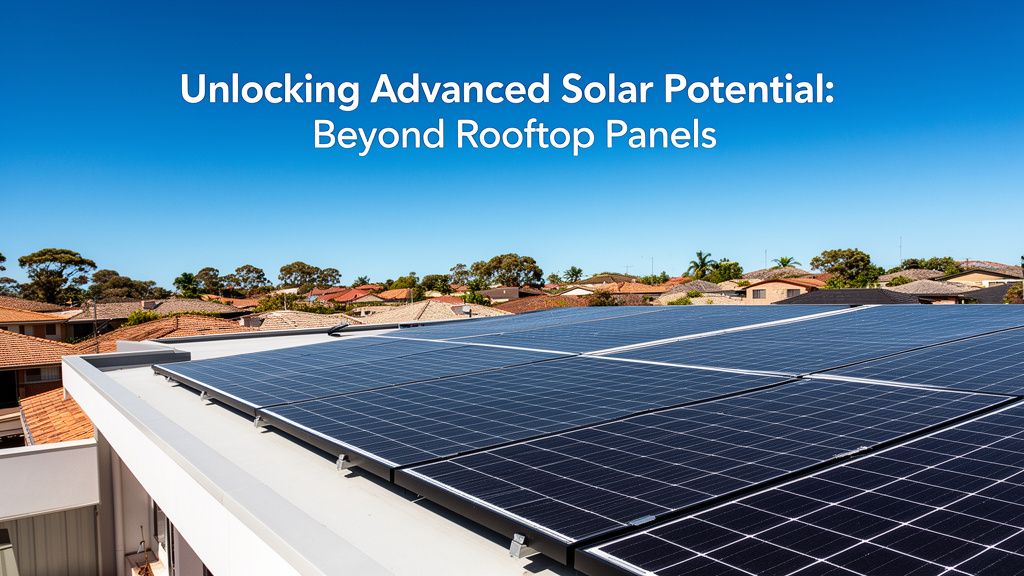
Beyond the Rooftop: Unlocking Solar Power's True Potential in Australia
TL;DR: Moving past basic rooftop panels, advanced solar solutions like battery storage, smart energy management, and virtual power plants are transforming how Australians utilise solar, offering greater grid independence, bill savings, and resilience. This new era maximises self-consumption and opens pathways for community-wide energy benefits, turning homes into proactive energy hubs.
What Are the Key Technologies Pushing Solar Beyond Conventional Limits?
The key technologies pushing solar beyond conventional limits in Australia include advanced battery storage solutions, smart inverters, and sophisticated home energy management systems. For years, rooftop solar was largely about generating electricity and selling excess back to the grid via feed-in tariffs. However, with lower FiTs and rising electricity prices, the focus has shifted to self-consumption and energy independence. Modern solar setups integrate these technologies to store surplus energy generated during the day for use at night or during peak demand, dramatically reducing reliance on the grid and mitigating "bill shock." This integration allows homeowners to essentially become mini power stations, managing their energy flows dynamically and efficiently.
How Does Battery Storage Revolutionise Solar Energy Use?
Battery storage revolutionises solar energy use by enabling households to store excess solar electricity generated during sunny periods for later consumption, rather than exporting it for minimal feed-in tariffs. For an average Australian home with a 6.6kW solar system, a 10-13.5kWh battery can store enough energy to power essential appliances overnight. While the upfront cost for a quality battery might range from $10,000 to $18,000 installed, depending on capacity and brand, government incentives like Victoria's Solar Homes Program or the South Australian Home Battery Scheme can significantly reduce this investment, making payback periods more attractive for savvy homeowners looking to maximise their solar investment and achieve greater energy autonomy.
What Role Do Smart Inverters Play in Optimising Solar Output?
Smart inverters play a crucial role in optimising solar output by acting as the brain of your solar system, capable of not just converting DC to AC power but also intelligently managing energy flows. Unlike conventional inverters, smart inverters can communicate with batteries, home energy management systems, and even the grid, making real-time decisions on where your solar power is best utilised—whether it’s powering your home directly, charging a battery, or exporting to the grid. Many modern smart inverters are "battery-ready," allowing for seamless integration of storage at a later date. This intelligence ensures maximum efficiency and flexibility, allowing you to adapt to changing energy prices and consumption patterns automatically.
How Do Virtual Power Plants (VPPs) Create a New Solar Landscape?
Virtual Power Plants (VPPs) create a new solar landscape by aggregating distributed solar battery systems into a single, cohesive network, allowing them to act as a larger power station. Instead of individual homes simply exporting surplus energy, VPPs coordinate these connected batteries to either charge or discharge in response to grid needs. This collective capability provides essential grid services, such as frequency regulation and peak demand management, making the overall electricity network more stable and resilient. For participating homeowners, joining a VPP often comes with financial incentives, turning their home battery into a revenue-generating asset and transforming individual energy independence into a community-wide energy solution.
What are the Financial Benefits of Joining a VPP in Australia?
The financial benefits of joining a VPP in Australia can be substantial, offering participants a range of incentives beyond standard feed-in tariffs. Many VPP programs provide upfront payments, often between $200 and $500, simply for connecting your battery. Additionally, participants typically receive ongoing credits or payments for every kilowatt-hour (kWh) their battery exports to the grid during peak demand periods, which can be significantly higher than standard FiTs. For example, some VPPs might offer credits equivalent to $0.40-$1.00/kWh during critical grid events, far surpassing the typical $0.05-$0.15/kWh FiT. These earnings can help offset battery installation costs and accelerate the payback period of your entire solar and storage system.
How Do VPPs Contribute to National Grid Stability?

VPPs contribute to national grid stability by rapidly responding to fluctuations in electricity supply and demand across the network. When the grid faces a surge in demand, or a large power plant goes offline, VPPs can quickly instruct thousands of connected home batteries to discharge stored energy, injecting power back into the system. Conversely, during periods of excess supply (like a very sunny day with low demand), VPPs can instruct batteries to charge, absorbing surplus renewable energy that might otherwise be curtailed. This dynamic balancing act helps to prevent blackouts, reduces reliance on expensive and emissions-intensive peaker plants, and ultimately supports the integration of more renewable energy into Australia's national electricity market, ensuring a more reliable and greener power supply for everyone.
What Advanced Solar Applications are Emerging for Australian Homes and Businesses?
Emerging advanced solar applications for Australian homes and businesses encompass seamless EV charging integration, robust off-grid systems, and the development of community microgrids. As electric vehicles become more common, integrating EV charging directly with a home solar system allows owners to effectively "fuel" their cars with sunshine, reducing running costs and carbon footprints. Off-grid systems provide complete energy independence for properties not connected to the main grid, or for those who desire total self-sufficiency. Furthermore, community microgrids are allowing entire neighbourhoods or industrial parks to generate, store, and share their own renewable energy, enhancing local resilience and reducing collective reliance on the central grid, signalling a profound shift in energy decentralisation.
Can Solar Power My Electric Vehicle and My Home Simultaneously?
Yes, solar power can efficiently power your electric vehicle and your home simultaneously, especially when coupled with battery storage and smart energy management. During daylight hours, your solar panels can directly power your home's needs and charge your EV. Any excess energy can then be stored in a home battery. When the sun goes down, or if your EV needs a top-up while the panels aren't generating, the stored battery energy can be used, ensuring your car is charged with renewable energy and your home remains powered. Dedicated EV chargers integrate with your solar system, prioritising solar generation for charging when available, and drawing from the grid only when necessary, making "fuelling" your EV virtually free and emissions-free from your own rooftop.
How Do Off-Grid Solar Systems Offer Ultimate Energy Independence?
Off-grid solar systems offer ultimate energy independence by completely disconnecting a property from the national electricity grid, allowing it to generate, store, and consume all its own power. These systems are typically comprised of a larger solar array, a substantial battery bank for multi-day storage, and a robust inverter/charger, often backed up by a generator for extended cloudy periods. While the initial investment is higher – often upwards of $30,000 for a residential setup – the long-term benefit is freedom from electricity bills, grid outages, and connection fees. For remote properties in the Australian outback or those seeking complete self-sufficiency, off-grid solar provides an unmatched level of reliability and control over their energy supply, making them immune to grid price hikes and disruptions.
Key Takeaways
- Maximise Self-Consumption: Focus on battery storage and smart inverters to use more of your generated solar power at home, reducing reliance on the grid and minimising exposure to low feed-in tariffs.
- Explore VPP Opportunities: Investigate Virtual Power Plants (VPPs) in your area to potentially earn additional income from your solar battery and contribute to grid stability.
- Integrate EV Charging: Consider a solar-integrated EV charging solution to power your electric vehicle with clean, free energy directly from your rooftop.
- Assess Advanced Applications: Evaluate off-grid systems for total energy independence or explore community microgrid initiatives for collective energy benefits in your region.
- Consult with Experts: Speak to local Australian solar professionals to design a system that not only meets your current needs but also prepares your home for future energy advancements.
Read More
For a comprehensive overview, check out our master guide: Read the Full Guide Here.