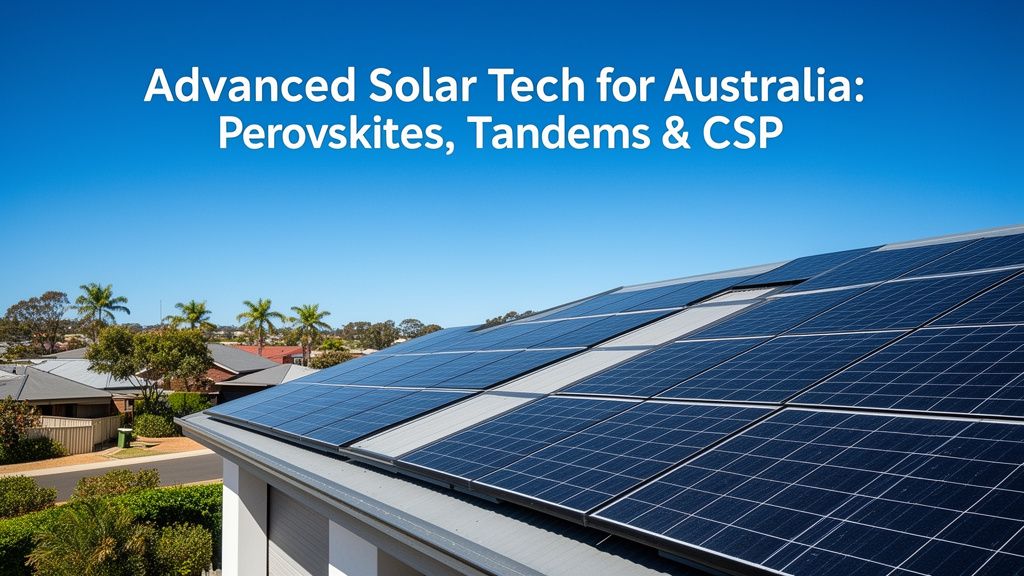
TL;DR: Advanced solar energy conversion technologies like perovskites, tandem cells, and concentrated solar power (CSP) are pushing the boundaries of efficiency, cost-effectiveness, and dispatchability beyond traditional silicon panels. These innovations promise to accelerate Australia's transition to a fully renewable energy grid by improving power generation and storage capabilities.
What Are Perovskite Solar Cells and Why Are They Considered a Game-Changer?
Perovskite solar cells are a new class of photovoltaic technology utilising a specific crystal structure, perovskite, as the primary light-harvesting material, and they are considered a game-changer due to their rapid efficiency improvements, low manufacturing cost potential, and flexibility. Unlike rigid silicon panels, perovskites can be manufactured using low-cost solution-based processes, allowing for printing onto flexible substrates. This opens up possibilities for novel applications like integrated building materials, transparent windows, and wearable electronics, far beyond traditional rooftop solar. With laboratory efficiencies already rivalling and, in some cases, exceeding conventional silicon cells, perovskites offer a pathway to cheaper, more versatile solar power. Their light weight and potential for high power-to-weight ratios are also attractive for specific applications, although stability and lead-toxicity concerns are still active areas of research.
How Do Perovskites Differ from Traditional Silicon Panels?
Perovskite solar cells fundamentally differ from silicon panels in their material composition and manufacturing processes. Traditional silicon cells are based on a heavily purified semiconductor, requiring high-temperature, energy-intensive fabrication. Perovskites, on the other hand, can be made from more abundant and less expensive materials and processed at lower temperatures using techniques akin to printing or coating. This difference in material science allows perovskites to absorb light across a broader spectrum more efficiently, potentially leading to higher power output per square metre. While silicon cells are durable and proven over decades, perovskites offer flexibility and transparency that silicon cannot, presenting new design opportunities for architects and product developers.
What Is the Current Status of Perovskite Technology in Australia?
The current status of perovskite technology in Australia is primarily focused on research and development, with significant activity in universities and CSIRO. While commercial perovskite products are not yet widely available for general consumers, Australian researchers are at the forefront of improving their stability, efficiency, and scalability for local conditions. Projects are exploring everything from their integration into urban infrastructure to their use in niche agricultural applications. Investment in this area is growing, with an eye towards establishing domestic manufacturing capabilities once the technology matures, potentially reducing the cost of solar deployment further than current silicon prices, which for a 6.6kW system typically range from $4,500 - $8,000 installed.
How Do Tandem Solar Cells Achieve Significantly Higher Efficiencies?
Tandem solar cells achieve significantly higher efficiencies by stacking multiple layers of different photovoltaic materials, each tuned to absorb a specific part of the solar spectrum that other layers might miss. This multi-junction approach allows the cell to capture a broader range of sunlight energy more effectively than a single material ever could, leading to theoretical efficiency limits well above the practical limits of single-junction cells. For example, a common tandem configuration might pair a wide-bandgap material (like some perovskites or III-V semiconductors) on top to absorb blue and green light, with a narrower-bandgap material (like silicon) underneath to absorb the remaining red and infrared light. This synergy maximises the conversion of sunlight into electricity, pushing laboratory efficiencies past 30%, a significant leap from the 20-23% typically seen in premium silicon panels.
The Principle Behind Multi-Junction Solar Cell Performance
The principle behind multi-junction solar cell performance is based on optimising light absorption across the entire solar spectrum. Different semiconductor materials have different bandgaps, meaning they are most efficient at converting photons of a specific energy range into electrons. By layering cells with different bandgaps, a tandem structure ensures that high-energy photons are absorbed by the top layer and lower-energy photons pass through to be absorbed by subsequent layers. This minimises energy loss that occurs when a single material tries to convert photons outside its ideal energy range, resulting in a much higher overall power output from the same amount of sunlight. This approach has long been used in niche applications like satellites, where high efficiency is essential.
Potential Applications and Cost Factors for Tandem Cells
The potential applications for tandem cells are vast, ranging from high-efficiency rooftop solar systems for space-constrained installations to concentrated photovoltaics (CPV) in utility-scale solar farms. In Australia, where land can be abundant but high energy density is sometimes critical, tandem cells offer a way to get more power from a smaller footprint. However, current cost factors for tandem cells are significantly higher than traditional silicon, mainly due to the complexity of manufacturing multiple precise layers and the use of more exotic materials (in some cases). While a standard 6.6kW silicon system might cost $4,500-$8,000, a hypothetical tandem system would be substantially more expensive today. Research is focused on reducing these costs, particularly through integrating perovskites with silicon to create more affordable and scalable tandem structures.
What Role Do Concentrated Solar Power (CSP) Systems Play in Large-Scale Energy Production?
Concentrated Solar Power (CSP) systems are important in large-scale energy production by harnessing solar energy to generate heat, which is then converted into electricity, often with integrated thermal energy storage. Unlike photovoltaic (PV) panels that directly convert sunlight into electricity, CSP technologies use mirrors or lenses to concentrate a large area of sunlight onto a small area, heating a fluid to extremely high temperatures. This superheated fluid then drives a conventional steam turbine to produce electricity, much like a fossil fuel power plant, but without the emissions. This makes CSP particularly valuable for base-load and dispatchable power generation, especially when paired with molten salt storage, allowing electricity to be generated after sunset or during cloudy periods. In sun-drenched Australia, CSP represents a significant opportunity for reliable, 24/7 renewable power.
Different Types of CSP Technology Explained
There are several different types of CSP technology, each using a unique method for concentrating solar radiation. Parabolic Trough systems use curved, trough-shaped reflectors to focus sunlight onto a receiver tube running along the focal line, heating oil or molten salt. Solar Power Towers employ an array of flat, sun-tracking mirrors (heliostats) to reflect sunlight onto a central receiver mounted on top of a tall tower, heating a fluid (often molten salt or steam) to very high temperatures. Dish Stirling systems use large parabolic dishes to focus sunlight onto a receiver at the focal point, driving a Stirling engine. Each type has its own advantages in terms of efficiency, operating temperature, and scalability, with power towers often favoured for very large-scale projects due to their high operating temperatures and efficient storage capabilities.
Why CSP Is Essential for Grid Stability and Storage in Australia
CSP is essential for grid stability and storage in Australia because it offers a dispatchable source of renewable energy, directly addressing the intermittency challenges of PV and wind power. By incorporating thermal energy storage, typically using molten salts, CSP plants can store heat for hours or even days, allowing electricity to be generated on demand, day or night. This capability helps balance the grid, providing power during peak evening demand when solar PV output drops off, or as a reliable backup during periods of low wind. For Australia's vast and increasingly renewables-dependent grid, CSP provides a necessary firming capacity, helping to ensure continuous and reliable electricity supply without relying on fossil fuel generation, thus strengthening the nation's energy security and emission reduction targets.
Key Takeaways
- Perovskite solar cells offer high efficiency potential, low-cost manufacturing, and flexibility, promising new applications beyond traditional silicon panels, though stability research continues.
- Tandem solar cells stack different light-absorbing materials to capture a broader spectrum, achieving significantly higher efficiencies than single-junction cells for smaller footprints.
- Concentrated Solar Power (CSP) provides large-scale, dispatchable renewable electricity by using mirrors to generate heat for steam turbines, often with molten salt storage for 24/7 operation.
- These advanced technologies are important for Australia's energy future, aiming to reduce costs, improve grid reliability, and accelerate the transition to 100% renewable energy.
- While current costs for these advanced systems are higher or they are still in R&D phases, ongoing innovation is rapidly bringing them closer to widespread commercial viability.
