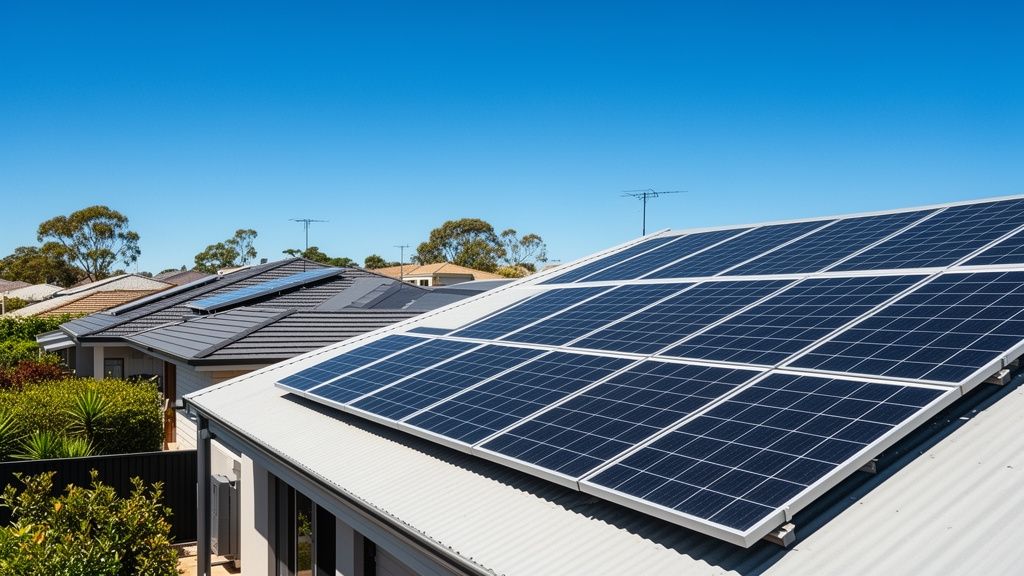
TL;DR: Large-scale battery storage deployments in 2025 provided the essential grid stability and connection solutions that many Australian renewable energy projects previously lacked. This technology directly solved grid congestion and network limitations, enabling numerous solar and wind farms to proceed that were once considered unfeasible due to grid access issues.
What Blocked Major Australian Renewable Projects Before 2025?
Many large-scale solar and wind projects across Australia faced significant hurdles and delays prior to 2025, primarily due to an overstretched grid. The existing transmission infrastructure, designed for a centralised fossil fuel generation model, struggled to integrate a surge of new, geographically dispersed renewable energy. Developers often found their projects stuck in long connection queues with AEMO, the Australian Energy Market Operator, waiting for costly grid upgrades that were years away. For instance, projects in renewable energy zones (REZs) like those in Western Victoria or the New England region of NSW often faced steep financial penalties from marginal loss factors (MLFs). These MLFs meant generators were paid less for their output because of transmission losses, sometimes making a project uneconomical before it even connected. A 2023 Clean Energy Council report highlighted that over 10 GW of committed renewable projects were facing connection delays or curtailment risks, pushing investment decisions back by years. This created a bottleneck, slowing Australia's transition to clean energy. Without a fundamental shift in how new generation connected, many projects simply couldn't get off the ground.
Grid Congestion and Connection Delays
Australia’s National Electricity Market (NEM) was designed with long transmission lines connecting distant power stations to demand centres. As more wind and solar farms came online, often in remote, resource-rich locations, these lines became overloaded. Imagine trying to merge hundreds of new cars onto an already full highway; traffic slows to a crawl. New projects required extensive and expensive network impact studies, often leading to requirements for system strength upgrades or new transmission lines costing hundreds of millions of dollars. These costs typically fell, at least in part, onto the developers, making many projects financially unattractive. Some projects, even after securing connection agreements, faced curtailment clauses, where their output could be forcibly reduced by AEMO during periods of grid congestion or oversupply.
Impact of Marginal Loss Factors
Marginal Loss Factors (MLFs) presented another major financial challenge. MLFs are a calculation used by AEMO to adjust how much a generator is paid for the energy they send into the grid, based on how much of that energy is lost during transmission to the main consumption points. If a project was located far from major load centres or on a part of the grid experiencing congestion, its MLF could be significantly less than 1.0, meaning they were effectively paid for less energy than they produced. For example, a project with an MLF of 0.8 would only receive 80% of the wholesale price for its generated electricity. This eroded revenue, adding another layer of financial uncertainty to projects already grappling with high upfront capital costs. Many developers found it impossible to secure financing for projects that carried such unpredictable and potentially severe revenue risks.
How Did Battery Storage Address Grid Constraints for Developers?
Battery storage became the vital missing piece for many stalled renewable projects by directly addressing grid constraints and unlocking new operational capabilities. Instead of waiting years for major transmission upgrades, developers integrated large-scale batteries, typically ranging from 50MW/100MWh to 200MW/400MWh, directly alongside their solar or wind farms. These co-located batteries smoothed out the variable output of renewables, making their power delivery more predictable and "firm" from the grid's perspective. This greatly simplified the connection process with AEMO, as the combined plant looked more like a traditional generator, capable of dispatching power on demand. Batteries also offered essential grid services, such as Frequency Control Ancillary Services (FCAS), which help stabilise the grid frequency. This capability was previously a major hurdle for connecting variable renewables. By providing these services locally, the integrated projects reduced the need for the wider grid to manage variability, making them more attractive to network operators.
Firming Variable Renewable Energy
Wind and solar farms produce power intermittently, depending on weather conditions. This variability was a significant concern for grid operators, who need a constant, reliable supply of electricity. Large-scale batteries changed this dynamic entirely. By storing excess generation during peak production hours and discharging it when renewable output dropped or demand spiked, batteries effectively "firm" the supply. A 100MW solar farm paired with a 50MW/100MWh battery, for example, could guarantee a more consistent power delivery, even as clouds pass over. This firming capacity made it easier for AEMO to integrate these projects into the NEM, reducing perceived risks and often shortening connection timelines. Financial institutions also viewed these hybrid projects as less risky, making investment capital more accessible.
Providing Essential Grid Services
Beyond firming, batteries are excellent at providing a range of essential grid services, particularly Frequency Control Ancillary Services (FCAS). When frequency deviates from 50 Hz on the NEM, rapid power injections or withdrawals are needed to bring it back into line. Batteries can respond within milliseconds, far faster than traditional generators. By offering these FCAS capabilities, co-located batteries made renewable projects valuable grid assets, not just energy producers. This ability to contribute to grid stability helped overcome objections from network operators and allowed projects to secure connection agreements where they might have struggled before. The market for FCAS services also provided a new revenue stream for these integrated projects, improving their overall financial viability.


What Economic Upside Did Batteries Create for Stalled Projects?
The integration of battery storage transformed the economic outlook for many previously stalled renewable projects, turning them into viable, even highly profitable, ventures. Developers could now engage in "revenue stacking," earning income from multiple sources beyond just selling wholesale electricity. This included payments for FCAS, capacity payments for making power available during peak demand, and energy arbitrage – buying low and selling high. Curtailment, which previously cost projects millions in lost revenue, significantly reduced. Batteries allowed projects to store power during periods of oversupply and low wholesale prices, then release it when prices were higher, dramatically improving a project's average selling price per MWh. This improved revenue predictability and overall project economics made it easier to secure financing, with banks and investors seeing a clearer path to return on investment.
Unlocking New Revenue Streams
Standalone renewable projects earned revenue almost solely from selling energy into the wholesale market. The addition of batteries opened up a multitude of new income streams. Integrated projects could now participate in the FCAS market, often earning hundreds of thousands of dollars per megawatt-hour of battery capacity annually. They could also bid into the energy market more strategically, performing energy arbitrage. For instance, a battery might charge at 5c/kWh during the middle of the day when solar generation is high and wholesale prices are low, then discharge in the evening peak when prices hit 25c/kWh or more. Additionally, some projects could secure long-term contracts for "firming" services or capacity payments, providing a reliable baseload power equivalent for energy retailers, adding another layer of stable income.
Minimising Curtailment and Maximising Output
Curtailment was a major financial drain for many renewable projects, particularly those in congested parts of the grid. Batteries directly addressed this by providing a place to store excess power instead of letting it go to waste. If AEMO signalled that the grid was at capacity or there was an oversupply, the solar or wind farm could continue generating at full capacity, with the excess energy directed into the co-located battery. This meant fewer instances of being forced to switch off or reduce output. When grid conditions improved or demand increased, the stored energy could then be discharged, ensuring that the maximum possible amount of generated clean energy was eventually sold and contributed to the grid. This direct increase in saleable output significantly boosted a project's lifetime revenue and accelerated its payback period.
Key Takeaways
- Before 2025, Australian renewable projects often stalled due to grid congestion, high MLFs, and connection delays.
- Large-scale batteries became crucial by firming variable renewable output and providing essential grid stability services like FCAS.
- Integrating batteries enabled projects to overcome connection barriers, making them more attractive to grid operators and financiers.
- Battery storage opened new revenue streams for developers, including energy arbitrage and FCAS payments, improving project economics.
- Co-located batteries drastically reduced energy curtailment, ensuring more generated renewable energy was captured and sold.
Read More
For a comprehensive overview, check out our master guide: Read the Full Guide Here.