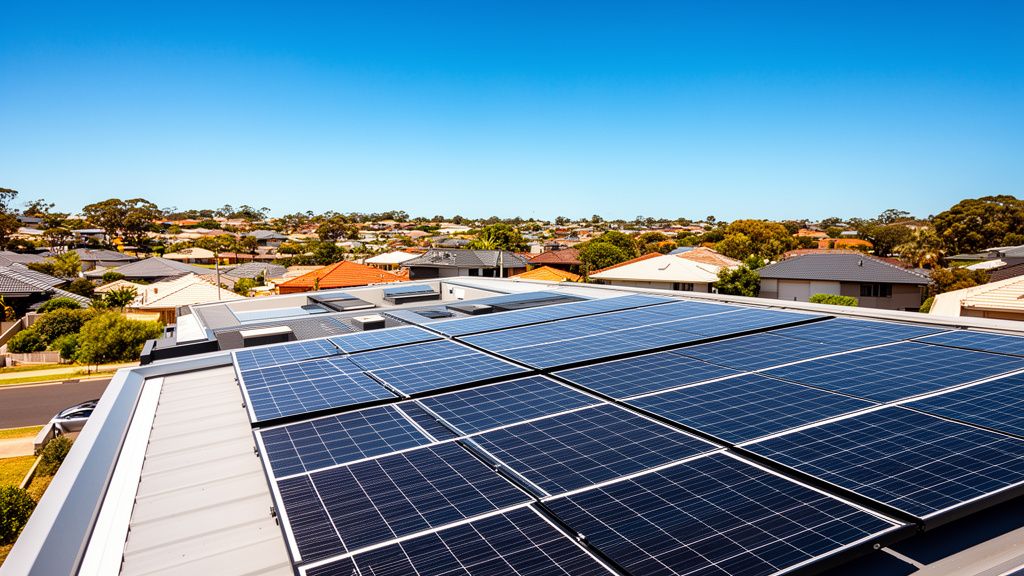
TL;DR: Australian homeowners and large-scale projects are rapidly adopting battery storage, driven by rising electricity prices, lower battery costs, and a desire for energy independence. This boom supports Australia's push towards a grid powered predominantly by solar and wind, offering stability and reliability for a renewable future.
Why are Australian Households Investing More in Home Battery Storage?
Australian households are increasingly installing battery storage systems alongside their solar panels, moving beyond simply exporting excess power. This shift comes from a combination of falling battery prices, a desire for greater energy independence, and the declining value of solar feed-in tariffs. While a typical 6.6kW solar system still offers significant savings on daytime electricity use, storing surplus generation for evening consumption maximises self-sufficiency. For instance, in 2024, many retailers offer feed-in tariffs below 5-7 cents per kilowatt-hour, while peak grid electricity can cost 30-50 cents per kilowatt-hour. Shifting that gap from export to self-consumption creates substantial value.
What are the financial benefits of home batteries?
The financial case for home batteries strengthens each year. A common 10kWh home battery system typically costs between $10,000 and $15,000 fully installed, before any state-based rebates. For a household with a 6.6kW solar system, adding this battery can increase their self-consumption of solar energy from around 30-50% to 70-90%. This translates to annual savings potentially ranging from $800 to $1,500, depending on electricity usage patterns, tariffs, and location. States like Victoria and New South Wales offer rebates, such as the Victorian Solar Homes Program which provides up to $2,950 for batteries, further shortening payback periods to 5-8 years for many systems. These rebates make the upfront cost more manageable for many families across the country.
How Are Large-Scale Batteries Changing Australia's Energy Grid?
Large-scale battery energy storage systems (BESS) are fundamentally transforming Australia's National Electricity Market (NEM), providing essential stability and enabling more renewable energy integration. These utility-scale batteries, some as large as 300MW/450MWh, do more than just store excess solar and wind power; they inject or absorb electricity almost instantaneously. This rapid response helps maintain grid frequency and voltage, acting as a critical buffer against sudden changes in supply or demand. Projects like Neoen's Hornsdale Power Reserve in South Australia, which famously responded to grid events faster than traditional generators, demonstrated the reliability and speed of this technology. We now see over a dozen such projects operating or under construction across the NEM.
What grid services do large batteries provide?
Large batteries perform several grid services that are crucial for a renewable-heavy energy system. They offer Frequency Control Ancillary Services (FCAS), which maintain the precise 50 Hertz frequency of the grid. If frequency dips too low or rises too high, a large-scale battery can inject or absorb power in milliseconds, preventing blackouts. They also provide 'synthetic inertia,' mimicking the stabilising effect of large spinning generators without the carbon emissions. This capability is particularly important as coal-fired power stations, which inherently provide inertia, retire. The Victorian Big Battery, a 300MW/450MWh system, supports stability across the entire state and even across borders, allowing more renewable generation to connect without compromising reliability. These systems are now also participating in energy arbitrage, charging when prices are low (often during peak solar generation) and discharging when prices are high (during evening peaks).
What's the Future for Renewable Energy in Australia?
Australia's renewable energy outlook predicts a significant expansion of solar and wind generation, supported by a rapid build-out of battery storage and new transmission infrastructure. The federal government's target of 82% renewable electricity by 2030 requires substantial investment and coordination across the energy sector. We are on track to exceed 40% renewable energy in the NEM in 2024, largely driven by rooftop solar and utility-scale solar and wind farms. The Australian Energy Market Operator (AEMO) forecasts that by 2050, the NEM will need approximately 40GW of new utility-scale solar, 60GW of new wind, and a massive 90GW/1,000GWh of dispatchable capacity, mainly from batteries and pumped hydro. This means that for every gigawatt of new solar and wind, we will need significant battery support.


How will new infrastructure support renewable growth?
Building new transmission lines remains a key component of this future. Projects like Project EnergyConnect, linking South Australia and New South Wales, and HumeLink in NSW, are designed to unlock new renewable energy zones. These zones, located in areas with strong wind and sun resources, will host thousands of megawatts of new generation. Without adequate transmission to transport this clean power to demand centres, the full potential of renewables cannot be realised. The integration of smart grid technologies, virtual power plants (VPPs) that aggregate home batteries, and advanced forecasting will further optimise the system. Australia is moving towards an energy system that is cleaner, more decentralised, and increasingly resilient, with battery storage playing a central role in making intermittent renewables dispatchable and reliable.
Key Takeaways
- Australian home battery installations are booming due to lower costs, high grid electricity prices, and state rebates like those in Victoria.
- Large-scale batteries are essential for grid stability, providing rapid frequency control and synthetic inertia, allowing more renewables to connect.
- Australia targets 82% renewable electricity by 2030, which requires substantial new solar, wind, and especially battery storage capacity.
- New transmission infrastructure and smart grid technologies are crucial for connecting renewable energy zones to major demand centres.
- Battery storage transforms intermittent solar and wind into reliable, dispatchable power for a cleaner, more stable grid.