TL;DR: Residential and grid-scale battery storage capacity is experiencing explosive growth across Australia. With household battery capacity surging by 41% to 3,283 megawatt-hours (MWh) and grid-scale capacity exceeding 9 gigawatts (GW), advanced storage solutions are becoming essential tools for managing household electricity bills and navigating the financial realities of two-way solar charging tariffs.
Rapid Scalability in Domestic Battery Capacity
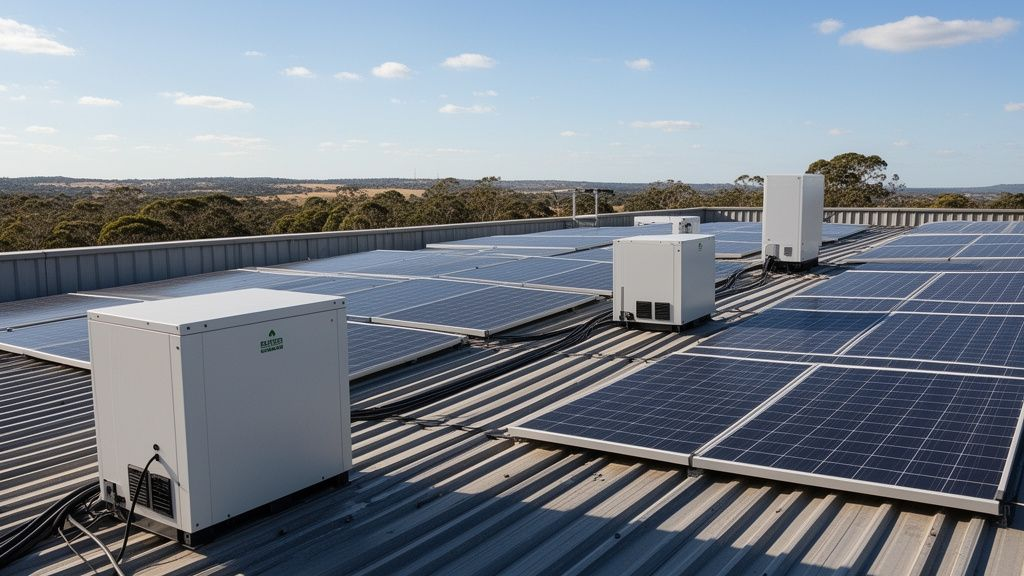
Australia is leading the world in the adoption of home energy storage, driven by the need to manage rising retail electricity costs and secure backup power. According to the Australian Energy Market Operator's (AEMO) latest Quarterly Energy Dynamics report, household battery capacity has increased by an impressive 41% year-on-year, reaching a total of 3,283 megawatt-hours (MWh) across the nation.
Simultaneously, the utility sector has seen a parallel expansion, with grid-scale battery capacity doubling to exceed 9 gigawatts (GW). Significant grid projects, such as the second stage of the massive Supernode battery, have officially commenced operations, cementing its status as the largest battery system on Australia's main electricity grid. This dual-layer expansion of both domestic and grid-scale storage is essential to support the variable output of wind and solar systems.
As noted by Meredith O’Brien, Head of Energy at Compare the Market, installing a battery allows households to store excess clean solar energy generated during peak daylight hours. Instead of drawing expensive electricity from the utility grid in the evening, homeowners can rely on their stored battery power, drastically reducing their overall environmental impact and cost of living.
Leading Hardware Solutions for Hybrid Energy Storage
For consumers looking to adopt battery storage, several major manufacturers offer advanced, scalable, and highly reliable hybrid technologies designed to meet a wide variety of household demands:
- GoodWe Systems: The GoodWe GW8.3-BAT-D-G21 battery is engineered to work in tandem with the GoodWe 10kW single-phase hybrid inverter (GW9.999KEHA-G20). Featuring 4 MPPTs and 200% solar oversizing, this system ensures high-efficiency battery charging even in low-light winter conditions.
- Neovolt Hybrid Solutions: Neovolt provides a highly adaptable single and 3-phase hybrid inverter and battery range, incorporating models such as the BW-INV-SPB5K, BW-INV-SPH5K, and the BW-BAT series, which are designed to support a seamless transition between solar, battery, and grid power.
- DEYE ESS Storage Solution: This highly efficient High-Voltage (HV) storage system features scalable storage ranging from 7.68 to 15.36 kWh. Built with extremely safe LiFePO4 (Lithium Iron Phosphate) cells, this durable system is backed by a comprehensive 10-year warranty and supports smart load control.
- AlphaESS AC Coupled Solutions: Models such as the G3-S5 and G3-B5 unlock seamless, scalable, and highly efficient AC-coupled energy storage. These are designed for quick integration and long-term reliability in both residential and commercial solar installations.
- SAJ HS2 Series: This is a three-phase hybrid all-in-one storage solution designed to simplify installation and provide high-output backup capability for larger households.
Economic Opportunities of Two-Way Tariffs and Grid Integration
As the volume of rooftop solar generation continues to grow, energy retailers and grid operators are adjusting how they manage and reward electricity exports. Traditionally, solar owners enjoyed flat feed-in tariffs for every kilowatt-hour exported to the grid. However, the introduction of "two-way solar charging" is fundamentally shifting these economics.
Under two-way solar charging frameworks, solar owners may actually be charged a fee for exporting excess electricity to the utility grid during off-peak, high-supply hours (typically in the middle of sunny days when supply far outstrips demand). Conversely, these same frameworks provide strong financial incentives for households to export their stored solar energy during peak evening hours when grid demand is high and fossil fuel generation is expensive.
By utilizing a smart solar battery system, homeowners can program their storage units to avoid daytime grid export penalties, instead saving that power for self-consumption or exporting it at premium incentive rates during peak periods. This makes advanced battery storage an indispensable economic asset rather than just an optional accessory.
Key Takeaways
- Surging Battery Adoption: Household battery capacity has increased by 41% to 3,283 MWh, while grid-scale capacity has doubled, exceeding 9 GW nationally.
- Advanced Safe Chemistries: Leading manufacturers utilize highly stable LiFePO4 chemistry and offer long-term performance warranties of up to 10 years (e.g., DEYE ESS).
- Navigating Two-Way Charging: Modern battery systems protect consumers from daytime grid export charges while allowing them to cash in on high peak-export incentives.
- Scalable Integration: Solutions like the AlphaESS G3 AC-coupled series and Neovolt BW-BAT range provide homeowners with the flexibility to scale their storage as energy needs grow.