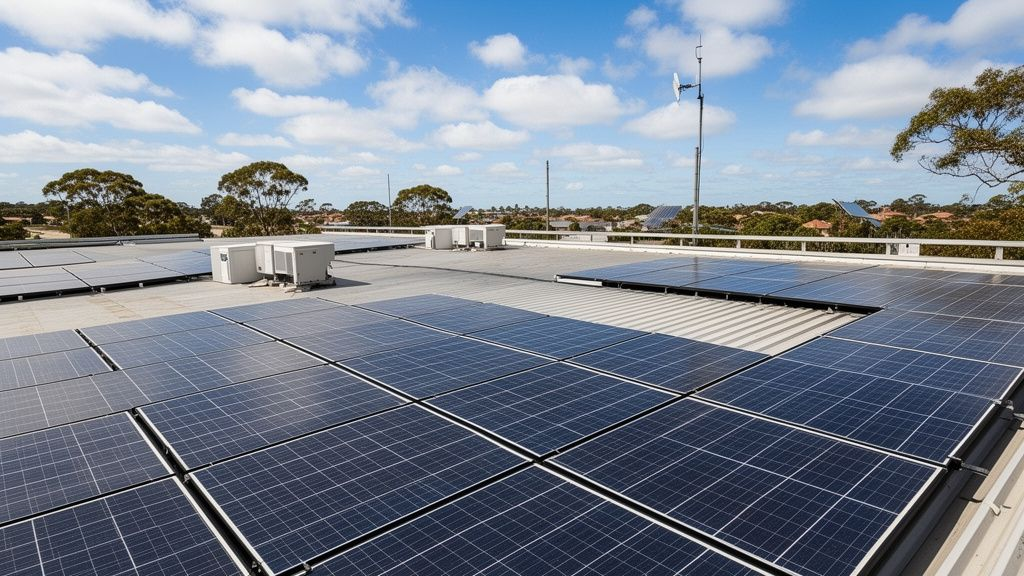
TL;DR: The 2025–26 GenCost report confirms that renewable energy remains Australia's lowest-cost pathway to net-zero emissions. Supported by major projects like Victoria's first long-duration battery, Queensland's pumped hydro, and structural regulatory shifts from the AEMC, the nation's clean energy transition is accelerating across regional and utility-scale sectors alike.
Introduction: The Independent Voice of Clean Energy
The transition to a renewable-powered future in Australia is not a distant prospect; it is an active, rapidly expanding movement occurring across the country's rooftops, transmission grids, transport routes, and regional towns. At the heart of this shifting landscape is the Smart Energy Council, an independent, not-for-profit body representing over 1,000 members across the Australian smart energy industry. For 70 years, the Council has connected businesses of all sizes, leading advocacy campaigns, and unlocking systemic barriers to a renewable future. Through targeted working groups—including Consumer Energy, Large Scale, Manufacturing, Transport, Stewardship, and Global—the Council actively shapes the national policies driving utility-scale wind, solar, and battery storage projects.
Simultaneously, the Clean Energy Council is highlighting the sheer scale of production through initiatives like the 'Energising Australia' campaign. This campaign brings to life the stories of remote workers, farmers, and community leaders who are constructing some of the world's largest clean infrastructure projects. Grounded in the CSIRO's latest GenCost 2025–26 report, which reconfirms that renewables are the lowest-cost pathway to net-zero emissions, Australia's energy transition is proving to be both an environmental and economic triumph.
GenCost 2025–26 and State-Level Energy Shifts
The release of the CSIRO’s GenCost 2025–26 report on July 17, 2026, provided a definitive confirmation that renewable energy technologies continue to be the absolute lowest-cost pathway for Australia to achieve its net-zero emissions targets. This finding underpins state-level policy decisions and industrial investments across the continent.
For instance, on July 22, 2026, the Western Australian Government announced its formal backing of wind energy projects as a vital tool to ensure long-term energy security. By diversifying its power grid with onshore wind generation, Western Australia is actively mitigating the supply volatility associated with older, fossil-fuel-based systems. This public-sector backing aligns with broader federal initiatives to decarbonize critical mineral mining and heavy processing sectors.
Regional Projects and the People of 'Energising Australia'
To truly understand the massive scale of the transition, one must look to regional Australia, where wind, solar, and storage facilities are driving local employment and community funding. The Clean Energy Council's 'Energising Australia' campaign documents several notable projects:
-
The MacIntyre Wind Farm (Warwick, Queensland): Currently developed by ACCIONA Energia, MacIntyre is the largest wind farm under construction in Australia. The project is a major economic driver, employing a local workforce of approximately 360 people. Local businesses, such as Byrne Automotive owned by mechanic Adam, have secured ongoing work by maintaining and servicing the large fleet of ACCIONA vehicles used in construction. Maria, the Stakeholder Engagement Lead for MacIntyre, emphasizes the value of giving back to the Warwick community. Local students, like school student Hayden, have toured the site to witness firsthand how wind turbines will contribute to Queensland's future energy network.
-
The Wambo Wind Farm (Jandowae, Queensland): Developed as a joint venture between Cubico and Stanwell Corporation, the Wambo Wind Farm showcases how clean energy and community welfare go hand in hand. The project provided grant funding to the residents of the Taralga Retirement Village, directly improving their comfort and mobility. The development also prioritizes the preservation of Indigenous history. Tracy, a Cultural Heritage Manager representing the Western Wakka Wakka people, works alongside her team to carefully recover and preserve ancient Indigenous artefacts found on the construction grounds. Meanwhile, young locals like student and farm hand Tom earn income during school holidays by cleaning the specialized trucks utilized across the construction site. Additionally, regional workers like Carlene successfully balance their lives by dividing their time between ACCIONA Energia's MacIntyre Wind Farm and running their own local farms.
-
The Dulacca Wind Farm (Miles, Queensland): Developed by RES and Octopus Investments, this regional facility has integrated itself into the local community by providing crucial financial support to local enterprises. Sonia, the owner of Stenhouse Fitness, was able to secure funding for the Murilla Fitness Centre. This financial backing allowed the gym to purchase extra gear, which directly supported the influx of new workers residing in the town to finalize construction of the wind farm.
-
The Gannawarra Solar Farm (Gannawarra Shire, Victoria): Developed by Edify Energy, this 60 MWp solar farm was the first utility-scale solar project constructed in Victoria. Demonstrating the value of grid firming, it is fully integrated with a 25 MW energy storage system. Regional landowners like Greg host the massive solar array on their agricultural properties, while his neighbor Tim is preparing his land to host a future battery project to further stabilize the local renewable supply.
-
The Kidston Pumped Hydro Project (Kidston, Queensland): This massive civil engineering undertaking, developed by Genex Power, is scheduled for completion in 2024. Project Director Tony and Jumbo Operators like Kyle are driving the development of what will become only the fourth operational pumped hydro project in Australia's history, providing crucial long-duration storage capacity to firm up the Queensland grid.


Corporate Milestones: Battery Innovations and Cost Reductions
In parallel with large-scale generation, commercial and residential storage solutions are experiencing rapid technological advancement and market changes. On July 24, 2026, Fox ESS officially launched the 'POWER BEAST', a modular storage system specifically designed to simplify the deployment of energy storage systems in the Commercial and Industrial (C&I) sectors.
On July 16, 2026, the State Electricity Commission (SEC) of Victoria, in partnership with Energy Dome, announced a plan to construct Victoria's first long-duration battery project at a newly established innovation precinct. This project represents a major step forward in establishing long-term grid stability using novel storage technologies.
For residential consumers, battery storage has become significantly more accessible. On July 13, 2026, manufacturer Sigenergy announced a direct price reduction, cutting battery costs through a $1,000 discount per 9kWh module. Because this discount is designed to stack directly with existing Federal Rebates, Australian households can secure total savings of up to $10,000 on integrated solar and battery installations, dramatically accelerating the payback period of home energy systems.
Strengthening the Market: Distribution Ring-Fencing Reforms
As clean energy options expand, ensuring a fair and competitive market is essential. On June 25, 2026, the Australian Energy Market Commission (AEMC) published a formal consultation paper reviewing a rule change request submitted by Nexa Advisory. This request seeks to clarify and strengthen distribution ring-fencing arrangements in Chapter 6 of the National Energy Rules (NER).
Distribution Network Service Providers (DNSPs) hold natural monopolies over regional electricity poles and wires. To prevent these entities from using their market power to unfairly disadvantage independent solar, battery, and home energy providers, Nexa Advisory has proposed several structural changes:
- Elevating Core Rules: Moving core ring-fencing obligations and waiver conditions directly from the Australian Energy Regulator's (AER) guidelines into the NER itself.
- Waivers as a Last Resort: Restricting DNSPs from obtaining ring-fencing waivers unless they can prove an independent, verifiable market failure and a measurable benefit to consumers.
- Affiliate and Branding Safeguards: Providing clearer guidance on affiliate dealings, data sharing, and restricting DNSPs from using their dominant brand name to cross-promote or subsidize private commercial energy services.
- Financial Resilience: Introducing strict financial resilience tests to ring-fence a DNSP if its parent company experiences financial deterioration.
By creating a transparent playing field, these regulatory updates ensure that emerging markets remain competitive, allowing independent installers and consumer energy plans to thrive.
Industry Connections: Smart Energy Events in 2026
Collaboration remains key to executing these transitions smoothly. To facilitate knowledge sharing, the Smart Energy Council is hosting a series of Power Circle Industry Lunch & Networking events and Smart Installer Roadshows throughout July and August 2026:
- Perth: Industry Lunch & Roadshow on Tuesday, 28 July 2026, at the Tradewinds Hotel & Suites.
- Townsville: Smart Installer Roadshow on Thursday, 30 July 2026, at Rydges Southbank.
- Sydney: Industry Lunch & Roadshow on Tuesday, 4 August 2026, at the Guildford Leagues Club.
- Melbourne: Industry Lunch on Thursday, 6 August 2026, at the Brighton Beach Hotel.
These forums enable business owners, installers, and policymakers to upskill, earn Continuing Professional Development (CPD) points, maintain strict compliance, and discuss grid development.
Key Takeaways
- Renewables Remain Cheapest: The CSIRO GenCost 2025–26 report reconfirms that wind, solar, and integrated storage represent Australia’s lowest-cost energy pathway.
- Massive Storage Deployment: Utility projects like Victoria's first long-duration battery (SEC/Energy Dome) and Genex's Kidston Pumped Hydro (completing in 2024) are creating a resilient, firmed national grid.
- Unprecedented Consumer Value: Sigenergy's $1,000 discount stacked with Federal Rebates offers up to $10,000 in savings on home batteries, bringing affordable energy to residential users.
- Market Protection: The AEMC is actively consulting on Nexa Advisory's ring-fencing rule change to ensure DNSP monopolies do not crowd out competitive independent solar and battery operators.
Related Guides
- Unlocking Residential Solar Potential: Why Design and Monitoring Matter More Than Panel Count
- Next-Generation Battery Storage: From Long-Duration Utility Projects to Subsidised Home Systems
- Decarbonising Australian Businesses: Commercial Solar, Industrial Storage, and Community Benefits
- Protecting Emerging Energy Markets: Clarifying Distribution Ring Fencing for Consumers


