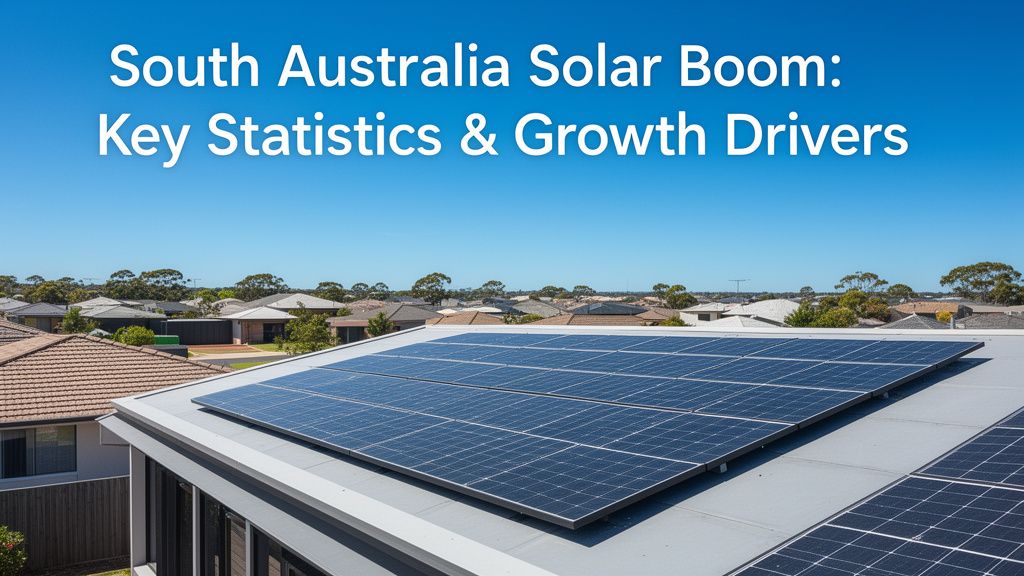
TL;DR: Over 40% of South Australian detached homes have rooftop solar and installed capacity exceeds 2 GW. The state regularly meets 100% of operational demand from renewables on sunny days. That success has created a second problem, which is what to do with all the midday power, and it is now reshaping what a good solar system looks like in SA.
How far ahead is South Australia?
Further than anywhere comparable.
More than 40% of detached homes in South Australia have rooftop solar, which is among the highest household penetration rates in the world. Installed capacity, mostly residential and commercial rooftop PV, exceeds 2 GW.
On sunny, mild days the state regularly meets or exceeds 100% of its operational electricity demand from renewables. That is not an occasional record; it happens routinely.
For a household considering solar, the useful implication is not bragging rights. It is that you are joining a market where midday power is abundant and therefore cheap, and that changes the arithmetic of what to install.
What drove the uptake
Three things, in roughly this order of importance.
High retail prices. South Australians pay some of the highest electricity rates in the country, commonly $0.35 to $0.45 per kilowatt-hour. Every kilowatt-hour you generate and use yourself avoids that, which is a stronger incentive than exists in most states.
Federal incentives. The Small-scale Renewable Energy Scheme discounts installations through Small-scale Technology Certificates, applied by the installer at the point of sale. On a 6.6kW system that brings the net price to roughly $5,000 to $8,000 depending on the installer and components. The discount steps down annually, so waiting has a running cost.
Visible neighbours. Solar adoption spreads street by street. Once a third of a suburb has panels, the technology stops looking experimental and starts looking like the default.
Payback for a well-sized system commonly runs three to five years, which is faster than most states because of the retail price the savings are measured against.
What has all that solar done to the grid?
Created a genuine engineering problem, and the response to it now affects what you can install.
The midday problem
The grid was built to move power one direction, from large generators to houses. Hundreds of thousands of rooftops exporting at the same moment sends it the other way.
At times, rooftop generation exceeds local demand entirely. That causes voltage rise on the distribution network, and voltage outside the allowed range causes inverters to trip off, which means your system stops producing on exactly the sunny days it should be producing most.
Wholesale prices go negative at midday for the same reason: too much supply, not enough demand. Which is why feed-in tariffs have fallen so far.
How the network responded
SA Power Networks has introduced dynamic operating envelopes, which allow the network to vary how much a given system may export depending on local conditions, rather than applying one fixed limit to everybody.
Smart meter requirements and smart inverter standards support that. Newer systems can be remotely curtailed during periods of network stress, and in return get higher export allowances at other times than a fixed limit would permit.
Large-scale storage does the rest. The Hornsdale Power Reserve and the Torrens Island battery absorb surplus and discharge into the evening peak, providing frequency services the grid used to get from synchronous generators.
What does this mean for a household installing solar now?
Three practical consequences, and they run against some standard advice.
Export income is no longer the point. With feed-in tariffs low and midday wholesale prices frequently negative, a system sized to maximise export is sized wrong. Size to your consumption, with headroom for an EV or electrification of gas appliances.
Check your export limit before designing the system. Your allowance depends on your location and connection, and it is not the same everywhere. An installer designing around an assumed figure can produce a system that will not be approved as specified.
Battery storage is worth more here than in most states. The gap between what your surplus earns exported and what grid power costs in the evening is wider in South Australia than almost anywhere, and that gap is what a battery monetises.
The federal Cheaper Home Batteries discount cuts roughly 30% off eligible installed costs at the point of sale, and state rebates have applied on top at various times. Ask your installer directly whether your quote includes both, because they do not always volunteer it.
Size the battery to your evening consumption rather than your daily total. Your retailer holds interval data showing exactly when you draw power, it costs nothing to request, and capacity that never discharges never pays for itself.
Key Takeaways
- Over 40% of SA detached homes have solar, capacity exceeds 2 GW, and the state regularly hits 100% of operational demand from renewables.
- High retail prices of $0.35 to $0.45 per kilowatt-hour, not generous feed-in tariffs, are what make solar pay so well in South Australia.
- A 6.6kW system costs roughly $5,000 to $8,000 after federal certificates, with payback commonly three to five years.
- High penetration has pushed midday wholesale prices negative and feed-in tariffs down, so size your system to consumption rather than export.
- Confirm your export limit with SA Power Networks before finalising a design, and consider storage, which pays better here than in most states.