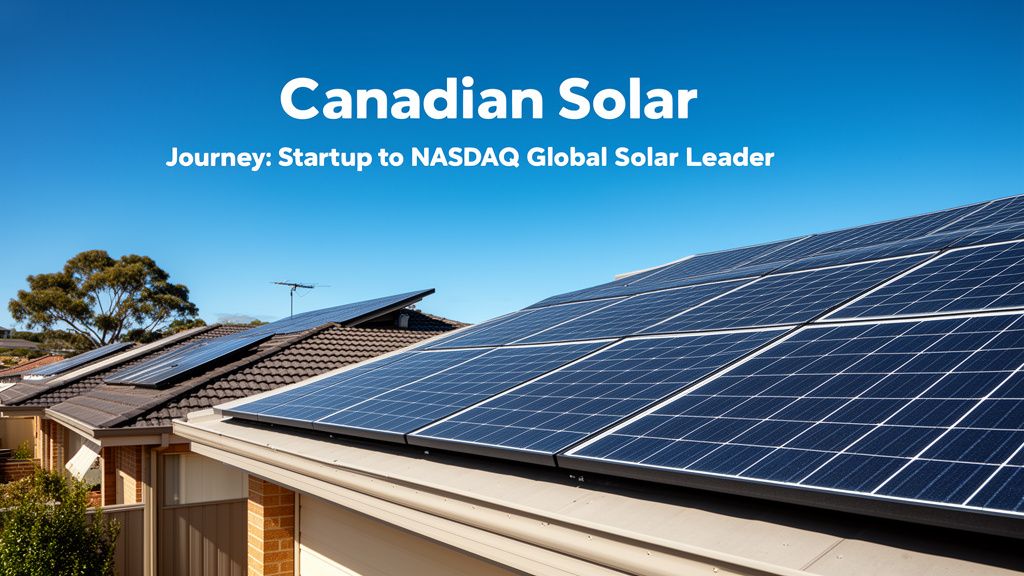
TL;DR: Canadian Solar started in 2001 in Canada, quickly expanding manufacturing into China to scale production of solar modules. Its focus on quality, research, and project development allowed it to grow rapidly, becoming a NASDAQ-listed company and a major global player in both module supply and large-scale solar project construction.
How Did Canadian Solar Begin Its Journey?
Canadian Solar began its journey in Ontario, Canada, in 2001, founded by Dr. Shawn Qu. The company didn't start with large-scale manufacturing immediately; it focused on bringing reliable solar technology to market. Dr. Qu, with a background in semiconductor physics, saw the potential for solar to become a widespread energy source. From the outset, the business prioritised quality control and research, which would later become cornerstones of its global strategy. Early on, the company made strategic decisions to leverage manufacturing capabilities in China, allowing it to scale production efficiently and meet growing global demand for solar panels. This move provided a cost advantage that many Western manufacturers struggled to match, setting the stage for aggressive market expansion. By 2006, just five years after its inception, Canadian Solar went public, listing on the NASDAQ stock exchange under the ticker CSIQ, a significant milestone for a relatively young solar enterprise.
Early Manufacturing and Quality Focus
The decision to establish extensive manufacturing operations in China enabled Canadian Solar to control its supply chain and scale production volumes rapidly. Instead of solely importing or assembling, they built their own facilities, maintaining a direct oversight on every step of the module production process. This approach helped maintain consistent product quality even as production capacities grew into the gigawatts. They invested in automated production lines and rigorous testing protocols, ensuring their panels met international standards for durability and performance. This commitment to quality helped them build a reputation for reliability, which was crucial in an emerging industry where trust in product longevity was key for both residential and commercial customers. This meant Australian installers could confidently offer Canadian Solar panels, knowing they performed well in our harsh conditions.
What Strategies Powered Canadian Solar's Global Expansion?
Canadian Solar's global expansion was driven by a multi-pronged strategy that combined aggressive market penetration with vertical integration and a strong emphasis on research and development. Beyond just manufacturing solar modules, the company diversified its operations into utility-scale solar project development. This meant they were not just selling panels to developers; they were also designing, building, and operating their own large solar farms worldwide. This strategy helped them capture more value across the solar energy supply chain and provided stable revenue streams from long-term power purchase agreements. For example, in Australia, Canadian Solar has been involved in several significant projects, including the 117MW Gangarri Solar Farm in Queensland, which powers local industry. This dual approach – module supply and project development – allowed them to adapt to different market conditions and hedge against fluctuations in panel prices.
Innovation and Product Development
A continuous investment in research and development has been another core driver. Canadian Solar understood that staying competitive meant evolving its product offerings. They pushed the boundaries of module efficiency, developing panels with higher power outputs and better performance in varying conditions. This included advancements in cell technology, module design for different applications (like bifacial panels), and improved durability to withstand extreme weather. Their panels typically feature robust frames and enhanced glass, making them suitable for Australia's often intense heat and hailstorms. This focus on innovation translates directly to better returns for customers. A more efficient panel means a smaller footprint for the same output, which is useful on residential rooftops, and a more robust panel means fewer warranty claims over the system's 25-year lifespan.


Australian Market Presence and Offerings
In Australia, Canadian Solar established a strong market presence through a network of authorised distributors and installers. They offer a range of modules suitable for both residential and commercial applications, from standard 370W panels to higher efficiency 440W+ models. A typical 6.6kW residential system in Sydney using Canadian Solar panels might cost a homeowner between $5,500 and $7,500, fully installed, depending on the inverter choice and installation complexity. Their products meet all Clean Energy Council (CEC) requirements and are backed by comprehensive warranties, typically offering a 25-year performance warranty and a 12-year product warranty. This long-term commitment gives Australian consumers confidence in their investment, knowing they are installing a product from a globally recognised brand with a strong local support network.
Key Takeaways
- Canadian Solar grew from a Canadian startup in 2001 to a NASDAQ-listed global entity by focusing on scalable manufacturing in China and aggressive market expansion.
- The company's success relies on a dual strategy: supplying high-quality solar modules and developing utility-scale solar projects worldwide, including in Australia.
- Continuous investment in research and development ensures their solar panels remain competitive, offering high efficiency and durability suited for diverse environmental conditions.
- Australian homeowners and businesses benefit from Canadian Solar's strong product range and warranties, with typical 6.6kW systems costing between $5,500 and $7,500.
Read More
For a comprehensive overview, check out our master guide: Read the Full Guide Here.


