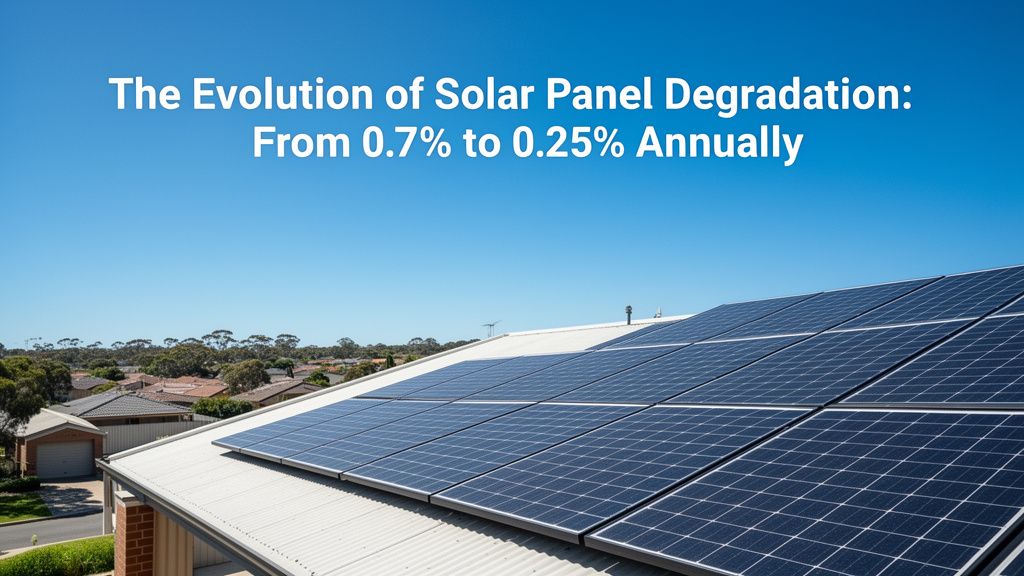
The Evolution of Solar Panel Degradation: From 0.7% to 0.25% Annually
For many Australian homeowners, going solar is one of the most significant long-term investments they'll make in their home. It's not just about today's energy savings; it's about securing your energy future, reducing your carbon footprint, and adding value to your property for decades to come. When you’re planning for that kind of longevity, one crucial factor often comes up in conversations with installers: solar panel degradation.
For years, the industry standard and common expectation was that solar panels would degrade by roughly 0.7% annually. This meant that over a typical 25-year warranty period, your system could lose a significant chunk of its initial power output. But here’s the ripper news: thanks to incredible leaps in technology and manufacturing, that figure has plummeted. Today, the best solar panels on the market boast an annual degradation rate as low as 0.25%. This isn't just a small tweak; it's a game-changer for anyone considering solar Down Under.
What Exactly is Solar Panel Degradation?
Before we dive into the good news, let's quickly clarify what degradation means. Solar panel degradation is the natural, gradual decrease in a solar panel's power output over time. It's an expected part of the panel's lifecycle, not a fault. Think of it like a new car slowly losing a bit of its showroom shine or an old battery not holding its charge quite as long.
The primary culprits behind degradation are environmental factors: prolonged exposure to UV radiation, extreme temperatures (especially our harsh Aussie sun), humidity, and physical stress. Over time, these elements can subtly alter the materials within the panel, leading to a slight reduction in its ability to convert sunlight into electricity.
The "Old Guard": Understanding 0.7% Annual Degradation
For a long time, the 0.7% annual degradation rate was the benchmark. If you installed a 10kW solar system, designed to meet your household's needs, that 0.7% figure would mean that after 10 years, your system would be operating at around 93% of its original capacity. After 25 years, it would be down to about 82.5%.
Let's put that into perspective. A 10kW system in a good sunny spot in Sydney could generate, say, 14,000 kWh per year initially. At 0.7% degradation, after 25 years, that same system would only be producing around 11,550 kWh annually. That’s a difference of 2,450 kWh per year, which, at an average electricity price of $0.30/kWh, represents a loss of over $700 annually in savings by year 25, compared to a system that didn't degrade as much. For homeowners investing upwards of $10,000-$15,000 in a quality system, maximising long-term output was always a key concern.
The Revolution: Driving Degradation Down to 0.25%
So, how did the industry manage to almost halve this rate? It's a testament to relentless innovation across several fronts:


- Materials Science: Manufacturers have developed superior encapsulants (the protective layers that seal the solar cells), more durable glass, and advanced backsheets. These materials are far more resistant to UV radiation, moisture ingress, and thermal stress, slowing down the aging process of the internal components.
- Manufacturing Precision: Automated production lines and rigorous quality control measures ensure fewer micro-cracks, better cell interconnections, and tighter tolerances in assembly. This reduces the chances of manufacturing defects that could accelerate degradation.
- Cell Technology: The advent of advanced cell architectures like PERC (Passivated Emitter Rear Contact), TOPCon, and Heterojunction (HJT) cells has played a massive role. These cells are inherently more stable and less prone to issues like LID (Light-Induced Degradation) and LeTID (Light and elevated Temperature Induced Degradation) – phenomena that cause an initial power drop after installation and further degradation over time.
- Improved Testing Standards: More stringent and realistic accelerated aging tests ensure that panels are designed to withstand real-world conditions for longer, pushing manufacturers to innovate for greater durability.
What Does 0.25% Mean for Australian Homeowners?
This reduction from 0.7% to 0.25% is a massive win for Aussie households considering solar.
-
Enhanced Longevity and Return on Investment (ROI): With a 0.25% annual degradation rate, a premium solar panel will retain approximately 93.75% of its original power output after 25 years. This is a huge jump from 82.5%.
Using our 10kW system example, at 0.25% degradation, after 25 years, it would still be producing around 13,125 kWh annually – nearly 1,600 kWh more per year than a panel degrading at 0.7%! That’s an extra $480 in annual savings (at $0.30/kWh) every year for potentially decades to come.
-
Greater Energy Security: More predictable and stable power output means you can rely on your system to deliver consistent savings and a strong contribution to your household's energy needs for much longer, without the need for significant oversizing or early replacements.
-
Stronger Performance Warranties: Manufacturers are so confident in these improvements that many now offer linear performance warranties guaranteeing 87% to 90% of the original output after 25 or even 30 years. This offers fantastic peace of mind for your investment.
-
Increased Property Value: A solar system that is guaranteed to perform strongly for longer adds tangible value to your home, making it a more attractive proposition for future buyers.
Is All Solar Created Equal? Choosing Wisely.
While the 0.25% degradation rate represents the pinnacle of current solar panel technology, it's important to understand that not all panels achieve this benchmark. Many quality panels still offer excellent performance with a 0.5% degradation rate, which is still a vast improvement over the old standard.
When you're doing your research or chatting with an installer, ask about the specific degradation rates and performance warranties of the panels they recommend. Look for reputable Tier 1 brands known for their cutting-edge technology and robust R&D. Investing in panels with a lower degradation rate, even if they cost a little extra upfront, will almost certainly pay dividends in the long run through greater energy generation and peace of mind.
The Future is Bright (and Efficient!)
The journey from 0.7% to 0.25% annual degradation is a powerful testament to the relentless innovation within the solar industry. It means that the long-term benefits of solar power for Australian homes are more compelling than ever before. We're not just installing solar; we're investing in an incredibly durable, high-performing asset that will quietly generate clean energy and savings for decades.
If you're thinking about going solar or upgrading your existing system, now is an exciting time. The improvements in degradation rates mean your investment will work harder and last longer, solidifying solar as a truly smart choice for any Aussie home. Speak to a local solar expert today to explore the best options for your place!
Read More
For a comprehensive overview, check out our master guide: Read the Full Guide Here.


