Q4 2025: Unpacking Australia's Landmark Quarter for Clean Energy Deployment
G'day, clean energy enthusiasts! Q4 2025 didn't just turn a page for Australia's clean energy sector; it rewrote the chapter entirely. This final quarter emerged as an absolutely landmark period, a testament to concerted efforts across government, industry, and individual households. It wasn't merely about incremental growth; it marked a significant acceleration in our transition towards a sustainable, renewable future, solidifying our reputation as a global leader in solar adoption. From suburban rooftops to sprawling solar farms, the momentum was palpable, demonstrating a collective commitment to harnessing our abundant sunshine.
Residential Solar Keeps Shining Bright
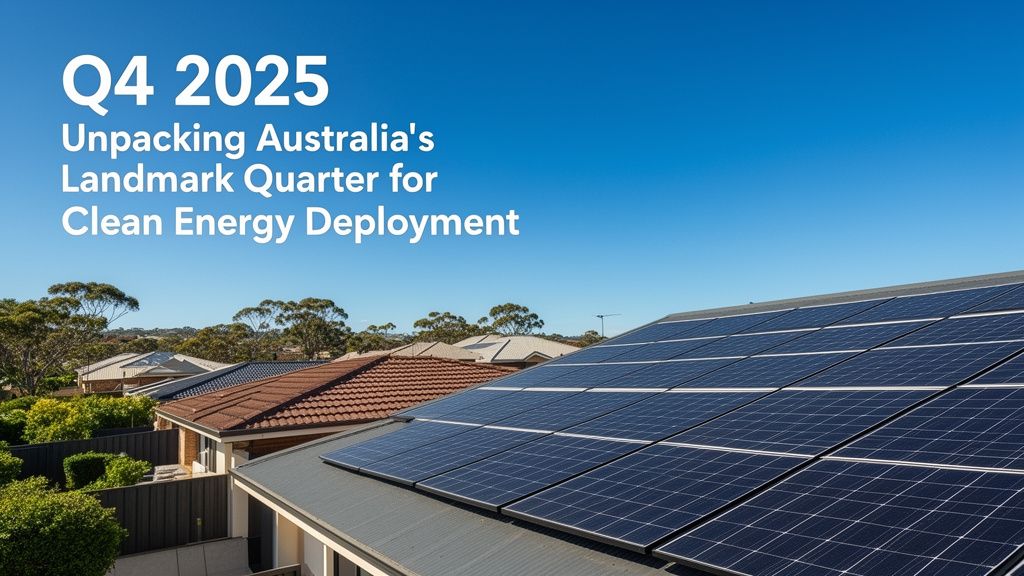
The residential sector truly led the charge, with an unprecedented surge in rooftop solar installations. Australian homeowners, feeling the pinch of soaring electricity bills, flocked to solar like never before. Falling system costs, generous Small-scale Technology Certificates (STCs), and state-based incentives, alongside increasingly sophisticated battery storage, made the decision a no-brainer for countless families. A typical 6.6kW residential system, which might have cost upwards of $15,000 a few years prior, was now routinely being installed for around $7,000 to $9,000 after government rebates – a truly compelling proposition.
The widespread adoption of home battery storage made Q4 2025 particularly special. No longer a niche luxury, batteries like the Tesla Powerwall 3 or locally-designed Sungrow and Alpha-ESS systems became integral components of new installations. Households were not just generating power; they were storing it to power their homes through the evening peak, selling excess back to the grid for a tidy sum, and even participating in virtual power plants (VPPs). This shift towards energy independence and optimised self-consumption drove massive savings, often reducing quarterly electricity bills by 70% or more, transforming homes into miniature power stations.
Businesses Get on Board: The Commercial & Industrial Surge
It wasn't just homeowners embracing the sun. Australian businesses, from small workshops to large manufacturing plants, significantly ramped up their clean energy investments in Q4 2025. The economic rationale was undeniable: reducing operational costs, hedging against volatile energy prices, and meeting increasingly stringent ESG (Environmental, Social, and Governance) targets. Large rooftop installations, often exceeding 100kW, became a common sight on industrial estates and shopping centres.
Businesses leveraged the instant asset write-off scheme and other clean energy financing options, installing systems that promised rapid payback periods, often within three to five years. For facilities with significant daytime energy consumption, such as cold storage or data centres, solar provided a direct and substantial boost to their bottom line. The quarter saw numerous examples of businesses achieving energy self-sufficiency during peak operational hours, dramatically improving their competitiveness and sustainability credentials.
Utility-Scale Projects Powering the Grid


Beyond rooftops, Q4 2025 was a powerhouse quarter for utility-scale clean energy projects. Several major solar farms and colossal battery energy storage systems (BESS) came online across the country, particularly in Queensland, New South Wales, and Victoria’s Renewable Energy Zones. These projects are the backbone of Australia’s grid transition, injecting gigawatts of clean power and enhancing grid stability.
Multi-hundred-megawatt solar farms, capable of powering hundreds of thousands of homes, were commissioned alongside cutting-edge BESS installations, storing excess renewable energy for dispatch when needed. The sheer scale and speed of deployment in this quarter were remarkable, underscoring the commitment to achieve national renewable energy targets. Significant progress was also made on critical transmission infrastructure upgrades, essential for connecting new generation assets to demand centres and ensuring a resilient grid.
Policy, Innovation, and a Green Workforce
Stable and ambitious government policy underpinned this landmark quarter. The commitment to achieving 82% renewables by 2030 provided certainty for investors and developers, fuelling the construction boom. Agencies like the Australian Renewable Energy Agency (ARENA) continued to drive innovation, supporting research into next-generation solar technologies like perovskites and advanced inverter capabilities that improve grid integration.
Furthermore, Q4 2025 saw a significant expansion of the clean energy workforce. From electricians and installers to engineers, project managers, and maintenance technicians, thousands of new jobs were created across the country. This growth highlights not just the environmental benefits of the clean energy transition, but also the substantial economic opportunities it presents for Australians. Our tertiary institutions and TAFE colleges saw increased enrolments in renewable energy courses, building the skills base for continued growth.
The Economic and Environmental Dividends
The dividends of Q4 2025's clean energy surge were multifaceted. Economically, lower wholesale electricity prices, driven by the influx of cheap solar, provided relief to consumers and businesses alike. Energy security was bolstered, reducing our reliance on volatile international fossil fuel markets. Environmentally, the quarter represented a significant step towards decarbonising our energy sector, reducing millions of tonnes of carbon emissions and pushing Australia closer to its climate targets.
Looking Ahead: Maintaining the Momentum
As we move beyond this remarkable quarter, the challenge and opportunity lie in sustaining this momentum. The foundations laid in Q4 2025 – a robust policy framework, technological maturity, burgeoning workforce, and widespread public enthusiasm – position Australia perfectly for continued leadership in the global energy transition. While grid integration and supply chain resilience remain key areas of focus, the collaborative spirit and undeniable progress of Q4 2025 inspire confidence that our sunny country is well on its way to a truly clean energy future. The future looks bright, indeed!
Read More
For a comprehensive overview, check out our master guide: Read the Full Guide Here.