TL;DR: Australia's fast-growing data centre sector does not have to compete with households for existing electricity supply. By utilizing the Clean Energy Council's proposed Flexible Contracting Framework, commercial operators can match their heavy energy consumption with new-build renewable generation, preventing wholesale electricity price spikes while driving regional employment and delivering over $200 million in community benefits.
The Rapid Rise of Australia's Data Centre Sector
Australia's digital infrastructure is expanding at an unprecedented rate, creating massive new electricity demands. Currently, more than 250 operational data centre facilities across the nation consume approximately 4 TWh of electricity every year. This represents roughly 2% of the total demand on the National Electricity Market (NEM)—an amount equivalent to the power consumption of more than 700,000 households. As digital operations scale, projections indicate that data centre electricity demand will reach nearly 10% of the entire market by the year 2050.
This rapid growth is a structural step-change that historical market frameworks were never designed to handle. Without coordinated policy action, adding this volume of demand directly to the existing grid could strain supply, leading to severe pressure on electricity prices and increased carbon emissions. Fortunately, this expansion does not need to come at the expense of average households and local businesses. Instead, data centres can serve as a primary catalyst for new clean energy investment across the nation.
The Consequences of Unmatched Grid Consumption
If Australia fails to pair data centre expansion with dedicated, matching investment in new renewable generation, the entire energy system face serious financial and environmental consequences. Independent research demonstrates that without matching new renewable investments, wholesale electricity prices by the year 2035 would rise by 26% in New South Wales and 23% in Victoria compared to a balanced scenario. Additionally, national electricity emissions would be 14% higher than they otherwise would be.
To prevent these outcomes, new energy supply must keep pace with data centre growth. Because data centres operate around the clock, they require a stable, massive supply of power, making them highly reliable partners for renewable energy developers. This large and predictable demand helps build strong investment cases, allowing developers to secure the finance needed to build new wind, solar, and battery storage projects. These projects can then absorb the grid load without competing for the power needed by residential consumers.
The Clean Energy Council's Flexible Contracting Framework
To manage this transition, the Clean Energy Council (CEC) has introduced a new policy paper titled Powering the digital economy, which outlines a Flexible Contracting Framework. This framework is specifically designed to help commercial data centres match their real-time grid consumption with new renewable generation. Under this system, data centres meet their energy obligations through a combination of Additional Firmed Renewables (AFRs) and recognized certificates. Specifically, operators will utilize Large-scale Generation Certificates (LGCs) until 2030, transitioning to Renewable Energy Guarantee of Origin (REGO) certificates thereafter.
By committing to invest in AFRs, data centre developers provide a durable, bankable investment signal to energy markets, encouraging the construction of new utility-scale generation. At the same time, the short-term certificates offer the operational flexibility required to cover variable grid demand and manage the "timing gap" that often occurs between the fast construction of a data centre and the longer timelines required to build renewable energy projects.
Rather than forcing companies to meet rigid, fixed obligations from their very first day of operations, the framework implements a structured "glide path" compliance profile. This glide path aligns directly with the data centre's gradual ramp-up phase, the specific delivery timelines of its contracted renewable generation projects, and its projected scaling trajectory over its operational lifespan.
As Clean Energy Council CEO Jackie Trad states: "Australia doesn’t have to choose between powering homes and powering the digital economy. We can do both, provided every major new electricity user helps secure the next generation of wind, solar and battery projects."
Economic Benefits and Regional Job Creation
Directing data centre demand into new renewable generation projects offers significant economic upside, particularly for regional Australian communities. The Clean Energy Council's framework is projected to unlock more than $200 million in community benefit funds and localized initiatives between 2024 and 2030. Additionally, these projects are expected to generate tens of thousands of regional construction and operational jobs.


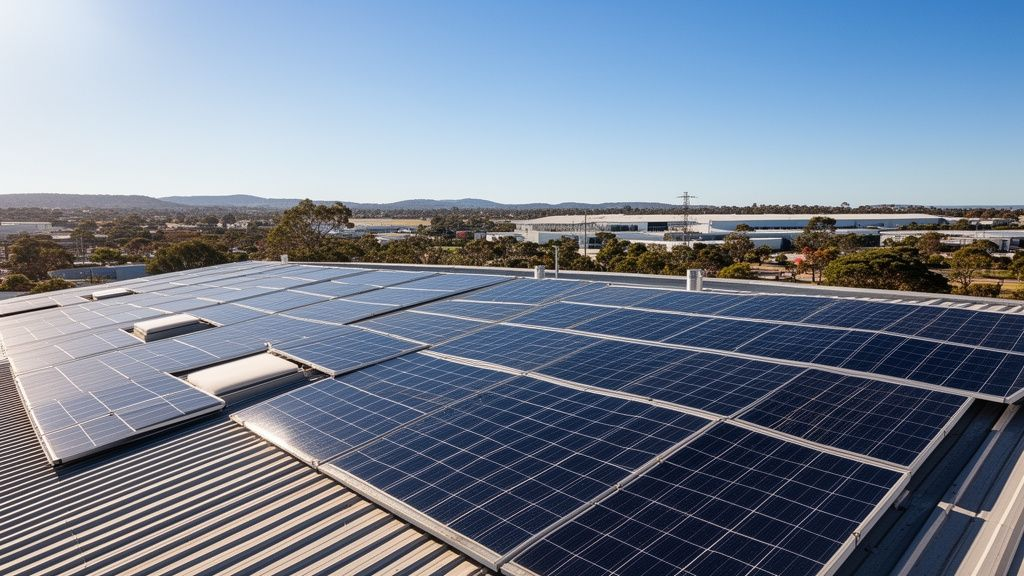
A prime example of this dynamic in action is the Richmond Valley Solar Farm and Battery Energy Storage System (BESS) in the Northern Rivers region of New South Wales. This massive hybrid project, developed by Ark Energy (a subsidiary of Korea Zinc), represents a total investment of $1.3 billion. The project has secured a financial investment decision (FID), drawing on $586 million in equity funding and $716 million in debt financing.
During its peak construction phase, the Richmond Valley project is expected to support over 850 direct and indirect jobs, generating approximately $180 million in local expenditure. Over its operating life, the developer will also maintain a community benefit fund of $850 per installed megawatt (MW) of solar generation, demonstrating how commercial energy investments directly support local regional development.
A Surge of Large-Scale Hybrid Projects Across the Grid
The Richmond Valley development is not an isolated case; it is part of a broader trend of major renewable and battery hybrid projects reaching financial close across Australia's main electricity grids. In July 2026, several other key projects advanced:
- Waroona Renewable Energy Project (Stage 1, WA): Developed by Frontier Energy, this project secured its financial investment decision, combining 132 MW of solar generation with an 81.5 MW, 6.9-hour (565 MWh) battery energy storage system.
- Fraser Coast Project (Queensland): Spanish energy giant Naturgy announced a $500 million financial investment decision for this site, which will combine 290 MW of solar with a 180 MW, two-hour battery storage system located southwest of Maryborough.
- Narrogin Wind Farm (Western Australia): Neoen Australia committed to constructing this 179 MW facility in Western Australia's Wheatbelt region after securing a long-term offtake agreement with state-owned utility Synergy.
- Mokoan Solar Farm (Victoria): European Energy locked in financing with Deutsche Bank to add a utility-scale battery to its operating 58 MW solar farm, improving local grid reliability.
These projects highlight how developers are actively responding to the need for firmed, dispatchable renewable energy. According to the CSIRO's latest GenCost report, renewables remain the absolute lowest-cost way to meet Australia's growing energy needs. Capitalizing on this cost advantage requires transitioning away from older fossil fuel infrastructure.
Policy Coordination and the Gas Transition
As Australia moves toward its net-zero goals, managing the decline of fossil fuels presents complex policy challenges. The Grattan Institute, led by energy experts Tony Wood and Alison Reeve, has highlighted that managing the decline of gas is a significant public policy hurdle, particularly as regional Australia bears the brunt of the transition. Issues surrounding gas reservation schemes and market predictability require careful, coordinated policy action across all levels of government.
Integrating large-scale data centres into the renewable grid via the Flexible Contracting Framework provides a structured pathway to reduce dependence on fossil fuels. By ensuring that new commercial energy demands are met with newly built, low-cost solar, wind, and battery storage, Australia can protect household consumers, lower wholesale prices, and achieve its carbon reduction targets simultaneously.
Key Takeaways
- Growing Grid Strain: Data centres currently use 4 TWh of electricity annually (2% of the NEM), a figure projected to climb to nearly 10% by 2050.
- Economic Risks: Failing to match this demand with new renewable generation could push 2035 wholesale electricity prices up by 26% in NSW and 23% in Victoria, while increasing national emissions by 14%.
- The Flexible Contracting Framework: This CEC framework uses a "glide path" system matching data centre loads with Additional Firmed Renewables (AFRs) and certificates (LGCs and REGOs).
- Substantial Community Value: Integrating commercial demand with regional renewables is projected to generate tens of thousands of jobs and deliver over $200 million in community benefits between 2024 and 2030.
- Proven Low-Cost Strategy: The CSIRO GenCost report confirms that renewables are the cheapest path to meeting national energy demands, supported by $1.3 billion hybrid developments like Ark Energy's Richmond Valley project.
Related Guides
- A Comprehensive Guide to Clean Energy Council Approved PV Modules and Enhanced Listings
- Securing Financial Close: Inside Australia's Surging Utility-Scale Solar and Battery Hybrid Pipeline
- Managing the Grid Glide Path: How the Flexible Contracting Framework Protects Electricity Consumers
- Tracking Australia’s Net-Zero Transition: Public Maps, Policy Debates, and Regional Impacts