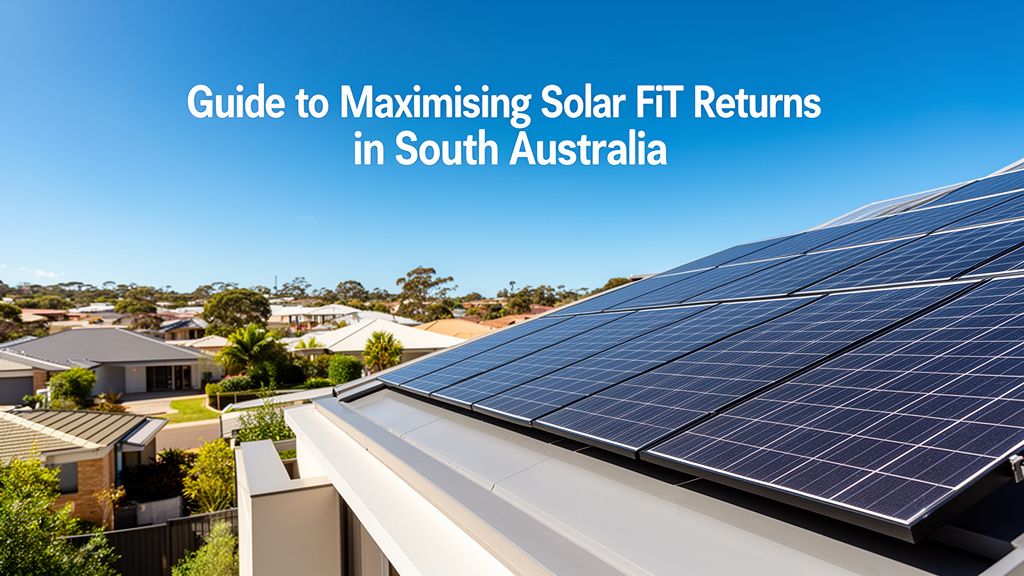
TL;DR: Solar feed-in tariffs (FiTs) in South Australia pay you for surplus electricity exported to the grid, but rates vary significantly between retailers. Maximising your solar returns involves prioritising self-consumption over exporting, strategically comparing retailer offers, and considering battery storage to minimise grid reliance and high energy purchases.
What Are Solar Feed-in Tariffs and How Do They Work in South Australia?
Solar feed-in tariffs (FiTs) are credits you receive for surplus electricity exported from your solar system to the grid, effectively reducing your overall power bill. In South Australia, like most states, the system predominantly operates on a "net" FiT basis for residential customers. This means you only get paid for the electricity your solar panels produce that isn't immediately consumed by your household and is instead sent back into the network. This contrasts with older "gross" FiT schemes which paid for all generated power, regardless of self-consumption, but these are largely phased out for new installations. Retailers in SA are not mandated to offer a minimum FiT, leading to a competitive market where rates can differ significantly. Understanding these rates is crucial because they directly impact the financial payback period of your solar investment.
How does the South Australian solar market influence FiTs?
South Australia boasts one of the highest penetrations of rooftop solar in the world, which significantly influences the dynamics of feed-in tariffs. With so much solar generation feeding into the grid, particularly during the middle of the day, wholesale electricity prices can sometimes drop, even into negative territory. This abundance of solar power can reduce the incentive for retailers to offer high FiT rates, as they can source power cheaply (or even for free) during these peak solar production times. Consequently, SA retailers tend to offer a wide range of FiTs, often influenced by their broader pricing strategies, grid stability considerations, and their own wholesale market positions. This makes it essential for homeowners to shop around and compare.
What's the difference between net and gross FiTs in SA?
The primary distinction between net and gross feed-in tariffs lies in how the exported electricity is measured and credited. A net FiT, which is the standard for most new residential solar systems in South Australia, credits you only for the excess electricity your home doesn't use that is then exported to the grid. For instance, if your solar system generates 5kWh and your home uses 3kWh, you're credited for the 2kWh exported. Conversely, a gross FiT would credit you for all 5kWh generated, regardless of your home's consumption, with your household then purchasing all its needed power from the grid. Gross FiT schemes were once more common but have largely been replaced by net FiTs, which incentivise self-consumption as the most economical use of your solar power.
How Do Retailers Determine South Australian Feed-in Tariff Rates?
South Australian retailers set their own feed-in tariff rates, leading to significant variations in how much you get paid for your exported solar power. Unlike some other states which might have a government-mandated minimum FiT, SA operates in a deregulated market, giving electricity providers the autonomy to craft their offers based on various commercial factors. These factors include the wholesale price of electricity, their operating costs, their desire to attract and retain solar customers, and the specific terms of their retail electricity plans. Some retailers might offer a higher FiT in conjunction with higher usage rates, while others might provide a lower, more stable FiT across all their plans. This competitive landscape means that what looks like a great FiT rate in isolation might not translate to the best overall bill once all charges are factored in.
Can different electricity plans affect my FiT rate in SA?
Yes, the specific electricity plan you choose can significantly impact the feed-in tariff rate you receive in South Australia. Many retailers offer a range of plans, and often, higher FiT rates are bundled with specific conditions. For example, a plan might offer a premium FiT of, say, 10-12c/kWh, but it could come with higher daily supply charges or more expensive peak usage rates for electricity imported from the grid. Other plans might offer a lower, fixed FiT (e.g., 5-8c/kWh) but have more competitive overall usage rates. It's crucial to consider your household's unique energy consumption patterns – how much you use, and when – when evaluating plans. A high FiT might not be the most financially beneficial if your household primarily consumes power during peak evening hours when your solar isn't generating.
What is the typical range for FiT rates in SA today?
In South Australia today, the typical range for residential solar feed-in tariff rates generally falls between 5 cents and 15 cents per kilowatt-hour (c/kWh). This range can fluctuate based on the retailer, the specific electricity plan chosen, and market conditions. Some competitive offers might occasionally push slightly higher, especially as a promotional incentive, while others sit at the lower end. It's important to remember that these rates are not static and can be updated by retailers, usually with prior notice. While a higher FiT rate is appealing, it's essential to compare it within the context of the entire electricity bill, including the cost of grid power you do import and any fixed daily supply charges, to truly determine the best value for your household.
What Strategies Can South Australian Homeowners Use to Maximise Their Solar Returns Beyond FiTs?
Maximising solar returns in South Australia involves strategic energy consumption and storage, moving beyond solely relying on feed-in tariffs to reduce your electricity bills. Given that the cost of electricity imported from the grid (e.g., 30-45c/kWh) is often several times higher than the FiT you receive for exported power (e.g., 5-15c/kWh), the most effective strategy is to self-consume as much of your generated solar power as possible. This means aligning your household's energy usage with your solar system's production hours, typically during the middle of the day. Shifting appliance usage, like running dishwashers, washing machines, or pool pumps during daylight hours, directly reduces the amount of expensive grid power you need to purchase, significantly boosting your savings.
How does self-consumption increase your solar savings in SA?
Self-consumption directly increases your solar savings in South Australia by allowing you to use your own free, generated electricity instead of buying more expensive power from the grid. Every kilowatt-hour (kWh) of solar electricity you consume directly from your rooftop system during the day is a kWh you don't have to purchase from your retailer at their much higher import rates. For example, if you export power for 8c/kWh but buy power for 35c/kWh, using your own power saves you the full 35c/kWh, which is significantly more valuable than the 8c/kWh you would have received for exporting it. This simple shift in energy use habits transforms exported power credits into direct savings on your most costly energy purchases, accelerating your return on investment.
Is investing in a home battery system worthwhile for boosting SA solar returns?
Investing in a home battery system can be a highly effective strategy for boosting South Australian solar returns, particularly by further optimising self-consumption and leveraging time-of-use (TOU) tariffs. A battery allows you to store surplus solar power generated during the day – which would otherwise be exported for a low FiT – and use it during the evening peak periods when grid electricity is most expensive. This effectively extends your self-consumption capabilities beyond daylight hours. While the upfront cost of a battery, typically $8,000 to $15,000+ for a 10-13 kWh system, is substantial, it can significantly reduce your reliance on the grid, especially for households with high evening energy demand or those on TOU plans where peak rates can reach 50c/kWh or more.
How Can You Choose the Best Electricity Retailer and FiT for Your SA Home?
Selecting the optimal electricity retailer and feed-in tariff in South Australia requires comparing offers based on your household's unique energy profile and solar export habits, not just the advertised FiT rate. While a high FiT might catch your eye, it’s crucial to evaluate the entire electricity plan, including the usage rates for grid power you consume, daily supply charges, and any contract terms. A plan with a lower FiT but competitive import rates and minimal daily fees could result in greater overall savings, especially if your household has high evening consumption or doesn't export a significant amount of surplus solar. Utilising government comparison websites like Energy Made Easy and understanding your historical energy usage will empower you to make an informed decision.
What key factors should you compare when looking at SA electricity plans?
When comparing South Australian electricity plans for your solar-equipped home, you should look beyond just the feed-in tariff rate. Key factors include the total annual estimated bill, which is the most holistic measure. Break this down further by comparing the import usage rates (e.g., peak, off-peak, shoulder rates), the daily supply charge, and the export FiT rate. Also consider any conditional discounts, such as pay-on-time offers or direct debit incentives, and whether these are sustainable for your household. Check for contract lengths, exit fees, and any solar-specific terms or conditions that might apply. A higher FiT could be offset by higher import rates or daily charges, so a comprehensive analysis is always necessary.
How often should SA residents review their solar electricity plan?
South Australian residents with solar systems should aim to review their electricity plan at least once a year, or whenever significant changes occur in their household's energy usage or the market. Retailers frequently introduce new plans, adjust rates, or offer special promotions, making annual comparisons worthwhile. Additionally, if your household's energy consumption patterns change significantly – for example, due to a new appliance, an electric vehicle, or changes in family routines – your current plan might no longer be the most economical. Proactively checking comparison sites and reviewing your bill against market offers ensures you're always on the most cost-effective plan for your unique solar and consumption profile.
Key Takeaways
- Prioritise self-consumption of your solar power over exporting it, as buying grid power is almost always more expensive than the FiT you receive.
- Compare full electricity plans, not just FiT rates, considering import charges, daily supply fees, and the estimated total annual bill.
- Regularly review your electricity plan (at least annually) using comparison sites to ensure you're on the best deal for your household and solar system.
- Consider a home battery if you have high evening energy consumption or are on time-of-use tariffs to maximise solar self-sufficiency and reduce peak grid purchases.
- Understand your household's unique energy usage patterns to select a plan that aligns with how and when you consume and export power.
Read More
For a comprehensive overview, check out our master guide: Read the Full Guide Here.