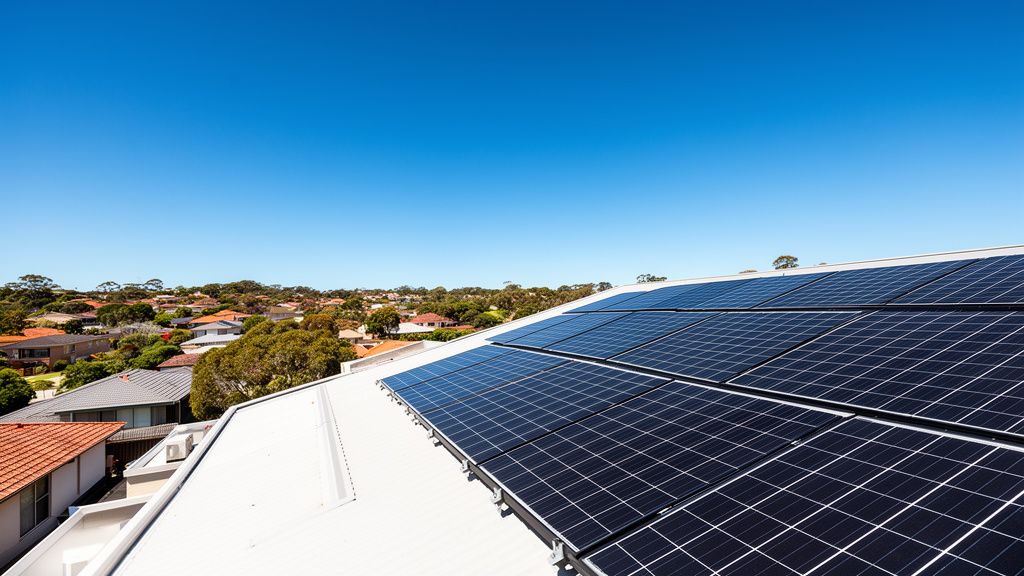
TL;DR: Researchers at Kyushu University have developed a groundbreaking tandem solar cell technology that significantly boosts energy conversion efficiency by capturing a wider spectrum of sunlight and minimising energy loss. This innovation promises to make solar power even more cost-effective and accessible, potentially accelerating Australia's transition to renewable energy.
What is Kyushu University's latest solar breakthrough?
Kyushu University's recent breakthrough involves the development of a highly efficient tandem solar cell that integrates multiple light-absorbing layers to capture more of the sun's energy. Traditional silicon solar panels typically convert around 18-22% of sunlight into electricity, primarily because silicon is most efficient at absorbing certain wavelengths of light, while others – like high-energy blue light or lower-energy infrared – are either lost or less efficiently utilised. The Japanese researchers have tackled this limitation by layering different photovoltaic materials, each tuned to absorb a specific part of the solar spectrum, effectively creating a more comprehensive "net" for sunlight. This multi-layered approach allows the cell to harvest a broader range of photons, pushing the boundaries of theoretical efficiency.
The challenge of traditional solar panels
Standard monocrystalline silicon solar panels, while robust and widely adopted across Australia, face inherent limitations in their ability to convert the full spectrum of sunlight into electricity. Silicon primarily excels at absorbing light in the visible and near-infrared spectrum. High-energy photons (like those in ultraviolet light) carry excess energy that is often lost as heat, while low-energy photons (deep infrared) simply pass through the silicon without being absorbed. This spectral mismatch means a significant portion of the solar energy hitting your roof in Perth or Brisbane is currently going unharnessed, limiting the overall output of your system.
How the new method captures more light
The Kyushu University team's innovation lies in its clever use of materials that complement silicon. While specifics of the proprietary materials are under wraps, the principle is to stack a perovskite-based cell on top of a traditional silicon cell. Perovskite materials are particularly good at absorbing high-energy visible and blue light, which silicon struggles with. By doing so, the perovskite layer converts these high-energy photons into electricity, while the silicon layer beneath it efficiently handles the lower-energy red and infrared light that passes through the perovskite. This "tandem" architecture ensures almost all incoming sunlight, from high-energy to low-energy wavelengths, is put to work, leading to a substantial leap in overall efficiency.
How does this breakthrough enhance solar panel efficiency?
This breakthrough significantly enhances solar panel efficiency by tackling two primary challenges: incomplete light spectrum absorption and energy loss through electron-hole recombination. By using a tandem cell design, the researchers have managed to increase the overall energy conversion rate, meaning more electricity can be generated from the same amount of sunlight hitting a panel. This is a critical step towards achieving the theoretical maximum efficiency for solar cells, moving beyond the inherent limitations of single-junction silicon technology. For Australian homeowners, this translates directly to more power from fewer panels or a smaller roof footprint.
Minimising energy loss within the cells
One of the major hurdles in solar cell design is energy loss due to what's known as "electron-hole recombination." When sunlight hits a solar cell, it excites electrons, creating an electrical current. However, if these excited electrons recombine with their "holes" (the absence of an electron), that energy is lost as heat instead of being converted into electricity. Kyushu University's new design reportedly incorporates advanced interface engineering and material compositions that significantly reduce these recombination rates. This means more of the electrons generated by sunlight are successfully harvested as electrical current, boosting the cell's output even under typical Australian sunlight conditions.
Harnessing a broader light spectrum
The tandem cell approach is inherently superior at harnessing a broader light spectrum. Imagine sunlight as a rainbow of colours, each with different energy levels. A traditional silicon panel is excellent at absorbing the "green" and "red" parts of the rainbow but lets much of the "blue" and "infrared" pass through. The Kyushu breakthrough adds a top cell (likely perovskite-based) specifically engineered to absorb these "blue" and higher-energy photons. The light that passes through this top layer (the "red" and "infrared") is then efficiently absorbed by the silicon bottom layer. This multi-spectral absorption ensures that a far greater percentage of the entire solar spectrum is captured and converted, pushing efficiencies potentially towards the 30% mark in laboratory settings.
What are the potential impacts of this technology on Australian homes and businesses?
The potential impacts of this advanced solar technology on Australian homes and businesses are substantial, promising to make solar power even more attractive and accessible. With higher efficiency, homeowners could generate the same amount of electricity with fewer panels, reducing installation costs and making solar viable for smaller roof spaces. Businesses with high energy demands and large roof areas could see drastically reduced electricity bills, freeing up capital for growth. This technology could also ease grid strain during peak demand by providing more decentralised generation, especially in states like Queensland and NSW where solar penetration is already high.
Driving down the cost of solar energy
While the initial manufacturing costs of new, advanced solar cells can sometimes be higher, the increased efficiency of Kyushu University's breakthrough promises to drive down the levelised cost of electricity (LCOE) over time. If a panel can generate 25-30% more power than current models for a similar footprint, it means you need fewer panels to achieve your desired output. For example, a typical 6.6kW system might currently require 20-22 panels. With 25% more efficient panels, you might only need 15-16 panels to achieve the same output, reducing labour, mounting hardware, and potentially balance-of-system costs. This would make the total upfront investment for a high-output system more palatable for many Aussie households, currently ranging from $6,000 to $10,000 after STCs for a 6.6kW system.


Accelerating payback periods for Aussie households
Faster energy generation directly translates to accelerated payback periods for Australian households. If your solar system produces more electricity, you export more to the grid (earning feed-in tariffs around 5-15 cents/kWh in most states) and import less from your retailer (avoiding costs of 25-35 cents/kWh). With a significant efficiency boost, a system that might currently pay for itself in 4-6 years could see that period drop to 3-4 years or even less. This quicker return on investment makes solar an even more compelling financial decision, allowing homeowners to enjoy free electricity sooner and for longer, significantly reducing overall household expenses in the long run.
When can we expect to see this advanced solar technology in the Australian market?
While lab breakthroughs are incredibly exciting, the journey from a university lab to Australian rooftops typically takes several years due to rigorous testing, scaling manufacturing, and commercialisation efforts. It's unlikely we'll see these exact panels available in Bunnings or through your local installer next year. However, the underlying technology, particularly the principles of tandem cells and improved recombination reduction, will influence the next generation of commercially available panels. We might realistically expect to see early commercial versions hitting global markets in 3-5 years, with broader adoption in Australia likely within 5-7 years, as manufacturing ramps up and costs become competitive.
The journey from lab to rooftop
The path from a scientific discovery in a laboratory to a mass-produced product on an Australian roof is a multi-stage process. First, the laboratory prototype needs to be perfected for stability and durability under various real-world conditions, including Australia's harsh UV and high temperatures. Then comes the challenge of scaling up manufacturing processes from small experimental cells to large, cost-effective production lines. This involves significant investment and optimisation. Finally, the product needs to undergo extensive certification processes to meet Australian and international safety and performance standards, ensuring it's reliable and safe for consumer use before it can be widely installed.
Overcoming commercialisation hurdles
Commercialisation hurdles are substantial. Beyond the technical challenges of manufacturing at scale, there are economic factors. Producing these advanced materials and multi-layered cells initially costs more than existing silicon panels. Companies need to find ways to reduce these production costs to make the technology competitive. Furthermore, securing patents, attracting investors, and building a robust supply chain are all critical steps. Education for installers and consumers will also be necessary to ensure market acceptance. However, with the increasing global demand for higher efficiency and lower cost solar, there is a strong incentive for companies to overcome these hurdles and bring such groundbreaking technology to market.
Key Takeaways
- Kyushu University's breakthrough involves highly efficient tandem solar cells that capture a broader spectrum of sunlight.
- The new technology improves efficiency by layering different materials (e.g., perovskite over silicon) and minimising electron recombination losses.
- For Australian homes and businesses, this could mean significantly higher energy output from the same or smaller roof space, leading to lower energy bills.
- Increased efficiency will likely drive down the levelised cost of electricity and accelerate payback periods for solar investments.
- While the technology is still in the lab stage, commercial availability in Australia could be 5-7 years away, influenced by manufacturing scale-up and cost reductions.
Read More
For a comprehensive overview, check out our master guide: Read the Full Guide Here.


