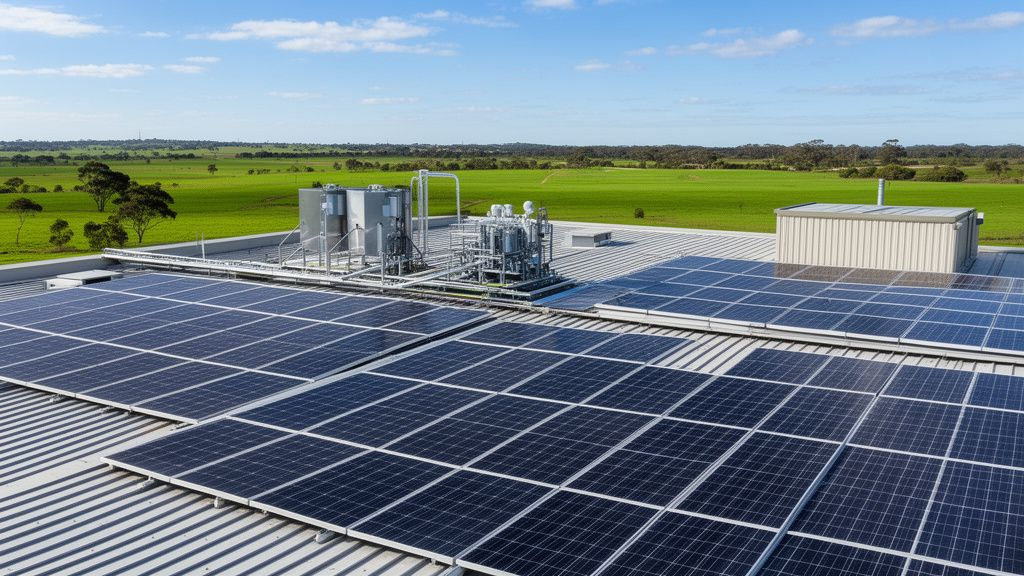
TL;DR: Rising global fertiliser and fuel prices, driven by international supply chain disruptions, have prompted Australian farmers to look to wind and solar as critical lifelines. By hosting renewable energy projects and manufacturing home-grown green hydrogen and ammonia, regional communities are turning global energy shocks into localized economic opportunities.
Australian agriculture has entered a period of profound transformation, driven by an unlikely combination of international geopolitical conflicts and local renewable energy innovation. At the center of this shift is a growing movement among regional farmers to integrate wind, solar, and battery storage directly into their agricultural operations. Rather than acting as passive hosts for projects that export electricity to urban centers, regional landholders are leveraging clean energy to produce home-grown resources like green hydrogen and green ammonia, asserting their independence from highly volatile global supply chains.
The Catalyst: Global Geopolitics and Doubled Fertiliser Prices
The immediate driver of this regional transition lies in international events. US President Donald Trump’s administration’s policies concerning Iran and the subsequent closure of the strategic Strait of Hormuz created severe shocks in global energy markets, leading to sharp surges in international petrol and diesel prices. While the impact on fuel was widely reported, the consequences for the global fertiliser market were even more severe for the agricultural sector.
For Australian farmers, who are heavily dependent on imported inputs, fertiliser prices doubled in a very short period. This dramatic cost increase forced many to re-evaluate their reliance on fragile international supply chains. Monica Morona, a farmer operating on the Hay Plains in south-west New South Wales, summarized the situation at the Australian Renewables in Agriculture Conference in Orange. She pointed out that consecutive global crises, including conflicts in Ukraine and Iran, proved that supply chain disruptions are persistent issues that require local, long-term structural solutions.
Regional Lifelines: The Renewables in Agriculture Conference
The conference in Orange, which drew more than 400 delegates, highlighted a sharp disconnect between mainstream media narratives of rural opposition to renewables and the reality on the ground. For many landholders, hosting wind, solar, and battery facilities has become a financial lifeline, particularly for properties heavily affected by climate change and persistent droughts.


In the New England Renewable Energy Zone (REZ) in New South Wales, local support for the energy transition is remarkably high. The mayor of Armidale, located at the center of this contested zone, noted that approximately 80 percent of local residents support the transition. However, local leaders have expressed a strong desire for renewable energy developers to do more to actively combat misinformation and demonstrate the direct, tangible benefits that these projects can bring to the surrounding communities.
Leading the Charge: GEGHA and Riverina Projects
The practical application of these agricultural renewable concepts is already underway through major regional projects. In the Gwydir Valley near Moree, the Good Earth Green Hydrogen and Ammonia (GEGHA) pilot project is being developed at Sundown Pastoral. The GEGHA facility is designed to utilize local solar and wind resources to produce approximately 4,500 tonnes of low-carbon anhydrous ammonia (NH3) annually, demonstrating the feasibility of local, green chemical manufacturing.
Looking to scale this model, Monica Morona is working to establish a much larger commercial-scale project named Riverina Renewable Hydrogen. This ambitious project aims to produce approximately 40,000 tonnes of green anhydrous ammonia (NH3) per year. By manufacturing fertilisers locally using regional wind and solar power, these initiatives aim to provide farmers with a stable, cost-effective, and low-carbon alternative to imported products, insulating the domestic agricultural sector from international market shocks.
Key Takeaways
- Fertiliser Cost Crises: Geopolitical events and shipping disruptions in the Strait of Hormuz caused global fertiliser prices to double, sparking a push for local energy independence.
- Farms as Energy Hubs: Regional landholders are shifting from hosting energy projects for metropolitan export to developing local green hydrogen and green ammonia facilities.
- High Local Support: Despite negative media narratives, local support for renewables in key zones like Armidale stands at approximately 80%, with many viewing these projects as financial lifelines.
- Pioneering Local Plants: Projects like the GEGHA pilot (4,500 tonnes NH3) and the Riverina Renewable Hydrogen project (40,000 tonnes NH3) lead the path toward clean agricultural chemical production.


