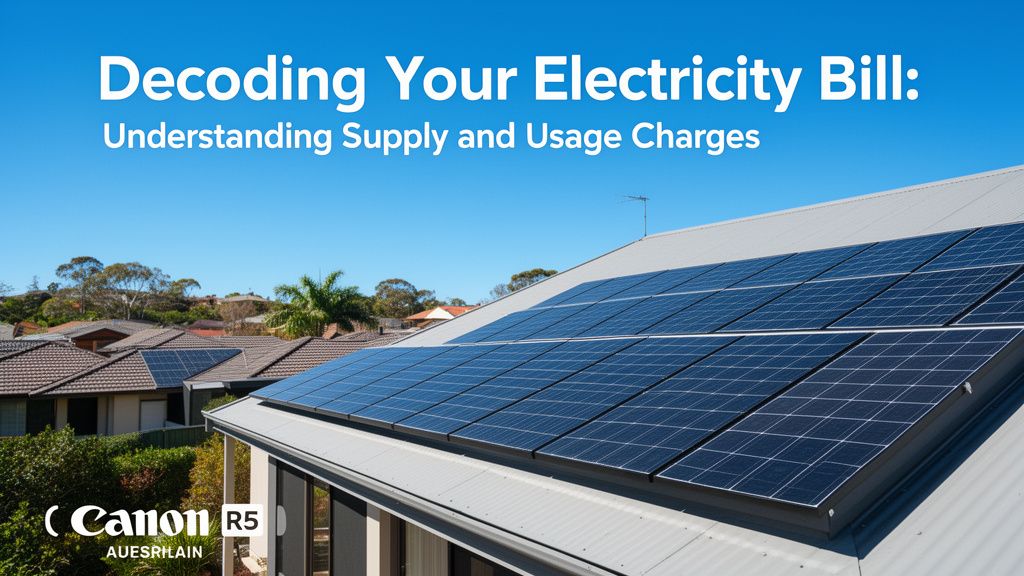
Decoding Your Electricity Bill: Understanding Supply and Usage Charges
The electricity bill can often feel like a perplexing mystery. For Australian homeowners, especially those with solar power, truly understanding this document is vital. It’s not just about avoiding a nasty shock; it’s about managing your energy usage, maximising your solar investment, and saving money. At its core, your bill has two main components: the supply charge and the usage charge. Let's decode them.
The Elusive Supply Charge
Imagine your home connected to a vast network of poles and wires, delivering power to your doorstep. This infrastructure requires constant maintenance and upgrades. The supply charge covers this. Also known as a 'daily service charge' or 'fixed daily charge', it’s a non-negotiable fee for being connected to the electricity grid.
You pay this daily, regardless of how much electricity you consume. Even if your solar panels produce every kWh your home uses, you’ll still see this charge. In Australia, supply charges typically range from 80 cents to $1.20 per day, varying by retailer and region. Over a 90-day cycle, this can easily add up to $72-$108 before you’ve used any power. It covers grid maintenance, meter reading, and administration. When comparing plans, always check the daily supply charge, as a lower rate can significantly impact your overall bill.
Unpacking the Usage Charge (Consumption)
If the supply charge is the 'rent' for your connection, the usage charge is what you pay for the actual 'goods' – the electricity itself. This variable component is directly tied to how much electricity your household consumes, measured in kilowatt-hours (kWh). One kWh powers a 1000-watt appliance for one hour.
In Australia, the cost per kWh typically ranges from 25 cents to 40 cents, depending on your location, retailer, and plan. This is where your solar system makes its biggest impact: every kWh you generate and use yourself means one less kWh you buy from the grid.
Usage charges aren't always a flat rate. Many plans feature different structures:
- Single Rate (Flat Rate): The same price per kWh, regardless of when you use electricity.
- Time-of-Use (ToU): Common with smart meters. Prices vary by time of day:
- Peak: Highest rates (e.g., 4 pm – 9 pm) when demand is highest.
- Shoulder: Moderate rates (e.g., 7 am – 4 pm and 9 pm – 10 pm).
- Off-peak: Lowest rates (e.g., 10 pm – 7 am) when demand is lowest.
- Controlled Load: A separate, cheaper rate for specific, high-consumption appliances like hot water systems or pool pumps, often connected to a separate meter.
Understanding your usage patterns and these tariffs is key to optimising your electricity spend.
The Solar Angle: How Your System Impacts These Charges

For solar owners, these charges have distinct implications. Your solar panels directly influence the usage charge, but have minimal impact on the supply charge.
- Supply Charge: Unaffected. You're still connected to the grid, so you pay the daily fee. This explains why your bill isn't zero, even with high solar generation.
- Usage Charge: This is where solar shines! Every kWh your system produces and your household immediately uses (self-consumption) is a kWh you don't have to buy from the grid. If your ToU peak rate is 35 cents/kWh, and you self-consume a kWh during peak hours, you effectively save 35 cents. This is often far more valuable than the feed-in tariff (FiT) you receive for exporting that same kWh (typically 5-10 cents/kWh).
Maximising self-consumption is crucial. Shift energy-intensive activities (dishwasher, washing machine) to daylight hours. Adding battery storage can further enhance this, storing excess solar for use during peak evening hours, dramatically reducing grid reliance and cutting usage charges.
Other Charges and Credits
Beyond supply and usage, your bill might include:
- GST: A 10% Goods and Services Tax on most charges.
- Concessions/Rebates: Government-provided discounts if eligible.
- Green Power: If you've opted for accredited renewable energy.
- Late Payment Fees: Avoidable if you pay on time.
Empowering Yourself: Tips for Decoding and Saving
Armed with this knowledge, you can take control:
- Review Your Bill Regularly: Don't just pay. Examine usage graphs, daily supply charges, and kWh rates.
- Understand Consumption: Identify when you use the most electricity using historical data.
- Compare Retailers: Use EnergyMadeEasy.gov.au. Focus on daily supply charges, kWh rates (especially peak ToU), and feed-in tariffs.
- Maximise Self-Consumption: Run appliances during the day to use your solar directly.
- Consider Energy Efficiency: Upgrade to efficient appliances to reduce overall kWh consumption.
Conclusion
Your electricity bill is a powerful tool. By understanding the fixed daily supply charge and the variable usage charge, you gain clarity on where your money goes. For Australian solar homeowners, this is crucial. It allows you to strategically leverage your solar investment, minimise reliance on expensive peak grid power, and maximise the financial and environmental benefits of your system. Don't let your next bill be a mystery; decode it and empower your energy future.
Read More
For a comprehensive overview, check out our master guide: Read the Full Guide Here.