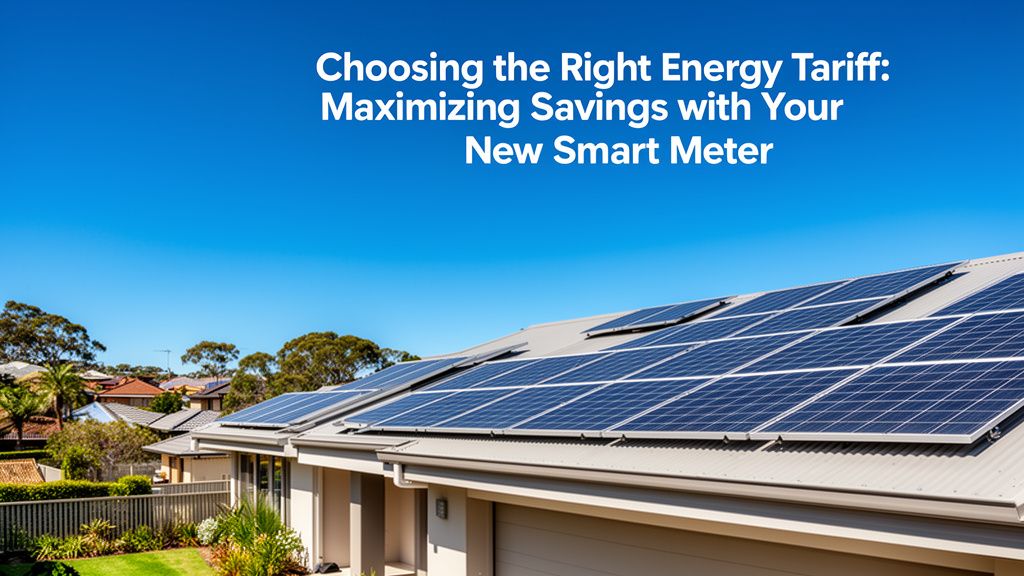
So, you’ve joined the solar revolution – congratulations! Tapping into Australia’s abundant sunshine is not only great for the planet but also fantastic for your wallet. And with your shiny new smart meter installed, you're now holding the keys to unlock even greater savings on your electricity bill. But here's the kicker: having a smart meter isn't enough on its own. To truly maximise your solar investment, you need to pair it with the right energy tariff.
For many Aussie households, navigating the world of electricity tariffs can feel like deciphering ancient hieroglyphs. There are so many options, so many numbers, and it's easy to stick with what you know. But with your smart meter providing real-time data on your energy usage and solar exports, you have an unprecedented opportunity to tailor your plan and make your solar system work harder for you. Let’s dive in and explore how to choose the perfect energy tariff to keep more dollars in your pocket.
The Power of Your Smart Meter
First, let's appreciate what makes your smart meter so, well, smart. Unlike old-school meters that only recorded total consumption, your smart meter continuously measures your electricity usage and solar exports, sending that data directly to your energy retailer. This means no more estimated bills, and more importantly, it enables time-based billing. You can see exactly when you’re using electricity, when your solar is generating, and when you’re exporting surplus power back to the grid. This detailed insight is the foundation for tariff optimisation.
Understanding Australian Energy Tariffs for Solar Households
Australia’s energy market offers several tariff structures. Knowing the pros and cons of each, especially with your solar setup, is crucial.
Flat Rate (Single Rate) Tariff
This is the simplest tariff: you pay the same price per kilowatt-hour (kWh) for your electricity usage, no matter what time of day you consume it. Your feed-in tariff (FiT) for exported solar might also be a flat rate.
- Pros: Predictable, easy to understand.
- Cons: Doesn't reward you for shifting your energy use to capitalise on cheaper periods or higher solar generation. You might miss out on significant savings.
Time-of-Use (TOU) Tariff
This is where smart meters truly shine. With a TOU tariff, electricity prices vary depending on the time of day, week, and sometimes even season. Typically, you'll see:
-
Peak Rates: The most expensive times, usually late afternoon/evening (e.g., 4 PM - 8 PM), when demand is highest.
-
Shoulder Rates: Medium-priced periods, often before and after peak (e.g., 7 AM - 4 PM, 8 PM - 10 PM), and sometimes all day on weekends.
-
Off-Peak Rates: The cheapest times, usually overnight (e.g., 10 PM - 7 AM), when demand is lowest.
-
Pros: Can lead to significant savings if you can shift your major appliance usage (dishwasher, washing machine, charging EVs) to off-peak or shoulder periods when your solar is generating.
-
Cons: Requires more active management of your energy use; high usage during peak times can be very costly.
Controlled Load Tariff
This is a separate circuit on your meter for specific high-energy appliances like electric hot water systems, underfloor heating, or pool pumps. These appliances typically run during off-peak hours at a lower, flat rate.
- Pros: Very cheap for dedicated appliances.
- Cons: Not always available for all appliances or in all areas.
Feed-in Tariffs (FiT)
This is how much your retailer pays you for every kWh of surplus solar power you export to the grid. FiTs vary widely between retailers and states, typically ranging from $0.05 to $0.15 per kWh. Some retailers may offer a higher FiT for the first few kWh exported daily, or even TOU FiTs (where you get more for exporting during peak demand periods, though these are less common).
Matching Your Lifestyle to Your Tariff
The "best" tariff isn't universal; it depends entirely on your household's energy habits and solar system size.
- Are you home during the day? If you work from home or are retired, you have an excellent opportunity to maximise self-consumption of your solar power. A TOU tariff could be ideal, allowing you to run appliances during shoulder periods when your solar is generating.
- Do you have a home battery? A battery system significantly enhances your flexibility. You can charge it with solar during the day, or even from the grid during off-peak times, and then discharge it during peak periods, drastically reducing your reliance on expensive grid power. A TOU tariff is almost always the smart choice for battery owners.
- High evening usage? If your family uses a lot of power in the evenings (cooking, TV, air conditioning) and you don’t have a battery, a flat rate might actually work better to avoid sky-high peak charges. Or, you’ll need to commit to making significant changes to your energy habits.
- Pool pump or electric hot water? Ensure these are running during your solar generation hours or during off-peak times if they’re on a controlled load circuit.
The Nitty-Gritty: What to Look For and How to Compare
When comparing tariffs, don't just look at the headline FiT. Dig into the details:
- Daily Supply Charge: This is a fixed daily fee, regardless of your usage. It can vary significantly between retailers.
- Usage Charges (c/kWh): Compare the peak, shoulder, and off-peak rates for TOU tariffs, or the single rate for flat tariffs.
- Feed-in Tariff (c/kWh): How much you get paid for your exported solar. Remember, a higher FiT might come with higher usage charges or a higher daily supply charge. You need to consider the whole package.
- Discounts: Are they conditional (e.g., pay on time, direct debit) or unconditional? Always factor in the actual discounted rates.
- Contract Length & Exit Fees: Understand the terms before signing up.
Use Comparison Websites!
The Australian federal government’s Energy Made Easy website is a fantastic, unbiased tool to compare electricity offers in your area. Many states also have their own comparison sites (e.g., Victorian Energy Compare). Input your estimated usage and solar export data (which you can get from your smart meter portal or previous bills) to get personalised comparisons.
Practical Tips for Optimising Your Solar & Smart Meter
- Monitor Your Data: Regularly check your smart meter data via your retailer's app or web portal. Understand your consumption patterns.
- Shift Your Habits: Program your dishwasher, washing machine, and pool pump to run during solar production hours or off-peak times.
- Maximise Self-Consumption: Use high-energy appliances like ovens, air conditioners, or electric vehicle chargers during the day when your solar is generating. Every kWh you use directly from your solar is a kWh you don't buy from the grid, saving you more than you’d earn from exporting.
- Consider a Battery: If your budget allows, a home battery can supercharge your savings, especially on a TOU tariff.
- Review Annually: Energy prices and tariffs change. Make it a habit to review your tariff at least once a year to ensure you're still on the best plan for your evolving needs.
Common Pitfalls to Avoid
- Sticking with the status quo: Don't assume your old tariff is still the best. New tariffs are constantly emerging.
- Ignoring your smart meter data: The data is there to empower you; use it!
- Only focusing on FiT: A high FiT might sound appealing, but if it comes with exorbitant daily supply charges or peak rates you can't avoid, you could end up paying more overall.
Maximising Your Solar Investment
Your new smart meter is more than just a fancy gadget; it’s a powerful tool for taking control of your energy costs. By understanding the different tariff options and actively monitoring your energy patterns, you can make an informed decision that truly maximises the financial benefits of your solar system. Don't leave money on the table – explore your options, compare, and switch to a tariff that aligns perfectly with your solar-powered lifestyle. Your wallet (and the planet) will thank you!
Read More
For a comprehensive overview, check out our master guide: Read the Full Guide Here.