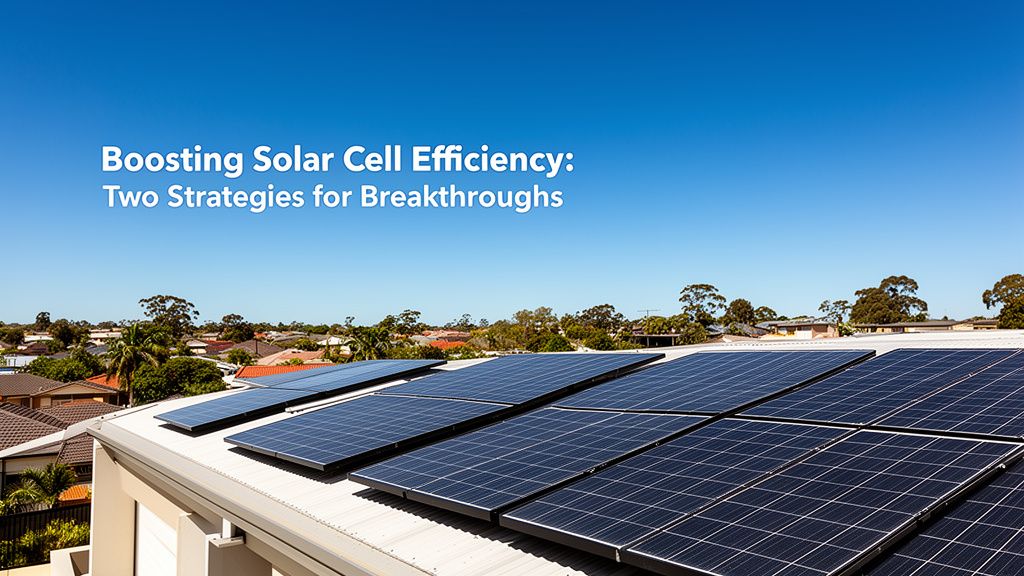
TL;DR: Boosting solar cell efficiency primarily relies on two key strategies: incrementally enhancing established silicon technology through advanced cell designs like PERC and TOPCon, and pursuing revolutionary breakthroughs with novel materials and architectures such as perovskite-silicon tandem cells. Both approaches aim to maximise electricity generation per square metre, reducing costs and accelerating Australia's transition to clean energy.
How Are Conventional Silicon Solar Cells Being Made More Efficient?
Conventional silicon solar cells are being made more efficient through continuous improvements in cell architecture, material science, and manufacturing processes, squeezing every last photon's energy out of the established technology. For decades, the workhorse of the solar industry has been the silicon wafer, and engineers across Australia and the globe are constantly finding clever ways to enhance its performance without completely reinvention. These incremental gains, often measured in fractions of a percentage point, accumulate over time to deliver significantly more power from the same roof space, making solar an even more compelling investment for Aussie homeowners facing rising power bills. Even a 1% efficiency boost means a 6.6kW system generates an extra 66 watts under optimal conditions, translating to tangible savings over its 25-year lifespan.
What is Passivated Emitter Rear Cell (PERC) Technology?
Passivated Emitter Rear Cell (PERC) technology is a key incremental innovation that significantly improved silicon cell efficiency by better utilising sunlight that passes through the silicon without being absorbed. Traditional solar cells absorb light on the front surface, but some photons pass straight through the silicon, going to waste. PERC cells add a dielectric passivation layer on the rear surface, which reflects these unabsorbed photons back into the silicon cell, giving them a second chance to be converted into electricity. This rear-surface reflection boosts overall efficiency, typically adding 1-2% to a standard cell's output. For an average Australian family's 6.6kW system, upgrading from standard cells to PERC could mean an additional $50-$100 in annual savings, depending on your feed-in tariff and electricity usage.
How Do TOPCon and Heterojunction (HJT) Further Improve Silicon?
TOPCon (Tunnel Oxide Passivated Contact) and Heterojunction (HJT) technologies represent the next evolution in high-efficiency silicon cells, building on and surpassing PERC's capabilities. TOPCon cells enhance the passivation layer with a thin tunnel oxide and polysilicon layer, drastically reducing recombination losses at the rear contact, where electrons and holes can recombine instead of flowing as current. This can push efficiency beyond 23-24%. HJT cells, on the other hand, combine crystalline silicon with layers of amorphous (non-crystalline) silicon, creating a superior interface that minimises electron losses and operates exceptionally well at higher temperatures – a significant advantage under the scorching Australian sun. Both TOPCon and HJT are more complex to manufacture than PERC, but their superior performance translates into smaller system footprints or higher outputs from existing roof space, offering better value for money despite a slightly higher upfront cost, perhaps an extra $500-$1,000 for a typical residential system, which quickly pays itself back through increased generation.
What Revolutionary Technologies Are Pushing Solar Efficiency Beyond Silicon's Limits?
Revolutionary technologies are pushing solar efficiency beyond silicon's theoretical limits primarily through the development of multi-junction and tandem cells, most notably combining silicon with cutting-edge materials like perovskites. While silicon is excellent at converting certain parts of the solar spectrum into electricity, it's not perfect across the entire range. These advanced approaches aim to capture a broader spectrum of light by layering different materials, each optimised to convert specific wavelengths, thereby significantly increasing the overall energy harvested from the sun. This opens up the possibility of breaking the ~29% theoretical efficiency limit of single-junction silicon cells, potentially reaching into the mid-30s or even 40s in the lab, paving the way for significantly cheaper clean energy for all Aussies in the future.


Why Are Perovskite-Silicon Tandem Cells Considered a Game-Changer?
Perovskite-silicon tandem cells are considered a game-changer because they combine the strengths of two different materials to capture a much wider spectrum of sunlight than either can achieve alone. Silicon is great at absorbing red and infrared light, but less efficient with blue and green light. Perovskites, a class of synthetic materials, excel at absorbing blue and green light. By layering a thin perovskite cell on top of a conventional silicon cell, the perovskite layer absorbs the high-energy blue and green photons, letting the lower-energy red and infrared photons pass through to the silicon layer below. This "tandem" approach allows the system to harness nearly the entire solar spectrum, drastically increasing overall efficiency. Research cells have already achieved efficiencies over 30%, far surpassing what single-junction silicon can manage. This breakthrough could mean we get more power from fewer panels, lowering the cost per watt (currently around $0.70-$1.00 per watt for premium residential installations) and accelerating payback periods right across Australia.
What Other Novel Materials and Architectures Show Promise?
Beyond perovskite-silicon tandems, several other novel materials and architectures show promise for future solar breakthroughs, though they are generally further from commercialisation. Quantum dot solar cells, for instance, use semiconductor nanocrystals that can tune their light absorption properties by changing their size, potentially converting a broader spectrum of light more efficiently. Organic photovoltaics (OPVs) use carbon-based materials, offering flexibility, transparency, and low manufacturing costs, making them suitable for niche applications like windows or wearable tech, even if their efficiency is currently lower than silicon. Multi-junction solar cells, commonly used in space applications, stack multiple semiconductor layers (like gallium arsenide) to capture different light wavelengths, achieving extremely high efficiencies (over 40%) but at a much higher cost, limiting their terrestrial use for now. These cutting-edge technologies are all part of the global race to develop the next generation of solar power, making clean energy more accessible and affordable for everyone.
Key Takeaways
- Incremental improvements like PERC, TOPCon, and HJT are continually boosting the efficiency of traditional silicon solar cells, offering better value for residential installations.
- These silicon advancements lead to more power generated per square metre, reducing system footprint or increasing output from existing roof space.
- Revolutionary technologies, particularly perovskite-silicon tandem cells, are breaking through silicon's theoretical efficiency limits by combining materials optimized for different light spectra.
- Tandem cells promise significantly higher efficiencies (over 30%), potentially reducing the cost per watt for future solar installations.
- While still emerging, novel materials like quantum dots and organic photovoltaics offer potential for flexible, transparent, or extremely high-efficiency niche solar applications.
Read More
For a comprehensive overview, check out our master guide: Read the Full Guide Here.