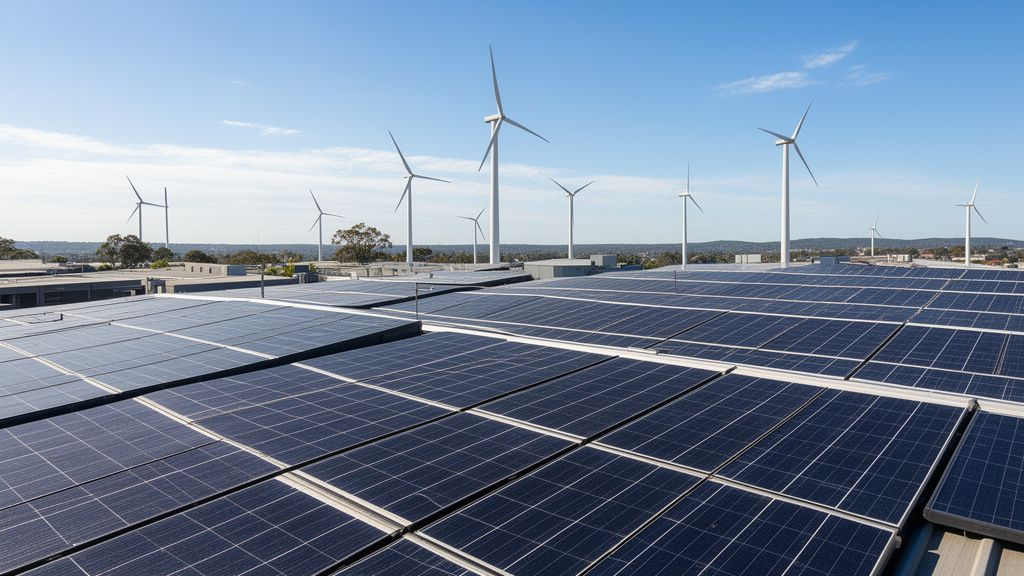
TL;DR: Established in 2001, Australia's Renewable Energy Target (RET) has been the quiet legislative force driving the installation of solar systems on over four million rooftops. Operating through a market-based certificate system funded by electricity retailers, the scheme is split into large-scale targets (LRET) and small-scale incentives (SRES). In July 2025, the SRES mechanism expanded to deliver the federal Cheaper Home Batteries discount, fueling a surge in household energy storage. As the scheme begins its final wind-down towards a firm closing date of December 31, 2030, understanding how these shrinking certificate discounts work is important for Australians planning their clean energy transition.
Introduction to the Renewable Energy Target (RET)
Australia is globally recognized as a powerhouse for rooftop solar installation, but the massive scale of this transition was not an accident. At the heart of this national shift is the Renewable Energy Target (RET), a quiet yet incredibly effective policy that has been operating for a quarter of a century. Most Australian households have never read a word of the legislation, yet it has touched their daily lives and influenced every clean energy quote they have ever received.
The RET is the legislative foundation that has placed solar panels on more than four million Australian roofs. It acts as a financial offset, built directly into the pricing of solar panels and battery storage solutions across the country. Established long before solar power became a mainstream household feature, the RET has survived political shifts, market evolutions, and industry restructuring to remain one of the most successful renewable energy mechanisms in Australian history. Rainbow Power Company had already been designing and installing solar for 14 years when the RET switched on in 2001, watching the scheme arrive, evolve, and transform the entire clean energy sector.
The Origin Story: How the RET Was Born (1997-2001)
The journey of the RET began in 1997 when the concept of a national renewable target was first announced. After extensive planning and legislative drafting, the proposal was formalized into law under the Renewable Energy (Electricity) Act 2000. This paved the way for the official commencement of the scheme on April 1, 2001.
At its inception, the policy was known as the Mandatory Renewable Energy Target (MRET). By modern standards, its original goal was modest: the policy aimed to achieve an additional 9,500 gigawatt-hours (GWh) of renewable energy generation per year by the year 2010. This target represented approximately two percent of Australia's total electricity generation at the time.
The primary strength of the MRET was its elegant market-based design, which avoided relying on annual government budget allocations or competitive grant funding rounds. Instead of taxpayer-funded handouts, the scheme established a legal mandate that integrated clean energy directly into the electricity market. This market structure has remained remarkably consistent for twenty-five years, proving that policy-driven market incentives can successfully drive long-term infrastructure investment.
The Mechanics of Clean Energy Certificates
The core mechanism of the RET relies on the creation and trading of environmental certificates. The system works through a simple but legally binding framework:
- Generation: Renewable energy generators earn a tradeable certificate for each megawatt-hour (MWh) of clean electricity they produce.
- Obligation: Electricity retailers are legally obligated to purchase and surrender a predetermined quota of these certificates to the government every year.
- Trading Market: This obligation creates a continuous demand for certificates. The value of the certificates flows directly back to the clean energy developers and households who install eligible generation systems.
- Funding: Because electricity retailers fund the purchase of certificates, the system is financed entirely through the energy market rather than federal budget expenditures. This protects the scheme from annual political fights over government spending.
By building the cost of transition into the retail energy market, the RET established a reliable economic pull toward cleaner power. This mechanism ensured that developers of wind farms, solar farms, and household solar installations had a guaranteed second stream of revenue, making clean energy projects financially viable and bankable for financial institutions.
A Quarter-Century Timeline: Five Major Milestones of the RET
Over its 25-year history, the RET has evolved through five major historical phases that shaped the modern Australian energy landscape:
- 2001 (Commencement): The Mandatory Renewable Energy Target officially starts on April 1. With its initial 9,500 GWh target, Australia becomes one of the first countries in the world to implement a nationwide renewable energy market scheme.
- 2009 to 2010 (The Split): With broad bipartisan political support, the target is expanded to represent 20 percent of Australia's electricity supply by 2020. To manage different sectors of the industry, the target is split into two distinct schemes: the Large-scale Renewable Energy Target (LRET) for major commercial wind and solar farms, and the Small-scale Renewable Energy Scheme (SRES) tailored for residential and small-business solar installations.
- 2015 (The Target Settlement): Following a prolonged period of political debate and investment uncertainty, the large-scale target is adjusted and settled at 33,000 GWh of renewable generation by 2020. This settlement restores investment confidence across the sector.
- 2019 (Target Met Early): The Clean Energy Regulator officially confirms that Australia has built sufficient renewable energy capacity to meet the 33,000 GWh target for 2020. The milestone is reached more than a full year ahead of the legislated schedule.
- 2025 (The Battery Expansion): The SRES mechanism is given a brand-new role: facilitating the federal Cheaper Home Batteries discount. This update integrates battery storage incentives directly into the existing certificate framework, making batteries the fastest-growing segment of the clean energy industry.
The Small-scale Renewable Energy Scheme (SRES) and Your Solar Rebate
For regular Australian homeowners, the most visible part of the RET is the Small-scale Renewable Energy Scheme (SRES). This scheme is responsible for what is commonly referred to as the "solar rebate."
Under the SRES, when a homeowner installs an eligible rooftop solar system, the system is credited with a specific number of Small-scale Technology Certificates (STCs). These STCs are calculated based on the amount of clean electricity the system is expected to generate over its lifetime up to the scheme's end date.
Instead of requiring households to trade these certificates on the open market themselves, solar installation companies design their operations to manage this process. The installer applies the value of the STCs directly to the customer's quote as an upfront discount. This means the rebate is quietly subtracted from the initial purchase price of the system, greatly lowering the financial barrier to entry for millions of households.
The 2025 Evolution: The "Cheaper Home Batteries" Discount
In July 2025, the federal government expanded the proven SRES mechanism to address the growing need for home energy storage. Recognizing that rooftop solar generates peak electricity during the day, energy storage is critical to balancing the grid and saving households money during peak evening hours.
This policy change introduced the federal Cheaper Home Batteries discount, utilizing the same tradeable certificate mechanism that successfully deployed rooftop solar panels. Just like the "solar rebate" for panels, the battery discount is built directly into the upfront quote provided by qualified installers. This expansion has made home battery systems more accessible, leading to rapid adoption rates and positioning battery storage as a primary driver of clean energy industry growth.
Looking to the Future: The Path to 2030 and the Final Wind-Down
When the RET commenced in 2001, renewable energy sources supplied only about a tenth (10 percent) of Australia's total electricity, with nearly all of that clean power coming from legacy hydroelectric projects built decades prior. Today, renewables supply well over a third of the nation's electricity and continue to climb. This massive transition has set Australia on a path toward its current national goal of 82 percent renewable electricity generation by 2030.
While the RET was not the only policy driving this transformation, it did the heavy lifting during the early years of the transition. It made wind farms financially secure, dragged the solar industry into the mainstream, and created the solid supply chains and installer networks that exist today.
However, the RET is structured as a temporary transition program. The entire scheme is legislated to wind down and conclude on December 31, 2030. Because of this set end date, the number of years remaining in the scheme's lifetime reduces each year. As a result, the number of certificates a new system can claim decreases on January 1 of every year, meaning the upfront discount on solar panels and batteries shrinks over time. For households planning to transition to solar and battery storage, the incentive to act sooner rather than later increases as the 2030 deadline approaches.
Key Takeaways
- Historical Impact: The RET started in 2001 and has successfully driven solar installations on over 4 million Australian roofs, lifting renewable energy supply from 10 percent in 2001 to more than a third today.
- Two Key Schemes: The target is split into the LRET (for wind and solar farms) and the SRES (for residential solar and, since July 2025, home batteries).
- Upfront Discounts: Households receive incentives as upfront discounts on quotes through the creation of Small-scale Technology Certificates (STCs), avoiding complex paperwork.
- The 2030 Deadline: The RET will officially end on December 31, 2030. The value of the upfront solar and battery discounts decreases on January 1 of each year as the scheme winds down.
Related Guides
- Queensland's Clean Energy Transition: Inside the State's 206,494 MW Project Pipeline
- Balcony Solar and Plug-In Systems: Breaking Barriers for Renters and Apartments
- Selecting the Right Solar Package: System Sizes, Brand Options, and Smart Technology
- Understanding the "Cheaper Home Batteries" Discount and the SRES Subsidy
