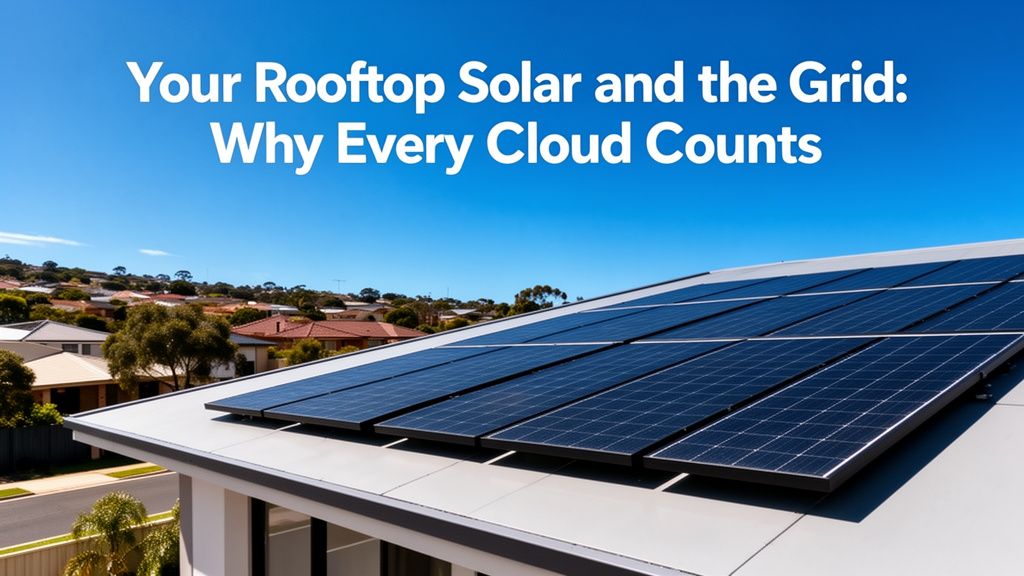
G'day, fellow Aussies! We love our sunshine, and it's no secret that we've embraced rooftop solar with open arms. Our sunburnt country leads the world in per capita solar adoption, with over 3.8 million Australian households now generating their own clean energy. It's a fantastic win for the environment, for our wallets, and for energy independence.
But have you ever stopped to think about what happens to all that glorious sunshine-generated power once it leaves your roof and heads into the national electricity grid? Or, more specifically, what happens when a big, dark cloud suddenly rolls over your suburb? That's where things get a bit more complex, and why understanding the relationship between your individual solar system and the vast, interconnected grid is crucial. Every cloud really does count.
Understanding Solar Power Fluctuation
Your rooftop solar system is a powerhouse, no doubt. On a clear, sunny spring day in Sydney, your 6.6 kW system might be pumping out a solid 5 kW for hours. But the sun isn't a constant, predictable source from the grid's perspective. Its output varies dramatically depending on several factors:
- Time of day: Solar production starts low at sunrise, peaks around midday, and tapers off towards sunset.
- Season: Longer days and a higher sun angle in summer mean more production than in winter.
- Weather: This is the big one. Clear skies mean maximum output. Light haze might reduce it slightly. But a passing cloud or a sudden thunderstorm can cause a rapid, significant drop in your system's output.
Imagine thousands of systems across a large area all experiencing these changes simultaneously. A single cloud might shade a few hundred homes, causing their combined output to plummet from, say, 2 MW down to 500 kW in minutes. When that cloud passes, it's a surge back up again. From the grid's control room, it's like thousands of tiny generators rapidly switching on and off, or drastically changing their output.
The Grid's Balancing Act
The electricity grid is a marvel of engineering, constantly balancing supply and demand to keep the lights on. It needs precisely the same amount of power being generated as is being consumed at any given second. If demand exceeds supply, frequency drops and we risk blackouts. If supply exceeds demand, frequency rises and equipment can be damaged.
Historically, the grid relied on large, centralised power stations (coal, gas, hydro) that could be ramped up or down relatively predictably by operators. These "synchronous generators" also provide essential "inertia" – a stable electrical momentum that resists sudden changes in frequency.
Rooftop solar, while abundant and clean, presents a different challenge. It's "intermittent" – meaning its output isn't entirely controllable or predictable by grid operators in real-time at scale. While slow, predictable changes (like the daily solar ramp-up and ramp-down) can be managed, it's the sudden, rapid changes caused by localised weather events that create headaches for grid stability.
Why "Every Cloud Counts" for the Grid
When a cloud reduces solar generation across a wide area, the grid needs to instantly compensate for that lost power. Here's why "every cloud counts":


- Frequency Stability: Rapid drops or surges in solar output can cause the grid's frequency to deviate from its target 50 Hertz. If this goes too far, safety mechanisms kick in, potentially leading to forced shutdowns in some areas to protect the broader grid.
- Need for Fast Reserves: To counteract these fluctuations, grid operators (like the Australian Energy Market Operator, AEMO) must keep "fast reserve" generators on standby. These are typically gas-fired power stations or hydro plants that can quickly ramp up or down. Maintaining these reserves is costly, and these costs are ultimately passed on to all energy consumers.
- Increased Curtailment Risk: In regions with very high solar penetration, like South Australia, there are times when there's simply too much solar power being generated for the grid to safely handle, especially on mild days with low demand. In these instances, solar output might need to be "curtailed" – effectively meaning your inverter might be told to temporarily reduce its export, or even switch off, to prevent grid instability. This can be frustrating for solar owners, but it's a vital measure to protect the system.
What's Being Done and What You Can Do
The good news is that Australia is at the forefront of tackling these challenges. We're not just complaining about clouds; we're innovating!
Technology and Policy Solutions:
- Batteries (Home and Grid-Scale): Batteries are game-changers. At home, a battery (typically costing between $8,000 - $15,000 installed for a decent size) can store your excess solar, smoothing out your own consumption and reducing reliance on the grid at peak times. Grid-scale batteries, like the massive ones in South Australia, can respond in milliseconds to stabilise frequency.
- Smart Inverters: Modern solar inverters have advanced capabilities that allow grid operators to communicate with them, potentially managing export limits or responding to grid conditions in real-time.
- Virtual Power Plants (VPPs): These are networks of home batteries (and sometimes smart appliances) that are coordinated by an aggregator. The VPP can collectively act like a small power plant, either exporting power to the grid or drawing from it, to help balance supply and demand.
- Improved Forecasting: Better weather forecasting, especially for cloud movements, helps AEMO anticipate and manage solar fluctuations more effectively.
- Demand Response: Programs that encourage consumers to shift their energy use away from peak times (e.g., charging electric vehicles when solar is abundant) also help balance the grid.
Your Role as a Solar Owner:
You're a vital part of Australia's energy future! Here's how you can help:
- Consider a Battery: If it's financially viable for your household, a Solar Battery reduces your reliance on grid exports and minimises the impact of your system's fluctuations. Plus, you get backup power during blackouts!
- Shift Your Consumption: Use your power-hungry appliances – washing machine, dishwasher, pool pump, EV charging – during the middle of the day when your solar is producing abundantly. This means more self-consumption and less stress on the grid.
- Stay Informed: Understanding how your system interacts with the grid helps you make better energy choices and appreciate the broader energy landscape.
- Participate in VPPs: If a VPP is available in your area, joining one can be a win-win, offering you financial incentives while contributing to grid stability.
The Future is Bright (and Stable)
Australia's love affair with solar isn't slowing down, and nor should it. The transition to a cleaner, renewables-dominated grid is essential for our planet. The challenges posed by intermittent sources like solar are real, but they are also being met with incredible innovation and investment.
By understanding that every cloud counts – not just for your immediate solar output, but for the entire grid's delicate balance – we can collectively work towards a more resilient, reliable, and sustainable energy future for all Australians.
Cheers to harnessing the sun, responsibly!
Read More
For a comprehensive overview, check out our master guide: Read the Full Guide Here.