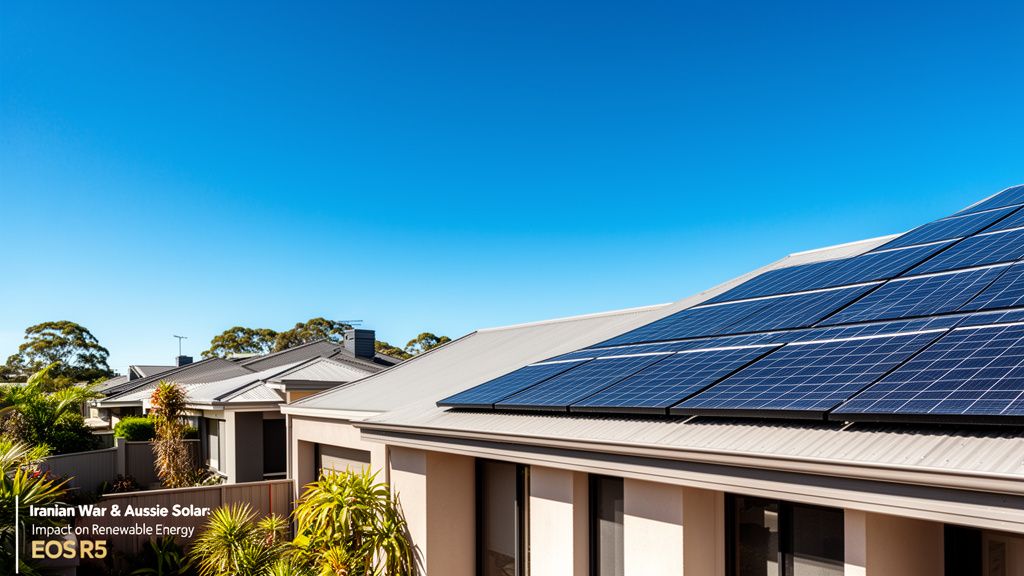
TL;DR: A war involving Iran would primarily spike global oil and gas prices, impacting the cost of traditional energy. While this would cause broad energy market volatility, Australia's growing renewable sector, especially solar, is largely insulated from direct supply chain disruptions and would likely see accelerated investment as a strategic hedge against future fossil fuel price shocks.
Will an Iranian War Directly Disrupt Australia's Solar Supply Chain?
An Iranian war is unlikely to directly disrupt Australia's solar supply chain significantly, as the primary components for solar panels originate predominantly from East Asia, not the Middle East. Australia's solar industry relies heavily on manufacturers in China, Vietnam, and other Southeast Asian nations for solar panels, inverters, and battery components. While global shipping routes could face some temporary turbulence if the conflict escalated to major maritime choke points, the direct supply of solar technology is not tied to the Middle Eastern oil routes that would be most immediately affected. Any indirect impacts would likely be short-lived, with supply chains proving resilient and adaptable in re-routing. The focus of such a conflict would be on oil and gas exports from the Persian Gulf, a distinct sector from solar manufacturing.
Global Solar Manufacturing Hubs vs. Geopolitical Hotspots
The vast majority of solar panel and inverter manufacturing is concentrated in East Asia, particularly China. This geographical separation means that a conflict in the Middle East, while a global concern, does not directly threaten the factories producing solar hardware for the Aussie market. Our supply lines are established via major Asian shipping lanes across the Pacific and Indian Oceans, largely bypassing the direct zone of conflict. Any impact on shipping insurance or container availability would be a general economic ripple rather than a targeted hit on solar components, similar to what was experienced during the initial phases of the global pandemic or the Suez Canal blockage.
Potential Indirect Shipping Impacts
While direct manufacturing is not threatened, significant escalation of conflict in the Strait of Hormuz could lead to increased global shipping costs and delays due to higher insurance premiums and potential re-routing of vessels. This could marginally increase the landed cost of solar panels in Australia, potentially adding a few hundred dollars to the total price of a standard 6.6kW system, which currently might set you back between $5,000 and $8,000 after rebates. However, these increases would likely be temporary and absorbed within the broader fluctuations of the solar market, as manufacturers and importers work to maintain competitive pricing for Aussie consumers.
How Would Global Oil Price Spikes Influence Renewable Energy Investment in Australia?
Global oil price spikes, often triggered by geopolitical events like an Iranian war, typically create a strong economic incentive for increased investment in renewable energy in Australia, rather than hindering it. When the price of crude oil surges, it has a cascading effect on global energy markets, leading to higher prices for petrol at the pump, increased costs for gas-fired electricity generation, and broader inflationary pressures. For Australian households and businesses, this directly translates to higher electricity bills and transport costs. In response, the economic attractiveness of generating your own power through rooftop solar or investing in utility-scale wind and solar farms becomes even more compelling. It acts as a natural hedge against volatile fossil fuel markets.
The Economic Case for Solar Amidst Rising Fossil Fuel Costs
Australians are no strangers to the pinch of rising energy costs. With power bills currently sitting at an average of $400-$600 a quarter for many households, any external shock that pushes these prices higher instantly makes solar a more appealing proposition. When petrol prices jump to $2.20 a litre or more, the long-term savings from a solar system, potentially cutting hundreds off your quarterly bill, become a simple choice for many. The payback period for a typical residential solar system can shrink considerably when grid electricity prices climb, making solar a sound financial decision for energy independence.
Government Policy and Incentives Remaining Stable
Despite geopolitical unrest abroad, the Australian government commitment to renewable energy targets and supporting policies, such as small-scale technology certificates (STCs) and various state-based rebates, is likely to remain steadfast. In fact, a global energy crisis could even drive further investment in domestic renewable generation to secure national energy security. These incentives help absorb initial installation costs, keeping solar accessible. For instance, the STC scheme can currently provide thousands of dollars off the upfront cost of a new solar system, a benefit unlikely to be removed just as global energy markets become more unpredictable.
Is Australia's Grid Vulnerable to Geopolitical Energy Shocks?
While Australia's energy grid still relies on fossil fuels, its increasing integration of domestic renewables, particularly rooftop solar, provides a buffer against global geopolitical energy shocks. Unlike nations heavily dependent on imported oil or gas for electricity generation, Australia is a net energy exporter of traditional fuels. However, our domestic reliance on gas and coal for baseload power still exposes us to price volatility, as these commodities are traded on global markets. The rapid uptake of solar and wind within Australia's National Electricity Market (NEM) is building resilience, reducing our reliance on imported fuel prices for our own electricity needs.
The Role of Rooftop Solar in National Energy Security
Rooftop solar systems, currently gracing over one in three Australian homes, represent a decentralised energy network that significantly improves national energy security. These systems generate electricity right where it is consumed, reducing demand on the main grid, especially during peak times. This distributed generation capacity means that even if global events cause large-scale power station fuels (like coal or gas) to spike in price or become less available, millions of Australian households continue to generate their own clean power, insulating them from the immediate impacts. It is a powerful, grassroots form of energy independence.
Long-Term Energy Strategy Towards Independence
Australia's long-term energy strategy is clearly shifting towards greater renewable energy independence. Significant investments in large-scale solar farms, wind projects, and battery storage are aimed at reducing our reliance on global fossil fuel markets and improving grid stability. Projects like the Vales Point coal power station being replaced by renewables, or the development of massive solar farms in Queensland, demonstrate a deliberate move to secure Australia's energy future with local, clean resources. Geopolitical instability only shows the urgency and wisdom of this transition, pushing us further towards a secure, self-sufficient renewable energy future.
Key Takeaways
- An Iranian war would primarily impact global oil and gas markets, causing price volatility for traditional energy sources.
- Australia's solar supply chain is largely insulated from direct disruption, as manufacturing hubs are in East Asia, not the Middle East.
- Higher global fossil fuel prices typically accelerate renewable energy investment in Australia, making solar more economically attractive.
- Government incentives for solar and renewables are likely to remain stable or even increase as a strategic response to energy security concerns.
- Australia's growing domestic renewable energy capacity, especially rooftop solar, acts as a significant buffer against global geopolitical energy shocks.