TL;DR: Your high electricity bill likely results from a combination of rising usage charges, fixed daily supply charges, and increasing network fees for maintaining the grid. Wholesale energy price hikes and retailer costs also contribute, making understanding your tariff and energy habits essential.
What Are the Main Components of My Electricity Bill?
The main components of your electricity bill include the cost of the energy you use, the fees for transporting that power across poles and wires, and other market and retail costs. You receive a single bill, but it covers a complex chain of generation, transmission, distribution, and retailing. Power companies divide these charges into various line items, often making it difficult to pinpoint exactly where your money goes without a detailed breakdown. Understanding each part helps you identify areas to save.
Usage Charges: What You Actually Consume
Usage charges are directly related to the amount of electricity your household consumes, measured in kilowatt-hours (kWh). Every appliance in your home, from your air conditioner to your phone charger, adds to this total. Retailers often charge different rates for usage depending on the time of day, particularly with 'time-of-use' tariffs. For instance, peak usage, typically in the late afternoon and evening, costs more per kWh than off-peak periods overnight. Many Australians pay between 25-40 cents per kWh for their power.
Network Charges: The Hidden Cost of the Grid
Network charges, sometimes called 'poles and wires' costs, make up a significant portion of your bill, often 40-50% in states like New South Wales. These charges cover the cost of building, maintaining, and upgrading the vast electricity grid, including power lines, substations, and transformers. Your retailer passes these fees onto you, even though they are set by the network distributors (like Ausgrid or Energex), not the retailer themselves. These costs are largely fixed, irrespective of your energy usage, and continue to rise as infrastructure ages and requires upgrades.
How Do Daily Supply Charges and Tariffs Add Up?
Daily supply charges are fixed fees retailers add to your bill simply for being connected to the grid, regardless of how much power you use. This fee ensures you have access to electricity whenever you need it. Even if you go on holiday and use no electricity, you will still incur this daily charge. These charges, combined with your chosen tariff structure, can significantly influence your overall bill, particularly for low energy users.
Understanding Daily Supply Charges
Every household connected to the electricity grid pays a daily supply charge. This fee covers the costs associated with your meter, billing services, and maintaining your connection to the network. Across Australia, these charges typically range from $1 to $1.50 per day, accumulating to around $365 to $550 per year before you even switch on a light. These charges are non-negotiable for grid-connected homes and remain constant regardless of your actual energy consumption. Comparing these daily charges between different retailers can offer some savings.
Different Tariff Structures and Their Impact
Your retailer’s tariff structure determines how they charge you for electricity. The most common types are single-rate, time-of-use (ToU), and controlled load tariffs. A single-rate tariff charges the same price per kWh 24/7. ToU tariffs charge different prices based on the time of day, with peak times (e.g., 4 pm - 9 pm) being the most expensive, shoulder times (e.g., morning/mid-afternoon) being moderate, and off-peak (e.g., overnight) being the cheapest. Controlled load tariffs apply a lower rate to specific high-energy appliances like hot water systems or pool pumps, provided they are on a separate circuit. Choosing the wrong tariff for your usage patterns can lead to unexpectedly high bills.

Are Renewable Energy Schemes and Government Levies Making Bills Higher?
Yes, a small portion of your electricity bill covers the costs of government schemes designed to promote renewable energy and support energy market functions. While these schemes ultimately aim for a cleaner, more stable energy future, their operational costs are partially recouped through consumer bills. These levies add to the base cost of your electricity, alongside the wholesale price retailers pay for power and their own operating margins.
The Role of Environmental Schemes
Government policies like the Renewable Energy Target (RET) drive investment in large-scale renewable projects across Australia. The costs associated with these schemes, which include subsidies and administrative fees, are partially recovered through charges applied to electricity retailers. Retailers then pass a portion of these costs onto consumers in their bills. While these charges represent a small fraction of the total bill, they contribute to the upward trend of electricity prices. They are a necessary part of the transition away from fossil fuels.
Wholesale Market Volatility and Retailer Margins
The wholesale price of electricity, which retailers pay to generators, can be highly volatile, influenced by factors like fuel costs, weather conditions, and generator outages. Periods of high wholesale prices, as seen in recent years due to global energy market disruptions, translate into higher retail prices. On top of these wholesale costs, retailers also incorporate their operating expenses, marketing, customer service, and profit margins into your final bill. These combined factors mean that even with stable usage, your bill can increase if wholesale prices or retailer overheads rise.
Key Takeaways
- Understand your bill's breakdown: Identify usage, network, and daily supply charges.
- Check your tariff: Ensure your current tariff (single-rate, time-of-use) matches your household's energy consumption patterns.
- Monitor energy use: Track which appliances use the most power, especially during peak times for time-of-use tariffs.
- Compare retailers: Regularly shop around for better deals on daily supply charges and kWh rates.
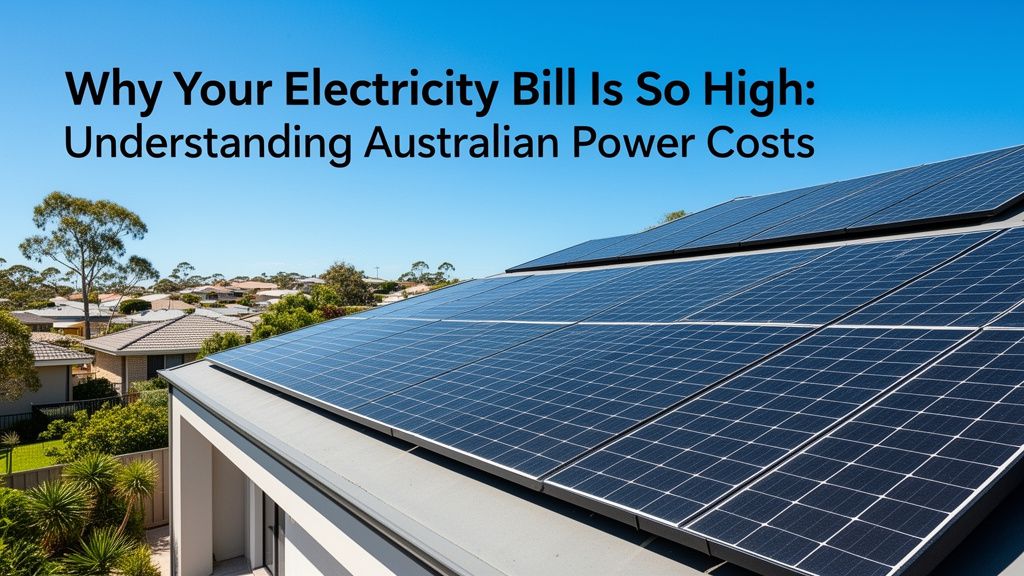
- Consider solar: Installing a solar power system can significantly reduce your reliance on grid electricity, cutting down usage charges and potentially earning credits from feed-in tariffs.
Read More
For a comprehensive overview, check out our master guide: Read the Full Guide Here.