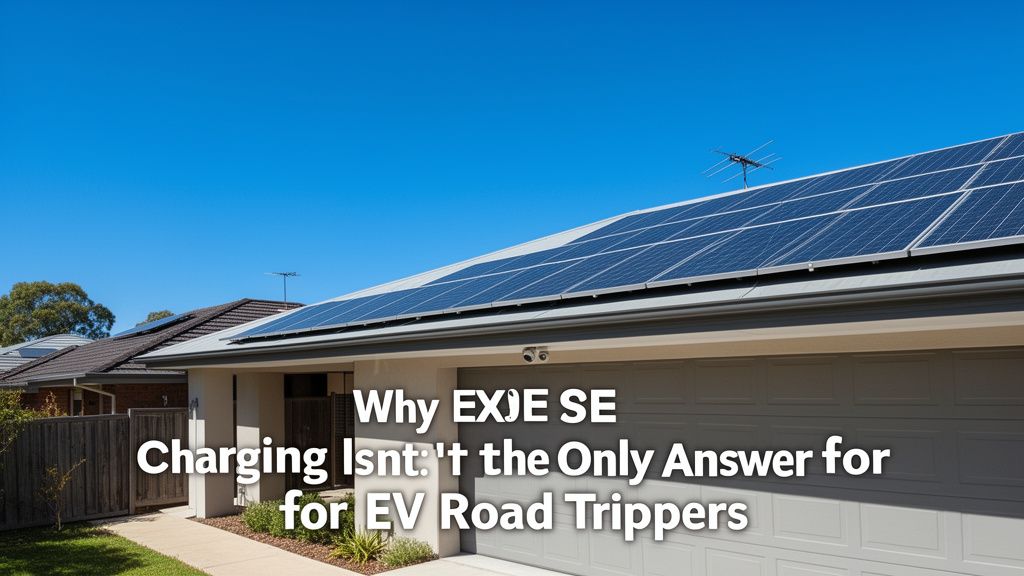
Why Fast Charging Isn't the Only Answer for EV Road Trippers
The rumble of a petrol engine is slowly giving way to the quiet hum of an electric vehicle on Australian roads. More and more Aussies are embracing EVs, and with that comes the exciting prospect of the classic Aussie road trip, sans the constant petrol station stops. When most people think about long-distance EV travel, the first thing that springs to mind is "fast charging." And fair enough, it’s a game-changer for quick top-ups. But to truly conquer our vast continent in an EV, fast charging isn’t the only answer – and often, it’s not even the best one.
The Allure (and Limitations) of Fast Charging
There’s no denying the convenience of a rapid charger. Pulling into a charging station and getting a significant boost in 20-40 minutes can feel like magic, especially when you’re on a tight schedule or covering big distances between major cities. These DC fast chargers (often 50kW, 150kW, or even 350kW) are vital arteries for our growing EV network, helping to quell range anxiety on principal routes like the Hume Highway or the Pacific Motorway. They’re fantastic for getting you from Sydney to Melbourne, or Perth to Margaret River with minimal fuss.
However, relying solely on fast charging for every leg of your journey has its drawbacks. Firstly, availability drops off dramatically once you venture off the main highways. Head into regional Australia, and you’ll quickly find that fast chargers are few and far between. Secondly, cost can be a factor. While cheaper than petrol for comparable distance, fast charging typically costs more per kilowatt-hour (kWh) than slower options, often ranging from $0.60 to $0.75/kWh. Compare that to home charging rates, which might be $0.25 to $0.40/kWh, especially with solar. Thirdly, frequent high-power charging can generate more heat, potentially impacting battery longevity over the very long term, although modern battery management systems mitigate much of this. And finally, during peak holiday periods, you might find yourself stuck in a queue, eating into your precious holiday time. Plus, fast chargers often slow down significantly after 80% state of charge, making that last top-up less efficient for your time.
Embracing the Slow Lane: Destination and Overnight Charging
This is where the true brilliance of EV road tripping reveals itself: destination charging. Imagine this: you arrive at your charming country pub, beachside Airbnb, or caravan park after a long day of driving. You plug your car in using a standard AC charger (often 7kW or 11kW, sometimes even just a 3kW power point), and while you’re enjoying a cracking parma, exploring the local sights, or sound asleep, your car is quietly filling up.


By morning, you wake up to a "full tank," ready for another day of adventure without needing to detour or wait at a fast charger. This method is often significantly cheaper, sometimes even free if included in your accommodation. It’s also gentler on your battery, and critically, it supports local businesses by encouraging longer stays in regional towns. Many hotels, motels, and caravan parks across Australia are increasingly offering EV charging – from dedicated Wallboxes to just a regular power point. It’s worth checking ahead or filtering on apps like PlugShare. A typical 7kW charger can add about 40-50km of range per hour, meaning an overnight stop can easily replenish 300-400km or more.
The Power of Home Charging on the Go
Don’t underestimate the humble 10A wall socket. Every EV comes with a portable charger (often called a "trickle charger" or "granny charger") that plugs into a standard household power point. While incredibly slow – adding only about 8-10km of range per hour – this offers unparalleled flexibility. Staying at a friend’s place? Plug in overnight. Found a remote cabin with no fancy charging? A regular power point could be your saviour. It’s not for quick boosts, but for an overnight top-up when options are scarce, it’s an absolute lifesaver, ensuring you wake up with enough juice to reach the next dedicated charger.
Planning is Your Best Mate
Successful EV road tripping across Australia isn't about chasing the fastest charger; it's about smart planning and embracing all available charging types. Apps like PlugShare and A Better Routeplanner are your best mates, showing you charger locations, types, and even user reviews. Always look for accommodation that offers charging options. Build a buffer into your plans – don’t aim to arrive at your next charger with just 10% battery remaining, especially in remote areas where distances between towns can be vast and unexpected detours can occur. Call ahead to confirm charger availability or functionality if you're relying on a specific spot.
The Aussie Solar Connection
For many Australians, the journey begins and ends at home with rooftop solar panels. Charging your EV at home using your own solar energy is virtually free and the most sustainable way to power your trips. This allows you to start every roadie with a full, free "tank" of sunshine, significantly reducing the overall cost of your adventure. As Australia continues its solar boom, we’ll hopefully see more public charging infrastructure also powered by renewable energy, making every charge a greener one.
In conclusion, while fast charging has an important role to play in the convenience of long-distance EV travel, it's not the singular solution. For a truly stress-free, cost-effective, and enjoyable Australian EV road trip, you need to think beyond the quick zap. Embrace the slower, destination-based charging, understand the utility of a simple power point, and always plan ahead. By doing so, you’ll unlock a world of adventure, powered by convenience and a little bit of Aussie ingenuity, making the journey just as rewarding as the destination.
Read More
For a comprehensive overview, check out our master guide: Read the Full Guide Here.


