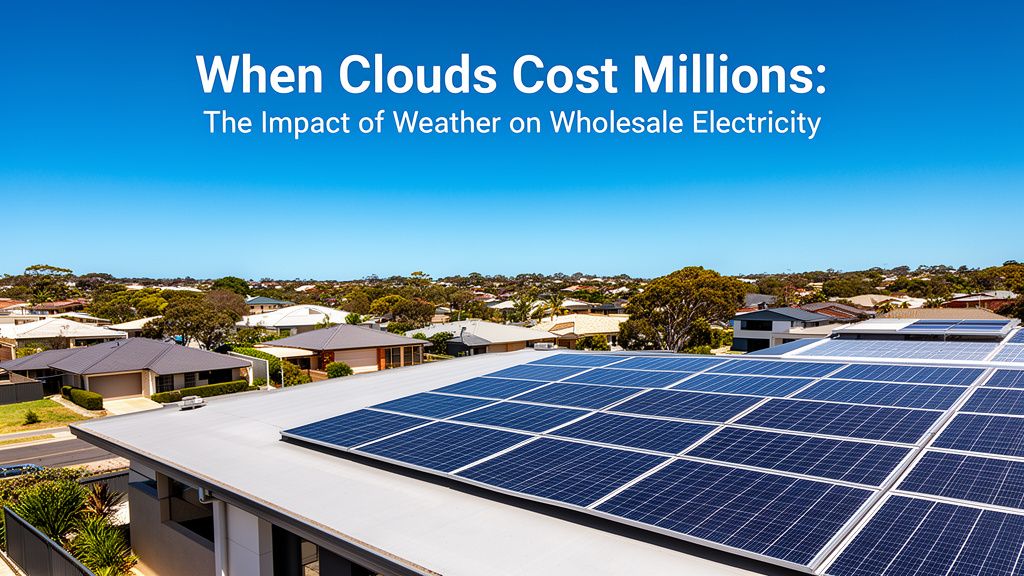
Australia is a sunburnt country, and we've embraced solar power with unmatched enthusiasm. Our rooftops glitter with PV panels, and vast solar farms stretch across regional landscapes, all contributing to a cleaner, greener energy future. But beneath this sunny optimism lies a complex challenge: what happens to our electricity grid and wholesale prices when the sun decides to take a break behind a blanket of clouds? The answer, surprisingly, can cost us millions.
Australia's Solar Revolution: A Double-Edged Sword
We're world leaders in per-capita rooftop solar installations, and our utility-scale solar capacity is rapidly expanding. Solar energy has become a cornerstone of the National Electricity Market (NEM), frequently driving down wholesale electricity prices, sometimes even into negative territory, during periods of high generation and low demand. This influx of cheap, renewable energy is fantastic for consumers and the environment.
However, solar's very strength – its reliance on the sun – is also its Achilles' heel. Unlike a traditional coal or gas-fired power station, a solar farm cannot simply be "turned up" on command if the weather changes. When thick clouds roll in, especially across large regions, solar output can plummet dramatically.
The Cloud Cover Conundrum: Instant Grid Shock
Imagine a typical Australian summer's day, with solar panels across eastern states feeding gigawatts of clean electricity into the grid. Wholesale prices might be sitting comfortably low, perhaps around $50 per megawatt-hour (MWh). Then, an unexpected cold front sweeps across the eastern seaboard, bringing with it a dense layer of cloud.
Within minutes, the output from hundreds of thousands of rooftop systems and large solar farms can drop by 50% or even more. This isn't gradual; it's an abrupt power loss equivalent to shutting down major power stations. The grid operators at the Australian Energy Market Operator (AEMO) face an immediate, critical challenge: how to replace that missing power, and fast.
The NEM's Balancing Act: Supply and Demand
To understand the financial implications, let's briefly recap the NEM. It's a real-time market where electricity generators bid to supply power, and industrial users, homes, and businesses demand it. AEMO continuously balances supply and demand every five minutes. The price is set by the most expensive generator needed to meet current demand – the "marginal" price. When supply is abundant and demand is low, prices are low. When supply is tight or demand spikes, prices shoot up.
When Clouds Push Prices Sky-High
When solar output suddenly drops due to cloud cover, the market immediately seeks alternative generation. This means calling upon power stations that are typically more expensive to run – often gas-fired plants, or even older, less efficient coal generators that might be sitting as reserve capacity. These generators, knowing their power is now urgently needed, can bid significantly higher into the market.


Instead of $50/MWh, prices can surge to hundreds, even thousands of dollars per MWh, potentially hitting the market cap of $15,000/MWh during extreme events. This isn't hypothetical; AEMO’s data frequently shows price volatility directly correlated with solar availability. A few hours of widespread cloud cover can cost the market millions, as expensive generators are dispatched to fill the void left by silent solar panels. This cost is ultimately passed on, albeit indirectly, to consumers.
Beyond Clouds: Other Weather Woes
While clouds are a primary culprit for solar, other weather events also wreak havoc on wholesale prices. Heatwaves, for instance, don't just reduce solar panel efficiency; they significantly increase demand as air conditioners crank up across the continent. Similarly, low wind periods can reduce wind farm output, further stressing the grid if solar is also subdued. Conversely, strong winds at night can drive prices very low. The intermittency of renewables is a constant puzzle for grid operators.
Building a Resilient, Renewable Future
The challenge of weather-driven price volatility isn't a reason to abandon solar; it's a call to accelerate the development of solutions that complement it.
- Battery Storage: This is arguably critical. Large-scale grid batteries, like the "Big Battery" in South Australia, can store surplus solar energy during sunny periods and release it within milliseconds when clouds appear or demand spikes. Similarly, home batteries add resilience at the local level.
- Improved Forecasting: AEMO and other market participants are investing heavily in advanced weather forecasting models. Better predictions about weather patterns allow grid operators to anticipate changes and dispatch traditional generators more smoothly.
- Diversification of Renewables: Combining solar with wind power (which often generates more at night or in different weather conditions) and hydro power creates a more balanced, stable renewable energy mix.
- Demand Response: Encouraging consumers and businesses to shift their energy use away from peak times, or to temporarily reduce it during supply shortages, can alleviate pressure on the grid.
The Sunny Outlook
Australia’s journey to a high-renewable grid is exciting but complex. The "million-dollar clouds" highlight the inherent variability of natural energy sources. However, with strategic investment in storage, smart grid technologies, and a diversified renewable portfolio, we can build a resilient, affordable, and truly sustainable energy future where the sun, even when hidden, continues to power our nation effectively.
Read More
For a comprehensive overview, check out our master guide: Read the Full Guide Here.


