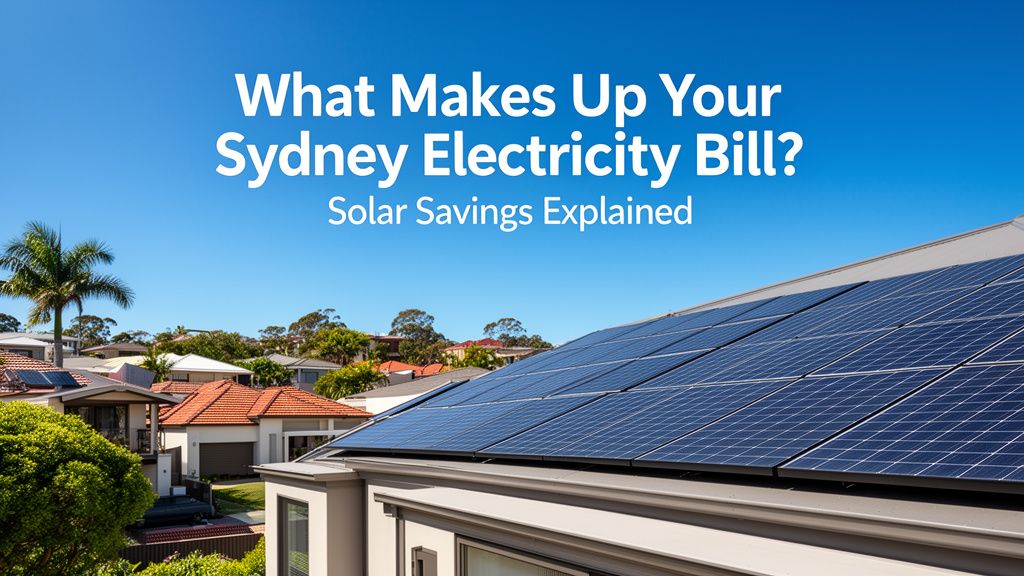
TL;DR: Your electricity bill in Sydney is primarily made up of a fixed daily supply charge, variable usage charges (based on how much power you consume), and network costs, along with environmental scheme levies. Installing solar panels can significantly reduce your variable usage charges and, in some cases, offset a portion of your fixed supply costs by generating your own power.
What are the Main Components of a Sydney Electricity Bill?
The main components of a Sydney electricity bill are generally categorised into fixed daily supply charges, variable usage charges, and various network and environmental costs. These charges combine to reflect the cost of getting electricity from the generator all the way to your home, maintaining the infrastructure, and supporting renewable energy initiatives. Understanding these parts is the first step towards taking control of your energy expenses, especially when considering how solar power can influence them. For the average Sydney household, these components can easily add up to hundreds of dollars each quarter.
Daily Supply Charge
The daily supply charge is a fixed fee you pay every day, regardless of how much electricity you use, covering the cost of connecting your property to the electricity grid. This charge is applied by your retailer to cover their operational costs, meter reading, billing, and the fixed costs of maintaining the grid connection to your home. In Sydney, these charges typically range from around 80 cents to $1.20 per day, depending on your retailer and specific plan. This means even if you're away on holiday and use no power, you'll still accrue this daily charge on your bill. It’s a non-negotiable part of being connected to the grid.
Usage Charges (Tariffs)
Usage charges, also known as consumption charges or tariffs, represent the cost of the actual electricity you consume, measured in kilowatt-hours (kWh). These are the variable costs that fluctuate with your household's energy habits. Sydney households often face different tariff structures, such as single rate, time-of-use (TOU), or controlled load. Single rate means you pay the same price per kWh no matter when you use it, typically ranging from 25 to 40 cents/kWh. TOU tariffs charge different rates for peak (e.g., 2 pm-8 pm), off-peak (e.g., 10 pm-7 am), and shoulder (all other times) periods, with peak rates being significantly higher.
How Do Network and Environmental Costs Impact Your Bill?
Network charges and various environmental scheme costs are significant, often less visible, components embedded within your electricity bill in Sydney. These charges cover the expenses associated with maintaining and upgrading the extensive network of poles, wires, and substations that transport electricity across New South Wales, as well as funding government-mandated renewable energy and energy efficiency programs. While you don't see them as separate line items on most residential bills, they make up a substantial portion of the overall cost per kilowatt-hour that retailers pass on to consumers. These costs are crucial for ensuring a reliable electricity supply and supporting Australia's transition to a greener energy future.
Network Costs
Network costs, which can account for roughly 40-50% of your total electricity bill, are paid to the distribution network service providers (DNSPs) like Ausgrid, Endeavour Energy, or Essential Energy in NSW. These charges cover the construction, maintenance, and operation of the infrastructure that delivers electricity from the high-voltage transmission network to your home. This includes everything from the massive power lines to the local transformers on your street. Retailers bundle these costs into your supply and usage charges, so you won't typically see a separate "network charge" line item on your bill, but they are a fundamental part of the price you pay for every kilowatt-hour.
Environmental Schemes
Environmental schemes are government-mandated programs designed to encourage renewable energy generation and improve energy efficiency. In NSW, these include the Renewable Energy Target (RET), which requires a certain percentage of Australia's electricity to come from renewable sources, and state-based energy efficiency schemes like the NSW Energy Savings Scheme (ESS). The costs associated with these schemes are passed on to consumers by electricity retailers. While these charges might add a small percentage to your bill, they contribute to a cleaner energy grid and long-term sustainability, often indirectly supporting the growth of solar power through incentives like Small-scale Technology Certificates (STCs) that reduce the upfront cost of solar installations.
Can Solar Panels Significantly Reduce These Bill Components?
Solar panels can significantly reduce several key components of your electricity bill, primarily by lowering your variable usage charges and potentially impacting your fixed costs indirectly. By generating your own power, you reduce the amount of electricity you need to purchase from the grid, directly cutting down the kWh charges on your bill. Furthermore, any excess solar power you export back to the grid can earn you a feed-in tariff, which provides a credit that can help offset some of the fixed daily supply charges or further reduce your overall bill. This makes solar a powerful tool for taking control of your energy expenses and achieving greater energy independence in Sydney.

Reducing Usage Charges
Installing a solar system directly tackles your usage charges by allowing you to self-consume the electricity generated by your panels. Every kilowatt-hour your solar system produces and your household uses is a kWh you don't have to buy from your energy retailer at their retail rate (e.g., 30-40 cents/kWh). This is known as "solar self-consumption" and it's the most economically beneficial way to use your solar power. By aligning your major electricity consumption with daylight hours – like running the washing machine, dishwasher, or charging an EV when the sun is shining – you can maximise your savings and dramatically shrink the variable portion of your electricity bill.
Offsetting Fixed Charges with Feed-in Tariffs
While solar panels don't directly eliminate the daily supply charge, the credits you receive from exporting excess solar energy back to the grid (known as a feed-in tariff or FiT) can effectively offset these fixed costs. When your solar system generates more electricity than your home is using, the surplus flows into the grid, and your retailer pays you for it. Although FiT rates in Sydney have reduced over time (currently often between 5-15 cents/kWh), these credits accumulate and are deducted from your total bill. For many solar owners, these FiT credits are enough to cover, or at least significantly reduce, the fixed daily supply charge, making your connection to the grid much more cost-effective.
Key Takeaways
- Your Sydney electricity bill comprises a fixed daily supply charge, variable usage charges per kWh, and embedded network/environmental costs.
- The daily supply charge is a non-negotiable fixed fee, typically around $1/day, regardless of usage.
- Usage charges vary based on your consumption and tariff type (e.g., single rate or time-of-use).
- Solar panels directly reduce your variable usage charges by generating your own power for self-consumption.
- Excess solar power exported to the grid earns feed-in tariff credits, which can offset your daily supply charge and further reduce your overall bill.
Read More
For a comprehensive overview, check out our master guide: Read the Full Guide Here.