G'day, fellow solar enthusiasts! Australia is a sunburnt country, and we’re leading the world in rooftop solar adoption. Our brilliant sunshine translates into significant savings and a greener future. But as any solar owner knows, the sun doesn't always shine predictably. Clouds roll in, storms gather, and suddenly your perfectly planned energy day goes a bit wobbly.
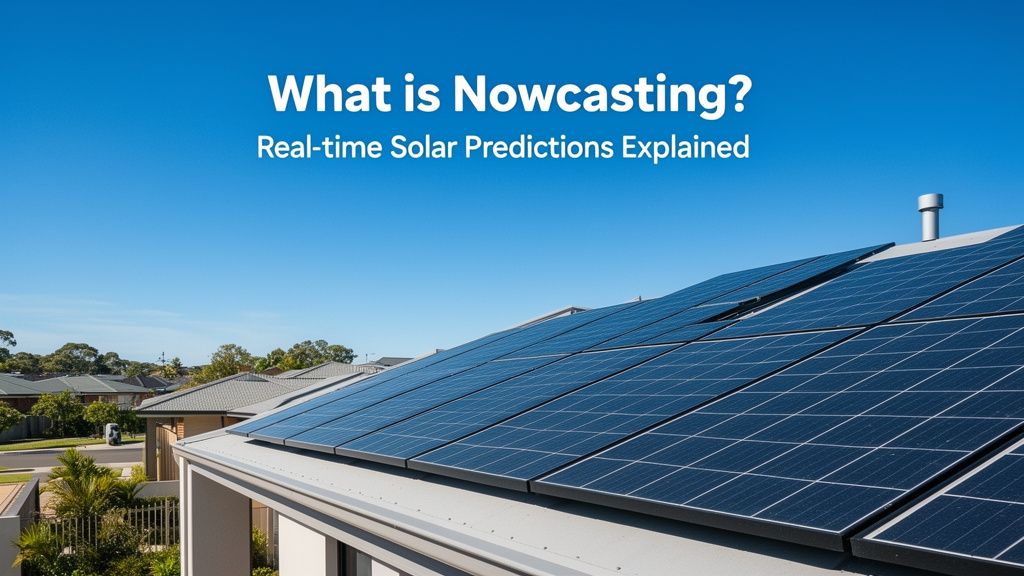
This variability is a key challenge, not just for individual homeowners trying to maximise their self-consumption, but for our entire electricity grid. Thankfully, there’s a sophisticated solution emerging that’s revolutionising how we manage solar power: Nowcasting. Forget simply looking at tomorrow's weather; nowcasting is about seeing the immediate future of your solar output, right now.
What Exactly is Nowcasting?
You're probably familiar with traditional weather forecasting – predicting conditions days or even weeks in advance. While incredibly useful, these predictions operate on a broader scale and longer timeframe. Nowcasting, on the other hand, is all about short-term, hyper-localised predictions, typically covering the next few minutes to a couple of hours.
Think of it this way: a traditional forecast might tell you there's a 60% chance of rain tomorrow in Sydney. Nowcasting would tell you there's a 95% chance of a heavy shower passing directly over your home in Surry Hills in the next 15 minutes, and that it will clear within half an hour. For solar power, this translates into incredibly precise insights into when the sun will be shining brightly on your panels, when it will be obscured by clouds, and for how long.
It’s not just an incremental improvement; it’s a paradigm shift from broad-brushstroke predictions to granular, real-time insights that can significantly impact your solar system’s performance and the stability of the wider energy network.
How Does Nowcasting Work for Solar?
Nowcasting for solar isn't about gazing into a crystal ball; it's a highly data-driven and technologically advanced process. It leverages a confluence of cutting-edge technologies to create its incredibly accurate, short-term predictions:
- Satellite Imagery: Geostationary satellites constantly monitor cloud cover and movement over vast regions. Nowcasting algorithms analyse sequences of these images to predict the trajectory and evolution of clouds with remarkable precision. If a cloud is moving at 30 km/h towards your suburb, the system knows exactly when it will start to block your sun.
- Ground-Based Sensors & Sky Cameras: Local weather stations equipped with pyranometers (sensors measuring solar radiation) provide real-time ground truth. Even more innovative are "sky cameras" or "fish-eye lens cameras" installed at key locations, including solar farms or even rooftops. These cameras capture wide-angle views of the sky, allowing AI to identify and track individual clouds, assess their density, and predict their immediate impact.
- Real-time Solar System Data: Your own solar inverter, and those of countless others connected to smart grids, provides a constant stream of actual generation data. This real-world performance data is fed back into the nowcasting models, allowing them to continuously learn, recalibrate, and improve their accuracy for specific locations and conditions.
- Artificial Intelligence and Machine Learning: This is where the magic happens. Sophisticated AI and machine learning algorithms process this colossal amount of real-time and historical data. They identify complex patterns, learn from past events, and continuously refine their predictive models. This allows them to account for subtle atmospheric changes, cloud formation, and dissipation that would be impossible for traditional models to predict.
By combining these diverse data streams and processing them with advanced AI, nowcasting systems can create high-resolution predictions (down to a few hundred metres and minute-by-minute intervals) for solar irradiance and power output.

Why is Nowcasting Crucial for Australian Solar?
Australia's phenomenal solar uptake makes nowcasting an incredibly valuable tool for several reasons:
- Grid Stability for AEMO: With millions of rooftop solar systems and large-scale solar farms, managing the supply and demand on the National Electricity Market (NEM) is a complex dance for the Australian Energy Market Operator (AEMO). Sudden drops in solar generation due to unexpected cloud cover can destabilise the grid, potentially leading to costly interventions or even blackouts. Nowcasting provides AEMO and network operators with the foresight to manage these fluctuations proactively, dispatching other energy sources or adjusting load to maintain balance and reliability.
- Maximising Self-Consumption for Homeowners: Imagine knowing exactly when your solar panels will generate peak power in the next hour. You could precisely time your washing machine cycle, charge your electric vehicle, run your pool pump, or even pre-cool your home, all powered by your own free solar energy. This intelligence helps you avoid drawing expensive power from the grid during peak times (which can be over $0.40/kWh in some states!), saving you serious dollars on your electricity bill.
- Optimising Battery Storage: For those with battery storage, nowcasting is a game-changer. Instead of just charging your battery when the sun is out, nowcasting allows your system to make intelligent decisions. If a heavy cloud bank is predicted in 30 minutes, your system might prioritise fully charging your battery now to ensure you have stored power when the solar output drops. Conversely, if sunny skies are predicted all afternoon, it might hold off on charging your battery from the grid, anticipating abundant free solar power.
- Enhanced Energy Trading and Dispatch (Large Scale): For commercial solar farms and businesses, nowcasting offers a competitive edge. More accurate predictions mean better bidding into the energy market, more efficient dispatch of power, and improved scheduling for maintenance or grid connection. This translates directly into increased revenue and reduced operational costs.
- Empowering Smart Homes: As our homes become smarter, nowcasting will be integrated into home energy management systems, automatically adjusting appliance schedules, EV charging, and HVAC systems to align perfectly with your predicted solar generation, creating a truly autonomous and efficient energy ecosystem.
The Australian Context: Leading the Way
Given our abundant sunshine and high penetration of rooftop solar, Australia is at the forefront of embracing and developing nowcasting technologies. Both governmental bodies like AEMO and innovative Australian tech companies are investing heavily in these solutions to ensure our grid remains stable, reliable, and increasingly powered by renewables.
The Future is Now(casting)
Nowcasting is more than just a clever weather trick; it's a fundamental shift towards a smarter, more resilient, and ultimately more sustainable energy future for Australia. By transforming the unpredictable nature of solar power into a predictable, manageable resource, nowcasting empowers everyone – from individual homeowners to national grid operators – to harness the full potential of the sun. The future of solar isn't just about generating power; it's about intelligently managing it, and nowcasting is leading the charge.
Read More
For a comprehensive overview, check out our master guide: Read the Full Guide Here.