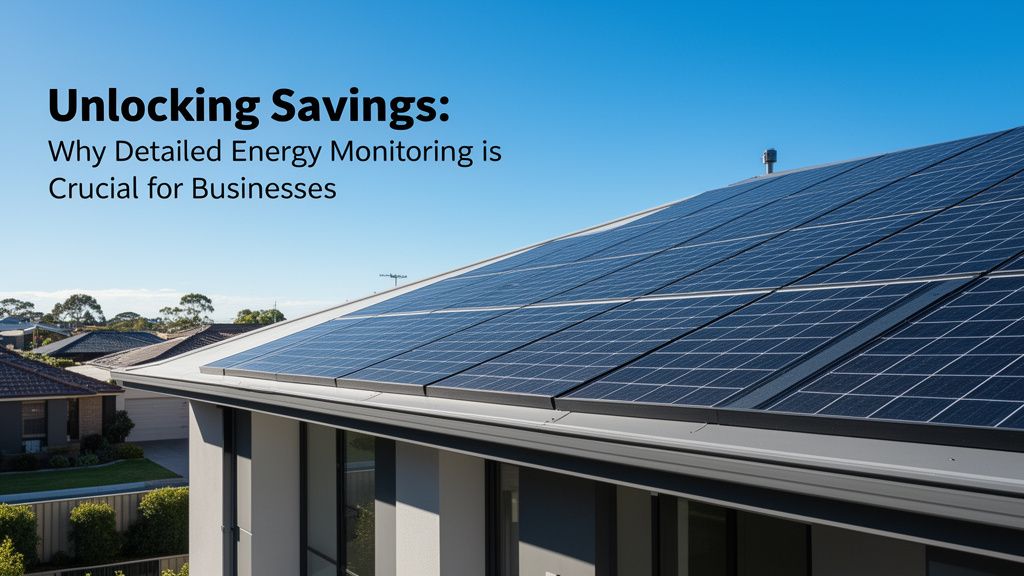
In the vast and sunburnt land of Australia, businesses are constantly seeking ways to cut costs and boost efficiency. With energy prices continuing their upward trend, simply paying the bill at the end of the month without understanding its components is akin to driving blind. For Aussie businesses, especially those that have invested in solar power, detailed energy monitoring isn't just a nice-to-have; it's a critical tool for unlocking substantial savings and maximising their investment.
Many businesses operate under the assumption that their energy consumption is a fixed cost, an unavoidable overhead. They might look at their quarterly electricity bill and sigh at the total, perhaps even making a mental note to "turn off lights more often." But this broad-stroke approach misses the forest for the trees. Without granular data, businesses are unable to identify specific inefficiencies, pinpoint energy-hungry equipment, or accurately measure the true impact of their solar PV system. This lack of insight leads to missed opportunities for cost reduction, suboptimal energy usage, and often, paying far more than necessary for power.
So, what exactly is detailed energy monitoring? It goes far beyond simply reading your overall smart meter. We're talking about sophisticated systems that track electricity usage in real-time, often down to individual circuits, departments, or even specific pieces of equipment. Imagine having a dashboard that shows you exactly how much energy your air conditioning unit is consuming at 2 PM on a Tuesday, or the power draw of your industrial freezer overnight. These systems often utilise sub-meters, smart sensors, and cloud-based platforms to collect, analyse, and present data in an easily digestible format. Crucially, for solar-equipped businesses, this monitoring integrates seamlessly with their solar inverter data, providing a complete picture of both generation and consumption. You can see precisely how much solar energy you’re producing, how much you’re using directly, and how much you’re importing from or exporting to the grid.
The power of this data is truly transformative. For starters, it allows you to identify energy hogs. Is that old refrigeration unit chewing through power at an alarming rate? Is your workshop’s air compressor running inefficiently? Detailed monitoring makes these issues glaringly obvious, allowing you to prioritise maintenance, upgrades, or even operational changes. By understanding when and where energy is being consumed, you can strategically shift high-energy activities to periods of abundant solar generation. This is key to maximising your solar self-consumption, reducing your reliance on expensive grid power, and avoiding those costly peak demand charges common in Australian networks.

Speaking of peak demand charges, these can be a real killer for Aussie businesses. Often charged based on the highest 30-minute average power draw (measured in kW) in a billing period, they can significantly inflate your bill, even if your overall kWh consumption isn't sky-high. Detailed monitoring helps you understand when these peaks occur and what equipment contributes most to them. With this knowledge, you can implement strategies like staggering equipment start-ups, managing large loads, or deploying battery storage to shave those costly peaks, leading to substantial savings that often dwarf the cost of the monitoring system itself. For example, reducing a 50kW peak demand charge by just 10kW could save a business hundreds of dollars a month depending on their network tariff – money that goes straight to your bottom line.
Beyond direct cost savings, detailed energy monitoring also enables proactive maintenance. Unusual spikes or consistent high energy consumption from a piece of equipment can indicate impending mechanical issues, allowing you to address them before they lead to costly breakdowns and operational disruptions. Furthermore, it provides irrefutable data to verify the savings from energy efficiency upgrades. Did switching to LED lighting really cut your lighting bill by 60%? Is that new, energy-efficient oven performing as promised? Monitoring allows you to quantify the return on investment for every efficiency initiative, justifying future investments and building a strong business case.
Across Australia, from bustling manufacturing plants in Melbourne to regional agricultural operations in Queensland and hospitality venues on the Sydney coast, businesses are reaping the rewards. They're not just saving money; they're improving their operational efficiency, reducing their carbon footprint, and gaining a significant competitive edge. With a clearer understanding of their energy landscape, they can make smarter, data-driven decisions that translate directly into improved profitability and sustainability.
When considering a monitoring solution, look for one that is scalable, user-friendly, and integrates seamlessly with your existing solar setup. The right system should offer clear visualisations, customisable alerts, and actionable insights, all backed by a reputable provider who understands the intricacies of the Australian energy market.
In a country where energy costs can significantly impact profitability, ignorance is no longer bliss. Investing in detailed energy monitoring isn't an expense; it's an investment in your business's future. Stop guessing and start measuring. Unlock the full potential of your solar investment and take control of your energy costs today.
Read More
For a comprehensive overview, check out our master guide: Read the Full Guide Here.