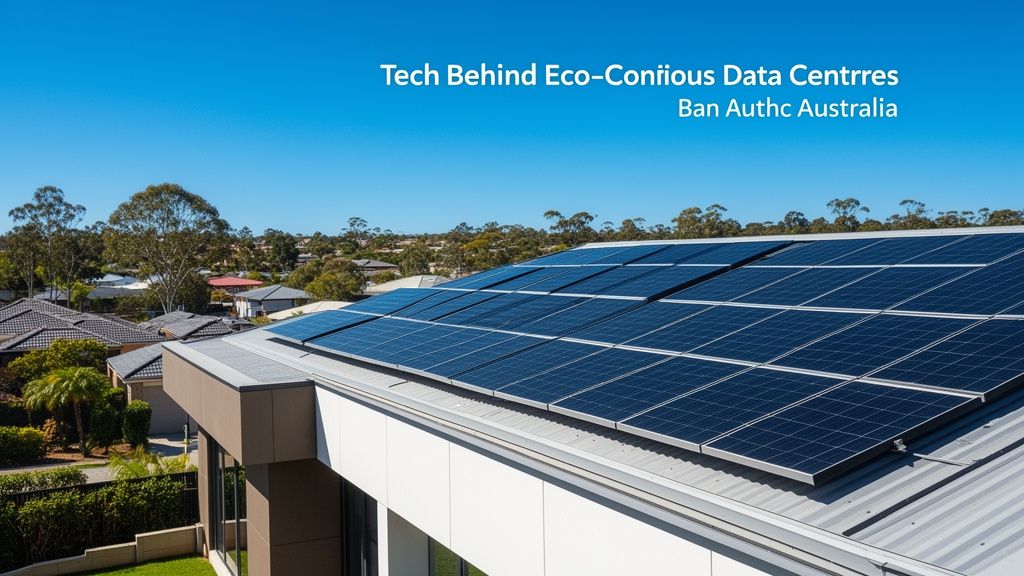
TL;DR: Eco-conscious data centres are rapidly adopting advanced technologies to dramatically reduce their environmental footprint. This includes integrating large-scale solar power solutions, employing sophisticated energy-efficient cooling methods, and optimising overall resource management, moving towards a truly sustainable digital infrastructure.
How Do Eco-Conscious Data Centres Reduce Their Grid Reliance Through Solar Energy?
Eco-conscious data centres significantly reduce their reliance on the traditional grid by integrating large-scale solar energy solutions, often complementing on-site generation with power purchase agreements (PPAs) from dedicated solar farms. Given Australia's abundant sunshine, leveraging solar power is a natural and highly effective strategy for these energy-intensive facilities to lower operational costs and achieve ambitious sustainability targets. This approach helps stabilise electricity supply and provides a hedge against volatile energy prices, a critical factor for facilities operating 24/7. Many large operators in Australia are now publicly committing to 100% renewable energy targets, primarily met through solar.
On-Site Solar and Battery Storage for Data Centres
Many Australian data centres are exploring or implementing substantial on-site solar installations. This might involve large rooftop arrays, extensive solar carports, or even ground-mounted systems on adjacent land where space permits. For a large data centre, these systems can run into megawatts (MW), offering significant self-generation capabilities. To enhance energy independence and ensure uninterrupted power supply, these solar systems are increasingly coupled with large-scale battery storage solutions. Think of systems like Tesla Megapacks or similar grid-scale batteries, which can store excess solar energy generated during the day for use during peak demand periods, or to provide backup power during grid fluctuations. Such an integrated system not only slashes electricity bills, which can be millions of dollars annually for a major data centre paying around $0.25 - $0.35 per kWh, but also bolsters energy security, which is paramount for data centre operations.
Power Purchase Agreements (PPAs) and Green Energy Procurement
Beyond direct ownership, data centres widely utilise Power Purchase Agreements (PPAs) to procure renewable energy. A PPA allows a data centre to buy electricity directly from a dedicated solar farm, either physically (where energy is delivered directly) or virtually (where the financial benefits of renewable generation are passed on). This provides long-term price certainty for renewable energy, typically over 10-20 years. Leading Australian tech companies are increasingly signing up for these agreements with new solar farms being built in regions like Queensland and New South Wales. Furthermore, data centres often purchase Large-scale Generation Certificates (LGCs) in Australia, which represent one megawatt-hour of electricity generated from eligible renewable sources. This allows them to effectively 'claim' renewable energy without necessarily being directly connected to a specific solar farm, contributing to the broader renewable energy market.
What Advanced Cooling Technologies Minimise Energy Consumption in Modern Data Centres?
Modern eco-conscious data centres dramatically cut energy consumption by employing advanced cooling technologies that move beyond traditional air conditioning, such as free cooling and liquid immersion, which are far more efficient. Cooling typically accounts for a substantial portion (often 30-40%) of a data centre's total energy consumption, making innovations in this area critical for environmental and economic sustainability. The goal is to minimise the Power Usage Effectiveness (PUE) ratio, ideally bringing it closer to 1.0, meaning almost all energy consumed goes directly to IT equipment.
Harnessing Australia's Climate with Free Cooling Techniques
Free cooling leverages external environmental conditions to cool data centre equipment, significantly reducing the energy required for mechanical refrigeration. In many parts of Australia, particularly during cooler months or in regions with arid climates, direct or indirect evaporative cooling systems can be highly effective. Direct evaporative cooling uses outside air that is filtered and humidified before being passed over servers, while indirect systems use a heat exchanger to transfer heat without mixing the air streams, protecting IT equipment from external contaminants. Utilising cooler ambient air in Tasmania, Victoria, or even arid inland parts of Western Australia and South Australia allows data centres to switch off energy-hungry chillers for significant periods, leading to substantial energy savings and a lower carbon footprint.
The Efficiency of Liquid Cooling and Heat Recovery Systems
Liquid cooling represents a step-change in data centre efficiency, offering superior heat transfer capabilities compared to air. Technologies like direct-to-chip liquid cooling (where liquid runs directly over hot components) and full immersion cooling (where server racks are submerged in a non-conductive dielectric fluid) are becoming more prevalent. These methods can cool much more densely packed racks with far less energy and a smaller physical footprint. Furthermore, the higher temperature of the waste heat generated by liquid cooling systems makes it more viable for heat recovery. Globally, some data centres channel this waste heat to warm offices or even supply district heating networks, creating a circular economy where energy is reused. While not yet widespread in Australia, the potential to repurpose this otherwise wasted energy is a key feature of truly eco-conscious designs.


How Are Data Centres Optimising Their Overall Energy Footprint and Resource Use?
Data centres are optimising their overall energy footprint and resource use through intelligent power management, efficient hardware, and circular economy principles that extend beyond just renewable energy sourcing. This holistic approach ensures every aspect of the data centre's operation is scrutinised for environmental impact and efficiency gains. From the power entering the facility to the eventual disposal of IT equipment, sustainability is becoming a core design principle for next-generation facilities.
Smart Power Distribution and Energy-Efficient Hardware
Optimising power distribution involves several key strategies. Many modern data centres are shifting towards higher voltage power distribution within the facility, and even considering direct current (DC) power delivery to server racks, which can reduce energy losses that occur during multiple AC/DC conversions. Intelligent power management systems monitor energy use down to individual server level, dynamically adjusting power delivery to match demand and turning off unused capacity. On the hardware front, there's a continuous drive towards more energy-efficient components, including processors designed for lower power consumption, solid-state drives (SSDs) which use less power than traditional hard disk drives, and sophisticated virtualisation technologies that allow fewer physical servers to run more workloads. These hardware and software advancements collectively contribute to a lower PUE and reduced overall energy demand.
Water Conservation and Lifecycle Management
Beyond energy, water is another critical resource for data centres, particularly in cooling towers. Eco-conscious facilities are implementing advanced water conservation strategies, such as closed-loop cooling systems that minimise evaporation, using recycled or greywater where appropriate, and employing sophisticated water treatment technologies to reduce consumption. Given Australia's often arid conditions and water scarcity issues, these measures are increasingly vital. Furthermore, a commitment to lifecycle management is crucial for IT equipment. This involves designing for durability, facilitating upgrades, refurbishing used equipment for secondary markets, and ultimately ensuring responsible recycling of components at end-of-life to minimise electronic waste (e-waste). Some data centres are even exploring the use of sustainable and recycled materials in their construction, reducing the embodied carbon of the building itself.
Key Takeaways
- Australian data centres are increasingly integrating large-scale solar power, both on-site and via Power Purchase Agreements, to reduce grid reliance and achieve sustainability targets.
- Advanced cooling technologies like free cooling and liquid immersion are critical for cutting the significant energy consumption associated with traditional air conditioning systems.
- Intelligent power management, energy-efficient hardware, and virtualisation are optimising power delivery and reducing energy draw at the IT equipment level.
- Focus on water conservation, responsible e-waste management, and sustainable construction materials are vital components of a truly eco-conscious data centre design.
- These technological advancements are crucial for data centres to operate efficiently and sustainably, mitigating their environmental impact in Australia's digital economy.
Read More
For a comprehensive overview, check out our master guide: Read the Full Guide Here.


