TL;DR: As Australia's National Electricity Market (NEM) transitions rapidly away from fossil fuels, the combination of home solar battery systems, localized virtual power plants, and climate-resilient grid integration is reshaping the energy landscape. Grounded in real-world data from Victoria's premium rebates to advanced UNSW Sydney climate modeling, this comprehensive guide explores how homeowners can maximize self-consumption, earn daily rewards, and secure energy independence.
Introduction: The Modern Energy Landscape in Australia
Australia is currently undergoing one of the fastest energy transitions in the world. As traditional fossil-fuel power stations retire, the National Electricity Market (NEM) is increasingly powered by decentralized renewable energy sources, specifically solar, wind, water, and geothermal energy. This massive influx of distributed energy resources presents unique opportunities and challenges. While residential rooftop solar generation has surged, a significant portion of this clean energy is lost or exported back to the grid during low-demand periods, reducing its financial value to the system owners.
To solve this mismatch, Australian homes and businesses are turning toward advanced battery storage. Adding a battery system allows consumers to capture excess daytime generation and store it for use during expensive evening peak periods, overnight, or on overcast days. Beyond individual cost savings, these localized systems can be networked into Virtual Power Plants (VPPs) to stabilize the wider grid and generate direct income for the participants.
Sizing and Sizing Options for Residential Systems
When planning a solar-and-storage installation, sizing is a critical factor that dictates system efficiency and return on investment. Major Australian installers offer several standardized system sizes to accommodate varying household consumption patterns.
For instance, variable-sized solar packages commonly deployed across the market include:
- 6.6 kW Solar Systems: Ideal for small-to-medium households with moderate daytime electricity use.
- 10 kW Solar Systems: Suited for medium-to-large families or homes looking to add electric vehicle (EV) charging capabilities.
- 13 kW Solar Systems: A popular high-yield residential size that provides ample surplus generation to charge large battery banks.
- 19 kW Solar Systems: Designed for large estates or light commercial applications with high baseline energy demands.
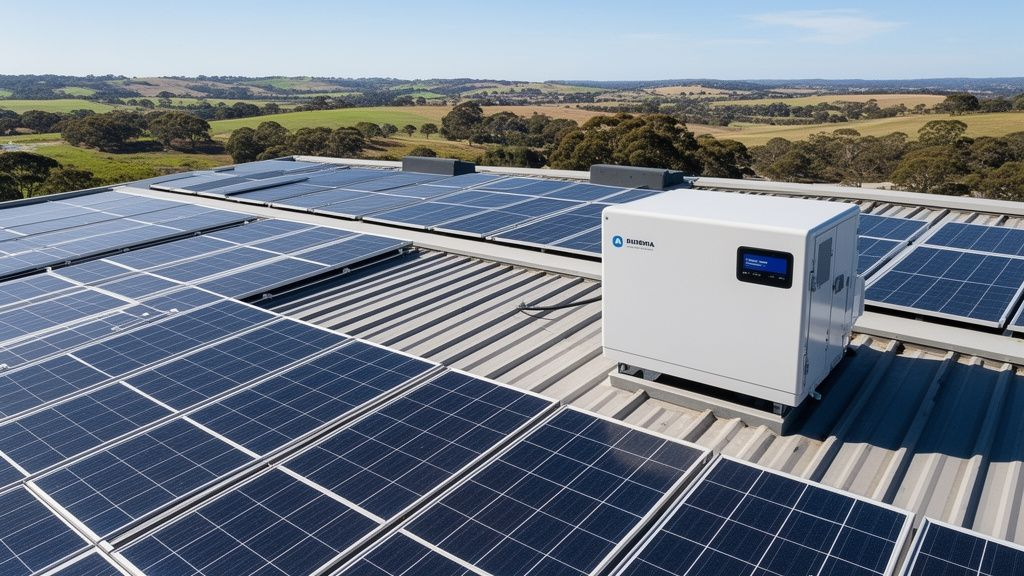
Real-world customer data demonstrates the practicality of these configurations. According to installation reviews from certified installers like Solid Solar Services, a popular residential configuration is a 13 kW system (such as 28 AKIO NeoStar 2P 470W panels, totaling 13.16 kW) paired with a high-efficiency inverter like the Fronius Gen24 10.0. These large residential systems generate substantial power, creating a massive surplus during the middle of the day that can easily fill high-capacity home batteries.
The Economics of Home Storage: Rebates and Virtual Power Plants
Integrating battery storage with solar panels has become significantly more accessible due to substantial government incentives and evolving utility plans. For instance, in Victoria, homeowners can access premium rebates to offset the upfront capital expenditure of large-scale storage. A 42 kWh battery system can qualify for a government rebate of up to $16,800. This incentive dramatically lowers the initial barrier to entry, enabling eligible households to pay as little as $5,500—which represents just a quarter of the system's full retail cost.
Beyond direct rebate assistance, homeowners can tap into Virtual Power Plant (VPP) programs to transform their battery from a passive storage unit into an active revenue-generating asset. These programs offer daily financial incentives by orchestrating how home batteries interact with the grid. Typical VPP rewards programs, such as those integrated by GridFree Solar, include:
- Free Grid Charging: Homeowners can charge their batteries directly from the grid for free between 11:00 AM and 2:00 PM, utilizing periods of high solar generation and low demand.
- Daily Peak Avoidance Bonus: Customers receive a $1 daily bonus simply for avoiding grid draw during peak hours, relying instead on their stored battery power.
- Premium Export Tariffs: Homeowners can earn 15¢/kWh by exporting stored energy back into the grid during the peak period of 6:00 PM to 8:00 PM when grid demand and pricing are highest.
In addition to these direct economic benefits, larger battery systems naturally feature an extended operational lifespan. Because a larger battery has more capacity, owners do not have to fully charge or drain the system to 100% or 0% each day. Keeping the battery in a balanced state (such as staying above 40% capacity) reduces chemical stress, thereby extending the total lifetime of the investment.

Clean Energy Regulation and Reporting Standards
To manage this distributed network safely and accurately, the Clean Energy Regulator (CER) enforces strict reporting guidelines under national frameworks. Under these guidelines, both large-scale facilities and qualifying distributed installations must strictly report energy production and consumption data. This includes monitoring and distinguishing between various forms of renewable generation, including:
- Solar energy used for electricity generation
- Wind energy used for electricity generation
- Water energy used for electricity generation
- Geothermal energy utilized for generation purposes
These guidelines ensure that the transition remains transparent, allowing grid operators to track capacity and plan infrastructure upgrades around reliable localized data.
Grid Resilience and Climate Variability: The UNSW Study
One of the most persistent concerns regarding a weather-dependent grid is its vulnerability to climate patterns. When major weather events occur, will the lights stay on? To answer this question, researchers at the ARC Centre of Excellence for Weather of the 21st Century and UNSW Sydney conducted a groundbreaking study.
Led by Dr. Doug Richardson, a 21st Century Weather Research Fellow, the team examined 84 years of historical weather data to model how the National Electricity Market (NEM) would perform under the Australian Energy Market Operator's (AEMO) projected expansion of renewable energy through to 2050. Specifically, they analyzed the combined influence of Australia's three major climate drivers:
- The El Niño-Southern Oscillation (ENSO)
- The Indian Ocean Dipole (IOD)
- The Southern Annular Mode (SAM)
Surprisingly Small Climate Influence
While previous studies focused on how these drivers affect demand or generation individually, the UNSW study was the first to analyze their combined, interconnected grid performance. The researchers discovered that while these macro-climate patterns certainly affect temperatures, cloud cover, and wind speeds, their overall impact on the electricity grid is surprisingly small.
As Dr. Richardson explained, "Once you combine electricity demand with wind and solar generation across Australia’s interconnected grid, many of those climate influences balance each other out." The study showed that while year-to-year variability does increase as the grid becomes more weather-dependent, large-scale climate drivers account for very little of this overall variability. The Southern Annular Mode (SAM) exhibited a modest influence during late winter and early spring, but ENSO and the Indian Ocean Dipole had very limited effects on the residual demand left after solar and wind generation are accounted for.
Implications for Future Energy Planning
To test if these climate patterns could help predict grid behavior, the researchers used machine learning models to generate seasonal forecasts. They found that relying on climate drivers alone yielded little predictive skill. However, when actual temperature data was added, forecasting accuracy improved significantly. This indicates that future energy planners will benefit far more from highly accurate local forecasts of wind speed, solar radiation, and temperature than from macro-forecasts of ENSO or IOD climate drivers.
These findings suggest that Australia's future renewable grid will be far more resilient to natural climate variability than previously assumed, reinforcing the viability of widespread residential and commercial solar adoption.
Key Takeaways
- Maximized Self-Consumption: Storing daytime solar prevents energy waste and protects homeowners from peak grid pricing.
- Rebate Accessibility: Victorian residents can claim up to $16,800 in rebates for a 42 kWh battery system, paying as little as $5,500 out of pocket.
- VPP Earnings: Participating in VPP programs yields direct benefits, including free grid charging (11 AM - 2 PM), a $1 daily peak avoidance bonus, and 15¢/kWh export rates (6 PM - 8 PM).
- Grid Resilience: Modern climate research from UNSW Sydney proves that Australia's interconnected renewable grid is highly resilient to major climate drivers like ENSO and the Indian Ocean Dipole, balancing out localized weather variability.
Related Guides
- Navigating Australian Solar Battery Rebates and Virtual Power Plant Incentives
- An Analytical Review of Australian Solar Brands: Aiko, Jinko, Risen, and Premium Inverters
- Evaluating Grid Resilience: Climate Drivers and Australia's Renewable Transition
- The Complete Residential Solar Journey: From Site Assessment to Live Monitoring