TL;DR: The Australian Federal Government has officially confirmed a monumental shift in commercial solar policy by expanding the Small-scale Renewable Energy Scheme (SRES) eligibility threshold from 100 kW to 1 MW starting October 1, 2026. This landmark reform is set to reduce upfront installation costs for medium-scale commercial solar projects by roughly 20%, unlocking access to immediate financial relief via Small-scale Technology Certificates (STCs) rather than complex Large-scale Generation Certificates (LGCs). By addressing the "missing middle" of commercial rooftops, this policy enables factories, warehouses, schools, and agricultural operations to rapidly adopt renewable energy, cut major overhead costs, and secure faster network connections.
The Historic SRES Threshold Expansion
On August 5, 2026, Climate Change and Energy Minister Chris Bowen officially announced that the Federal Government will expand the Small-scale Renewable Energy Scheme (SRES) starting October 1, 2026. This long-awaited change increases the eligibility cap for Small-scale Technology Certificates (STCs) from the previous limit of 100 kW to a substantial 1 MW. For more than a decade, the 100 kW cap effectively excluded larger commercial properties, forcing businesses that exceeded this limit to navigate the administratively complex Large-scale Generation Certificate (LGC) market. Under the new guidelines, systems up to 1 MW can now participate directly in the SRES, bringing simpler, faster, and more accessible financial relief to the medium-scale commercial solar sector.
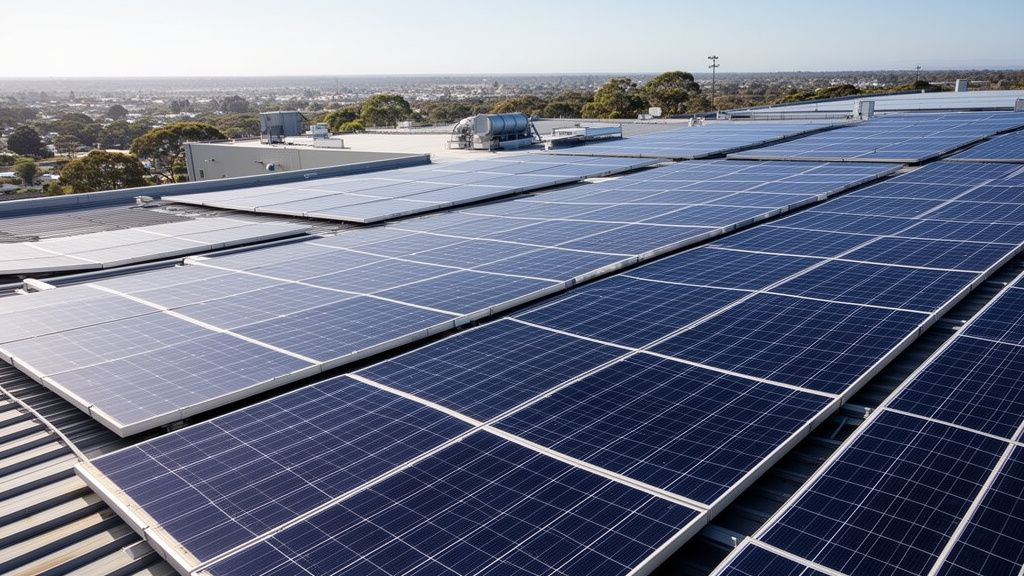
This expansion targets a massive segment of Australia's built environment. Medium-scale commercial buildings, including large warehouses, industrial factories, regional schools, major shopping centres, and agricultural facilities, often have extensive roof spaces and high electricity demands that far exceed 100 kW. Prior to this reform, installing a system sized to meet their actual load meant sacrificing the immediate financial benefits of the SRES. By lifting the limit to 1 MW, the Government has paved the way for these operations to install optimally sized solar arrays while receiving significant upfront financial support.
The Financial Mechanics: STCs vs. LGCs
To understand why this policy shift is so significant, it is essential to look at the financial mechanics of Australian solar incentives. Since 2011, the SRES has operated using Small-scale Technology Certificates (STCs). Under this model, eligible solar installations receive a set of certificates based on their expected clean energy generation over a deeming period. These certificates are typically assigned to the solar retailer or installer at the point of sale, translating into a direct, upfront discount on the installation cost for the buyer. This upfront incentive has been the primary driver of Australia's highly successful residential solar rollout.
In contrast, larger installations exceeding 100 kW have historically had to rely on the Large-scale Renewable Energy Target (LRET) and Large-scale Generation Certificates (LGCs). Unlike STCs, LGCs do not provide an upfront discount. Instead, they require the system owner to continuously monitor, report, and sell certificates on the open market based on actual ongoing generation. This process involves significant ongoing administrative overhead, legal reporting requirements, and exposure to fluctuating certificate prices. For many medium-sized businesses, the administrative burden of LGCs outweighed the benefits, leading to delayed projects or undersized 99 kW systems designed solely to stay below the SRES threshold. Transitioning these larger projects into the SRES model eliminates these administrative barriers, allowing businesses to secure simple, guaranteed upfront capital savings.
Unlocking the "Missing Middle" of Commercial Rooftops
In his address at the National Press Club, Climate Change and Energy Minister Chris Bowen described medium-scale commercial rooftop solar as Australia’s "missing middle." He highlighted the enormous, untapped opportunity that exists across the nation's industrial and commercial zones. According to Federal Government estimates, there is more than 80 GW of technical potential for commercial rooftop solar across Australia. However, despite this massive capacity, only about 5.6 GW has been installed to date. This leaves over 74 GW of potential rooftop solar power completely unutilised.


By expanding SRES eligibility, the Government aims to bridge this massive gap. The reform is expected to lower the upfront capital investment required for commercial solar installations by approximately 20%. For a medium-sized enterprise, a 20% reduction in upfront costs can equate to saving tens or even hundreds of thousands of dollars. This dramatic improvement in project economics will help businesses justify the capital expenditure and shorten payback periods, thereby accelerating the deployment of renewable energy and assisting Australia in meeting its national 2030 emissions and renewable electricity targets.
Overcoming Grid Connection and Network Barriers
Beyond financial incentives, the proposed reforms target another long-standing bottleneck in the commercial solar sector: grid connection approvals. Historically, as system sizes approach the megawatt scale, grid operators and network businesses have imposed strict, prolonged, and costly grid connection processes. These delays have frequently stalled commercial energy projects, raising costs and discouraging investment.
To resolve this issue, the Federal Government has confirmed it is actively collaborating with energy regulators and network businesses across Australia to streamline and speed up connection approvals for larger rooftop solar systems. By aligning financial support with regulatory fast-tracking, the government intends to remove both the capital and bureaucratic hurdles that have historically slowed down medium-scale solar deployment. This dual approach ensures that once a business commits to a system under the new 1 MW SRES threshold, the path to physical grid integration is as rapid and efficient as possible.
Commercial Solar Implementations and Installer Standards
For businesses planning to capitalize on the new SRES regulations, selecting a certified and experienced solar provider is crucial. Solar Link Australia, an established and trusted solar firm operating since 2010, is an example of an operator equipped to handle these larger, complex commercial installations. As a 100% Australian-owned and operated entity, Solar Link Australia is certified as both a Clean Energy Council (CEC) Approved Solar Retailer and a New Energy Tech Approved Solar Seller (NETCC).
Navigating commercial solar installations requires strict adherence to safety guidelines, engineering standards, and localized grid rules. Commercial systems demand rigorous site assessments, structural structural load calculations for warehouse roofs, and carefully tailored system designs. Utilizing established, certified providers ensures that the design, construction, and STC creation processes are managed in full compliance with Australian standards. This minimizes compliance risks and ensures that the projected 20% upfront cost savings are fully and accurately realized at the project's inception.
Key Takeaways
- Policy Milestone: Effective October 1, 2026, the SRES eligibility threshold officially expands from 100 kW to 1 MW, representing the most significant commercial solar policy update in over a decade.
- Upfront Cost Reduction: The expansion will reduce upfront commercial solar installation costs by approximately 20% by allowing businesses to claim simpler, upfront STC discounts instead of complex LGCs.
- The "Missing Middle": Out of an estimated 80 GW of commercial rooftop solar potential in Australia, only 5.6 GW has been installed. This reform directly targets this massive unutilized capacity.
- Faster Approvals: The Federal Government is working alongside energy regulators and network businesses to speed up grid connection approvals for larger commercial systems.
- Industry Alignment: To secure rebate eligibility and ensure structural safety, commercial enterprises should partner with accredited, NETCC-approved, and Clean Energy Council-approved solar retailers.
Related Guides
- Exploring Next-Generation Residential Solar Systems: Inverter and Battery Technologies for Australian Homes
- Sundown Solar and Battery Project Secures Key NSW Planning Approval Under Dust Mitigation Rules
- Designing Off-Grid Stand-Alone Power Systems and Hybrid Solar-Diesel-Battery Setups
- Navigating Australia's Solar Financial Landscape: Government Rebates and Flexible Payment Options