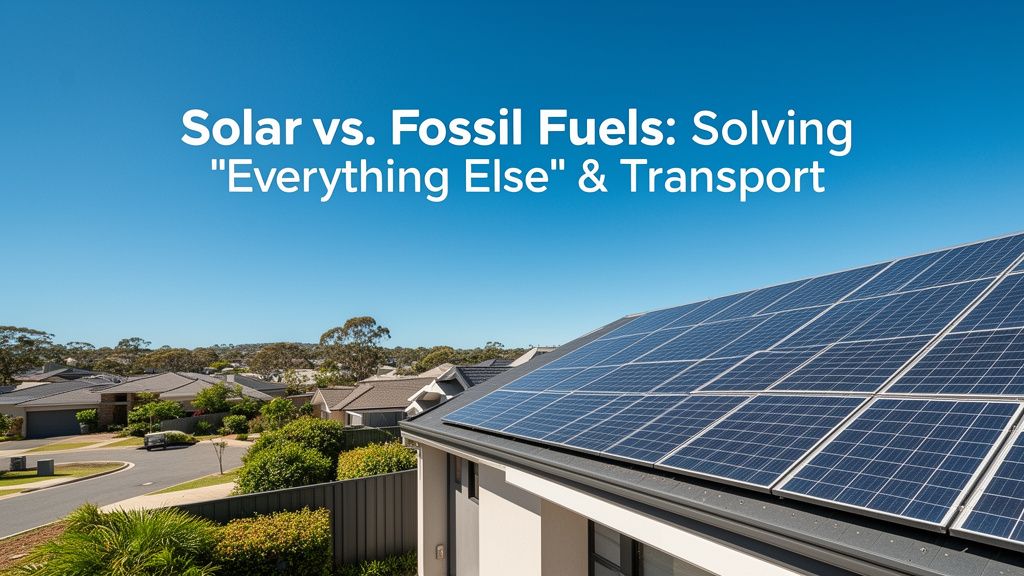
TL;DR: Fossil fuels present two distinct major problems: their use for stationary power generation (electricity, heating, industry) and their use in transportation. Solar energy offers a comprehensive and cost-effective solution for stationary power needs, drastically reducing emissions and household bills, but the transition in the transport sector is more complex and requires both direct and indirect solar-powered solutions.
What are the primary fossil fuel problems impacting Australian households and the environment?
The primary fossil fuel problems impacting Australian households and the environment stem largely from stationary energy generation, primarily for electricity, heating, and industrial processes. These "everything else" categories are massive contributors to greenhouse gas emissions and pose significant economic and health challenges. For decades, Australia's power grid has been heavily reliant on coal and gas, leading to a substantial carbon footprint. This reliance translates directly into higher electricity bills, as fossil fuel costs can be volatile, and it exposes households to the long-term environmental consequences of climate change, from more intense bushfire seasons to increased flooding. Transitioning away from these sources for homes and businesses is not just an environmental imperative but a shrewd financial move for many Australians, offering greater energy independence and stability.
How does grid electricity generation contribute to these problems?
Australia's electricity grid has historically been dominated by coal-fired power stations, which release vast amounts of carbon dioxide, sulfur dioxide, and nitrogen oxides into the atmosphere. These emissions contribute directly to climate change, air pollution, and respiratory health issues. For households, this means that even if you're not burning fossil fuels directly, your electricity consumption still carries an environmental burden and exposes you to the fluctuating wholesale prices of these commodities. When gas or coal prices spike globally, Australian households see their power bills jump, illustrating the economic vulnerability inherent in a fossil fuel-dependent energy system. The environmental impact is undeniable, from degraded landscapes due to mining to polluted air in urban centres.
What are the environmental and economic costs of burning fossil fuels for static uses?
The environmental costs of burning fossil fuels for static uses are profound, contributing to global warming, ocean acidification, and severe air quality degradation. Locally, this can manifest as smog and increased prevalence of respiratory illnesses in communities near power plants. Economically, beyond the direct cost of the fuel itself, there are significant indirect costs, often externalised from the price paid by consumers. These include healthcare expenses related to pollution, the economic damage from extreme weather events (like floods and droughts), and the long-term costs of environmental remediation. For example, maintaining and upgrading a fossil-fuel-dependent grid involves considerable investment, often passed on to consumers through network charges, highlighting the systemic expense of this energy model.
Why is the transportation sector a uniquely challenging fossil fuel problem?
The transportation sector presents a uniquely challenging fossil fuel problem due to its reliance on liquid fuels, inherent mobility requirements, and the sheer scale of global infrastructure built around internal combustion engines. Unlike stationary power generation, which can be centralised and transitioned to renewable sources like solar and wind more readily, vehicles require high energy density in a compact, portable form. Petrol and diesel have historically provided this efficiently, making them difficult to replace in a variety of applications, from passenger cars to heavy-duty trucks, shipping, and aviation. The existing ecosystem of petrol stations, vehicle manufacturing, and consumer habits represents a colossal inertia against rapid change, making decarbonisation in this sector a complex, multi-faceted engineering and behavioural challenge.
What makes decarbonising transport more complex than static electricity?
Decarbonising transport is inherently more complex than transitioning static electricity generation because it involves mobile energy sources. While a solar panel can sit on your roof and feed electricity into your home or the grid, a car needs to carry its energy source with it, often over long distances. Battery technology, while advancing rapidly, still faces challenges with energy density, charging times, and cost for certain vehicle types and ranges. Furthermore, the global supply chain for fossil fuels is deeply entrenched, and alternative fuels like hydrogen or advanced biofuels require entirely new production and distribution infrastructures. This means that unlike simply building more solar farms, the transport challenge requires a complete overhaul of how vehicles are powered, manufactured, and refuelled across every segment.
How are Australians starting to transition away from fossil fuel transport?
Australians are slowly but surely beginning to transition away from fossil fuel transport, primarily through the increasing adoption of Electric Vehicles (EVs). While still a small percentage of the total car fleet, EV sales are growing year-on-year, driven by factors such as lower running costs (especially when charged with rooftop solar), reduced maintenance, and environmental consciousness. Government incentives, such as stamp duty exemptions and rebates in some states, are also playing a role. Public charging infrastructure is expanding, albeit gradually, and innovations in electric trucks and buses are starting to appear in fleet operations. However, the pace of change needs to accelerate significantly to meet emissions reduction targets, highlighting the need for continued investment and policy support.
How does solar energy address the "Everything Else" problem for Australian homes?
Solar energy directly addresses the "Everything Else" problem for Australian homes by generating clean electricity on-site, drastically reducing reliance on grid power derived from fossil fuels. For a typical Aussie household, installing a 6.6kW solar system can offset a significant portion, if not all, of their daily electricity consumption, particularly during daylight hours. This means less demand for fossil-fuel-generated power from the grid and a smaller carbon footprint for the homeowner. Beyond just electricity, solar can also power efficient electric heating and cooling systems, hot water heat pumps, and induction cooktops, displacing gas usage and further slashing fossil fuel dependency. The financial savings are substantial, with many households seeing their electricity bills drop from hundreds of dollars a quarter to minimal service charges, often achieving payback on their system in just 3-5 years.
What are the direct financial benefits of rooftop solar for electricity?
The direct financial benefits of rooftop solar for electricity are compelling for Australian households. By generating your own power, you drastically reduce the amount of electricity you need to buy from the grid, which often costs around 30-40 cents per kilowatt-hour (c/kWh). Any excess electricity you produce can be exported back to the grid, earning you a feed-in tariff, typically between 5-15 c/kWh, further reducing your overall bill. For a typical 6.6kW system costing between $5,000 to $8,000 (after STCs), these savings can amount to $1,500-$2,500 annually, leading to a quick return on investment. This financial independence from volatile energy markets provides long-term cost stability and peace of mind for homeowners.


Can solar power Australian homes beyond just electricity?
Yes, solar can absolutely power Australian homes beyond just direct electricity needs, playing a crucial role in displacing other fossil fuel uses. For instance, solar-generated electricity can power highly efficient electric heat pumps for hot water, completely replacing gas instantaneous heaters or traditional electric resistive systems that draw from the fossil-fuel-heavy grid. Similarly, solar can contribute to powering reverse cycle air conditioners for heating, allowing households to switch off gas ducted heating systems. Modern induction cooktops, powered by solar, offer a faster, safer, and more energy-efficient alternative to gas hobs. By electrifying these traditionally gas-dependent appliances and powering them with rooftop solar, households can effectively eliminate their reliance on fossil fuels for most of their home's energy needs.
How can solar indirectly help solve the transportation challenge in Australia?
Solar energy can indirectly but significantly help solve the transportation challenge in Australia by providing a clean, cost-effective power source for electric vehicles (EVs) at home and feeding into a greener national grid for public charging. While solar panels don't directly fuel a car in the same way a petrol bowser does, they are fundamental to creating a sustainable electricity supply that can power an EV fleet. Charging an EV at home using your own rooftop solar means you're driving on sunshine, literally. This not only zero-outs your "fuel" costs but also ensures your transport emissions are minimal. As Australia's grid integrates more large-scale solar farms, even public charging stations and EVs charged away from home will draw increasingly cleaner power, accelerating the overall decarbonisation of the transport sector.
What is the role of solar in charging electric vehicles at home?
Rooftop solar plays a transformative role in charging electric vehicles at home, turning an EV from a high-emission vehicle (if charged from a fossil-fuel grid) into a truly zero-emission one. By charging your EV during daylight hours, when your solar panels are generating peak power, you can often "fill up" your car's battery for free using your own surplus electricity. This dramatically reduces the running costs of an EV, which already boasts lower per-kilometre energy costs than a petrol car. A typical household with a 6.6kW solar system can easily generate enough energy to power both their home and a substantial amount of EV driving, making the transition to electric transport even more financially attractive and environmentally responsible for Aussie families.
How does large-scale solar contribute to greening the grid for public charging?
Large-scale solar farms are absolutely vital for greening the grid, which in turn underpins the sustainability of public EV charging. As more utility-scale solar projects come online across Australia, they displace coal and gas-fired power stations, reducing the overall carbon intensity of the national electricity grid. This means that even when an EV owner uses a public fast charger, the electricity they draw is increasingly sourced from renewable energy, rather than fossil fuels. By expanding the proportion of solar and other renewables in the grid's energy mix, we ensure that every electron powering an EV, whether at home or on the road, contributes less to emissions, making the widespread adoption of electric transport a truly clean solution for Australia.
Key Takeaways
- Home solar effectively solves the "Everything Else" fossil fuel problem, significantly reducing electricity bills and household carbon footprints.
- The transportation sector presents unique challenges due to the need for portable, high-density energy, but EVs are gaining traction.
- Rooftop solar can zero-out your EV charging costs at home, making electric vehicles an even more financially attractive option.
- Large-scale solar farms are crucial for decarbonising the entire electricity grid, ensuring public EV charging is increasingly powered by clean energy.
- Australians can achieve greater energy independence and financial savings by embracing solar solutions for their homes and future transport needs.
Read More
For a comprehensive overview, check out our master guide: Read the Full Guide Here.