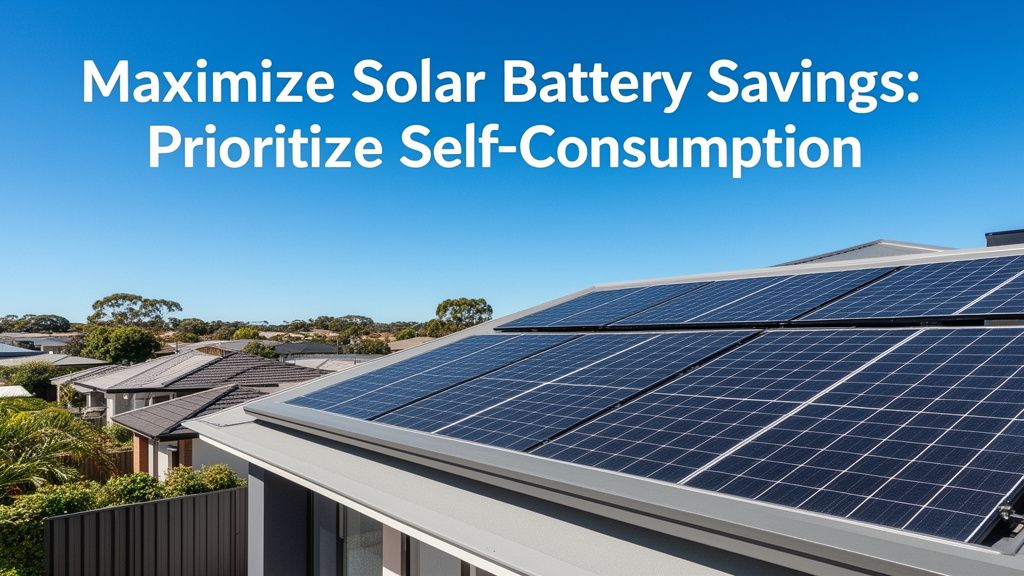
TL;DR: Your solar battery delivers the biggest financial return when you use its stored power to avoid buying expensive electricity from the grid. Focusing on self-consumption saves significantly more than exporting excess energy for low feed-in tariffs.
What is Self-Consumption and Why Does it Matter Most for Battery Owners?
Self-consumption means using the electricity your solar panels generate yourself, rather than sending it back to the grid. For solar battery owners, this concept stands as the cornerstone of real savings. When your solar panels produce more electricity than your home consumes during the day, a battery stores that excess power. Instead of exporting this surplus for a small credit, you retain it for use when your panels are not producing, like in the evening or on cloudy days. This direct usage of your own stored energy avoids expensive purchases from your electricity retailer. Australians often pay between 30-45 cents per kilowatt-hour (kWh) to buy electricity from the grid, while they might only receive 5-8 cents per kWh for exporting their surplus. This significant difference in value highlights why keeping and using your own power is the most financially sound strategy.
How Your Battery Changes the Energy Game
Before batteries, excess solar power automatically went to the grid, earning a feed-in tariff. Households still bought power back at retail rates when solar wasn't producing. A battery shifts this dynamic completely. It acts as your personal energy bank, letting you draw on your own stored solar instead of grid power when the sun goes down. This ability to match your solar generation with your household demand significantly boosts your independence from fluctuating grid prices. It transforms a system that mainly offsets daytime usage into one that provides clean, cheap energy around the clock. Your battery is less about selling power and more about avoiding buying it.
How Does Prioritising Self-Consumption Deliver Real Savings?
Prioritising self-consumption delivers real savings by directly reducing the amount of high-priced electricity you need to buy from the grid. Imagine your retail electricity price sits at 40 cents per kWh in Sydney. If your solar battery allows you to avoid importing 10 kWh from the grid each evening, you save $4.00 per day (10 kWh x $0.40/kWh). Over a year, this amounts to $1,460 in avoided electricity costs. Now, consider the alternative: exporting that same 10 kWh to the grid. If your feed-in tariff is a typical 6 cents per kWh, you would only earn $0.60 for that same amount of energy. The financial difference is stark: saving $4.00 versus earning $0.60. By retaining and using your own power, you effectively value each kWh at your import rate, which is often 5 to 8 times higher than your export rate. This fundamental economic reality drives the self-consumption strategy.
The Peak Price Advantage
Many Australian households pay higher electricity rates during peak evening hours, typically between 4 PM and 9 PM. This coincides precisely with when most people come home, turn on lights, cook dinner, and run appliances – times when solar panels produce little or no power. A solar battery charged during the day can discharge during these expensive peak periods, directly offsetting your highest-cost electricity consumption. This strategy insulates you from demand charges and time-of-use tariffs, further cementing the financial benefits of self-consumption over exporting.
What Strategies Maximise Your Solar Battery Self-Consumption?
Maximising your solar battery self-consumption involves a combination of smart technology and mindful energy habits. Modern battery management systems are programmed to prioritise your home's usage, ensuring the battery charges when there's excess solar and discharges when your home needs power and solar isn't available. You can enhance this by time-shifting your energy use. Run high-draw appliances like dishwashers, washing machines, or pool pumps during daylight hours when your solar panels are producing abundantly, letting them run directly from your panels or use minimal grid power. If you still have excess solar after meeting daytime needs and fully charging your battery, then consider running these appliances from your stored battery power in the evening rather than drawing from the grid. Monitoring your energy consumption through your solar app helps identify patterns where you might be exporting unnecessarily or importing when you could be using battery power.
Understanding Your System's Data
Most contemporary solar inverter and battery systems offer detailed monitoring apps. These apps provide real-time insights into your solar production, home consumption, battery charge level, and grid interaction. Regularly checking this data helps you understand your energy flows. You might notice, for example, that your battery is always full by 2 PM, and you consistently export power for the next few hours. This is a clear signal to adjust your habits or automation – perhaps set your electric vehicle to charge then, or delay running the dryer until the afternoon. Conversely, if your battery often depletes too early in the evening, you might need to conserve power or consider optimising your battery's charge/discharge settings if your system allows it.
Are There Times When Exporting Power Makes Sense with a Battery?
While prioritising self-consumption usually offers the best financial return for Australian solar battery owners, there are limited scenarios where exporting power can be a beneficial part of your strategy. One such scenario involves exceptionally high feed-in tariffs, though these are increasingly rare for standard residential connections. Some niche energy plans, or very specific regional schemes, might offer an export rate that approaches or even exceeds your import rate, making exporting profitable. However, for the vast majority of households across major cities like Melbourne, Brisbane, or Perth, feed-in tariffs sit far below retail purchase prices. Another scenario involves participation in a Virtual Power Plant (VPP) scheme.
Virtual Power Plants (VPPs) and Exporting
Virtual Power Plants pool the stored energy from many home batteries to act as a single, larger power source for the grid. If you join a VPP, your energy retailer or a third-party operator can remotely dispatch power from your battery back to the grid during periods of high demand or grid instability. In return, you receive payments or credits, which are often more lucrative than standard feed-in tariffs. These payments compensate you for providing grid services, effectively turning your battery into a small, distributed power station. While this involves exporting, it's a managed export with specific incentives, rather than simply letting excess energy flow back to the grid for minimal return. For most Australians, though, the daily savings from avoiding grid purchases still outweigh these specific export opportunities.
Key Takeaways
- Your solar battery offers the greatest financial benefit by allowing you to use your own generated electricity, avoiding expensive grid purchases.
- The value of saving 30-45c/kWh by using battery power far exceeds the 5-8c/kWh you earn from exporting excess power.
- Utilise your battery's smart management system and time-shift high-draw appliances to maximise your self-consumption.
- Monitor your energy usage via your solar app to identify opportunities to use more of your own power and reduce reliance on the grid.
- Only in specific circumstances, such as high-value Virtual Power Plant schemes, does exporting power become financially competitive with self-consumption.
Read More
For a comprehensive overview, check out our master guide: Read the Full Guide Here.