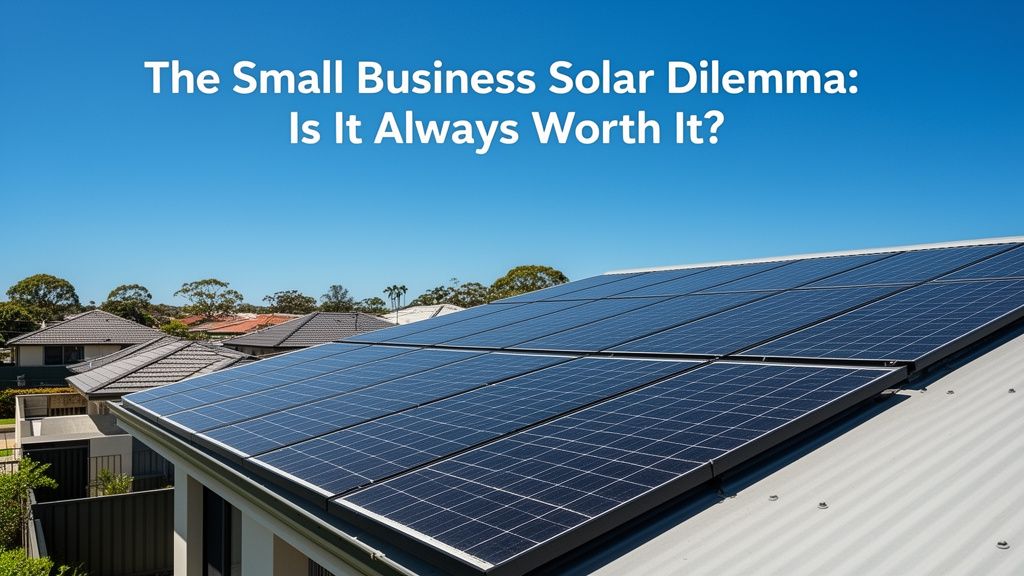
The Small Business Solar Dilemma: Is It Always Worth It?
G’day, fellow Aussie small business owners! We’ve all felt the pinch of rising electricity bills, and the idea of slapping solar panels on the roof seems like a no-brainer. After all, Australia has sunshine in spades, and who wouldn’t want to slash their operating costs and wave the green flag? For many, solar has proven to be a game-changer, but for others, the dream of energy independence has been overshadowed by unforeseen complexities. So, is commercial solar always the bright solution it appears to be? Let's dive into the nuances of the small business solar dilemma.
The Allure of Solar: Why Businesses Are Looking Up
There’s no denying the powerful appeal of solar energy for businesses. The benefits are substantial and often cited as key drivers for investment. Firstly, there’s the obvious: cost savings. With commercial electricity rates often sitting around 25-40 cents per kilowatt-hour, generating your own power during the day can dramatically reduce your grid reliance and, consequently, your energy expenditure. This isn't just a minor saving; it can significantly improve your bottom line over time.
Secondly, adopting solar boosts your environmental credentials. In an increasingly conscious market, showcasing your commitment to sustainability can be a powerful marketing tool, attracting eco-minded customers and even potential employees. It’s good for the planet and good for your brand image. Thirdly, solar offers a degree of energy security, hedging against future electricity price hikes and potential grid instability. Plus, the federal Small-scale Technology Certificates (STCs) offer an upfront discount on installation costs, making the initial investment more palatable.
The Cloudy Patches: When Solar Gets Tricky
While the benefits are clear, solar isn't a magic bullet for every small business. The "dilemma" arises when you start to factor in specific operational realities.
Upfront Investment & Cash Flow: Commercial solar systems, typically ranging from 10kW to 100kW for small to medium businesses, can cost anywhere from $15,000 to over $100,000, even after STC rebates. For a small business, this is a significant capital outlay. While financing options exist – from business loans to Power Purchase Agreements (PPAs) – it’s crucial to assess the impact on your cash flow and ensure the repayments don’t outweigh the immediate savings.
Operational Hours Mismatch: This is perhaps the biggest consideration. Solar panels generate electricity when the sun is shining. If your business primarily operates at night, or if you're a weekend-only retail outlet that closes during peak solar production hours, you might be exporting a significant portion of your generated power back to the grid. Unfortunately, commercial feed-in tariffs (FiTs) in Australia are notoriously low, often just 5-10 cents per kWh. This means you might be buying power for 30 cents and selling it for 7 cents – hardly a profitable exchange. Maximum self-consumption is key to a fast payback.
Roof Real Estate & Suitability: Not every roof is solar-ready. Factors like size, orientation (north-facing is ideal), shading from nearby trees or buildings, and the structural integrity of the roof itself can limit your system's potential. If your roof requires significant repairs or upgrades before panels can be installed, it adds to the upfront cost and complexity. For businesses operating out of leased premises, landlord approval is essential, and you might not want to invest heavily in an asset you could leave behind.

Leasing vs. Owning: Deciding between purchasing outright, financing with a loan, or entering a PPA requires careful consideration. A PPA, where a third party owns and maintains the system and you pay for the electricity it generates at a fixed rate, can eliminate upfront costs but ties you into a long-term contract. Owning the system outright gives you full control and all the savings, but demands the capital investment.
Navigating the Nuances: Key Considerations
So, how do you determine if solar is right for your specific small business? It boils down to thorough investigation and tailored analysis.
Energy Audit: Before anything else, get a detailed energy audit. Understand precisely when and how much electricity your business consumes. This data is critical for accurately sizing a solar system to maximise self-consumption.
System Sizing & Design: Don't just go for the biggest system your roof can hold. An experienced solar provider should design a system that closely matches your daytime energy usage. An oversized system that exports too much power will have a longer payback period.
Financial Analysis: Work with your accountant or a reputable solar consultant to project the payback period and Return on Investment (ROI). Consider all costs: installation, potential upgrades, maintenance, cleaning, and insurance. A typical payback for a well-matched commercial system might be anywhere from 3 to 7 years, but this varies wildly.
Financing Options: Explore all your financing avenues. Beyond traditional loans, government-backed initiatives or specific green finance products might be available. Understand the terms, interest rates, and overall cost of borrowing.
Maintenance & Longevity: Solar panels are generally robust, but they aren't maintenance-free. Regular cleaning can prevent efficiency losses, and inverters typically need replacing after 10-15 years. Factor these long-term costs into your financial modelling. Also, consider your business's longevity in its current location. Will you be there long enough to realise the full benefits?
Making an Informed Decision
The small business solar dilemma isn't about whether solar is "good" or "bad." It's about whether it's the right fit for your unique business. There's no one-size-fits-all answer.
Get multiple quotes from Clean Energy Council accredited installers. Ask for detailed proposals that include estimated generation, payback periods based on your specific usage, and a breakdown of all costs. Don't be afraid to challenge assumptions or ask for references from similar businesses they've helped.
Conclusion
For many Australian small businesses, solar represents an incredible opportunity to take control of their energy future, reduce costs, and enhance their brand. However, ignoring the potential pitfalls can turn a promising investment into a financial headache. The key lies in doing your homework, understanding your energy consumption patterns, and securing a system that's perfectly tailored to your operational realities. By carefully weighing the sunny benefits against the cloudy complexities, you can make an informed decision that truly empowers your business for years to come.
Read More
For a comprehensive overview, check out our master guide: Read the Full Guide Here.