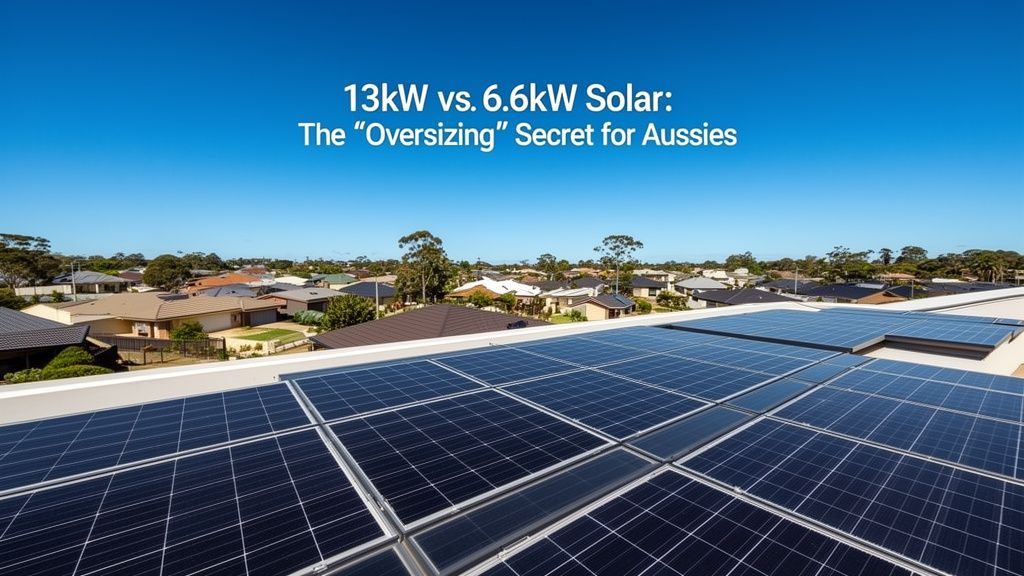
TL;DR: While the 6.6kW solar system is often recommended as the optimal size for Australian homes due to common inverter limits and feed-in tariff considerations, a 13kW system can be a far more strategic investment for many. This "oversizing" approach maximises energy generation throughout the day and future-proofs your home for growing energy demands, offering superior long-term savings despite a slightly higher upfront cost.
Why is the 6.6kW System So Commonly Recommended in Australia?
The 6.6kW solar system has long been touted as the "sweet spot" for Australian homeowners, a consensus largely driven by practical grid regulations and economic incentives. This system size is typically paired with a 5kW inverter, as most single-phase residential properties in Australia have a maximum inverter output limit of 5kW without requiring costly grid upgrades. This pairing means you can install up to 6.6kW of panels and still benefit from the maximum Small-scale Technology Certificates (STCs) and standard feed-in tariffs without triggering complex and expensive network connection approvals. For many years, this combination offered a fantastic balance between upfront cost, energy generation, and eligibility for incentives, making it a straightforward recommendation for the average household looking to reduce their power bills without overcomplicating things.
The Single-Phase Inverter Limit
Most Australian homes operate on a single-phase electricity connection, which traditionally caps inverter output at 5kW. This 5kW limit is a significant factor driving the popularity of the 6.6kW panel array, as it's the largest panel capacity you can generally connect to a 5kW inverter without substantial "clipping" (where the inverter can't process all the power the panels produce at peak times) while still fitting within the common network operator rules. Installers have become adept at designing systems around this constraint, ensuring homeowners get a good return on investment without triggering complex and expensive grid connection approvals, which can be a real headache.
Feed-in Tariff Incentives and Clipping
Feed-in tariffs (FiTs) also play a role in the 6.6kW recommendation, as historically, higher export capacities could sometimes lead to lower FiT rates or even necessitate export limiting devices. While "clipping" on a 5kW inverter means you might lose a small amount of peak generation from 6.6kW of panels, the idea is that this minor loss is offset by better generation during shoulder periods (morning/afternoon) and the simplified network approval process. For many, the calculation has been that maximising self-consumption with a system that rarely exports massive amounts of power during peak sun, coupled with a simple installation, makes the most economic sense.
How Does "Oversizing" a Solar System to 13kW Actually Work?
"Oversizing" a solar system, such as installing a 13kW panel array with a 10kW inverter (or even still a 5kW for some scenarios), deliberately installs more panel capacity than the inverter's nominal output. This isn't about wasting capacity; it's a shrewd strategy to maximise energy generation throughout the day, even with some expected "clipping" during absolute peak sun hours. The principle is simple: by having significantly more panels, your system can reach its inverter's maximum output earlier in the morning, sustain it longer through the day, and continue generating substantial power later in the afternoon or on cloudier days. This approach drastically increases your overall daily energy harvest, ensuring you're generating more of your own power for longer, which translates directly into larger savings on your electricity bill.
Maximising Early Morning and Late Afternoon Generation
A 13kW panel array paired with, say, a 10kW inverter, ensures that even when the sun isn't directly overhead, you're still producing significantly more power than a smaller system. This is crucial for Australian homes, where peak energy demand often occurs in the early morning and late afternoon – times when a standard 6.6kW system might only be producing a fraction of its capacity. With "oversizing", your panels hit the inverter's maximum output faster and maintain it longer, providing a substantial boost to your self-consumption during those critical shoulder periods, meaning less reliance on expensive grid power when you need it most.
Future-Proofing for Higher Energy Demands
Investing in a 13kW system is a forward-thinking move, preparing your home for the inevitable increase in electricity consumption that many Australians face. With the rise of electric vehicles (EVs), the increasing popularity of home battery storage, and the ongoing electrification of appliances, your future energy needs are likely to soar. A larger system provides the abundant energy needed to charge an EV, fill a battery, or run energy-intensive heat pumps, reducing your dependence on the grid and future-proofing your household against rising electricity prices. It's about building in resilience and capacity for tomorrow, today.
What Are the Real-World Cost Implications of a 13kW System vs. a 6.6kW?
While a 13kW system naturally carries a higher upfront cost than its 6.6kW counterpart, the difference isn't as proportional as you might think, and the long-term return on investment (ROI) can be significantly more attractive. A typical 6.6kW system in Australia might range from $5,000 to $8,000 after STC rebates, whereas a 13kW system could sit anywhere from $10,000 to $15,000, depending on components and installation complexity. The key is that the cost per watt decreases as system size increases; you're paying for additional panels, a larger inverter, and more labour, but the bulk of the fixed installation costs (permits, scaffolding, wiring) are similar regardless of size. This diminishing per-watt cost, combined with the dramatically increased energy generation, accelerates your payback period and amplifies your savings over the system's 25-year lifespan.
Comparing Initial Outlay and STC Rebates
The initial outlay for a 13kW system is indeed higher, but it's important to remember that Small-scale Technology Certificates (STCs) are calculated per 1kW of panels installed. This means a 13kW system will attract roughly double the STC rebate compared to a 6.6kW system, significantly cushioning the upfront cost difference. For example, if a 6.6kW system gets you around $3,000 in STCs, a 13kW system might net you closer to $6,000, effectively reducing the net cash difference between the two sizes. You're paying more, but you're also getting more back from the government incentive.
Calculating the Long-Term ROI
The real magic of the 13kW system lies in its long-term financial benefits. While the payback period might be slightly longer initially due to the higher upfront cost, the sheer volume of electricity generated translates into substantially greater savings over two decades. If a 6.6kW system saves you $1,500 annually, a 13kW system could easily save you $2,500-$3,000 or more, especially if you're a high energy user or integrate a battery. This increased annual saving means that over the life of the system, your total financial gain will be significantly larger, making the 13kW option a much smarter investment for substantial, enduring bill reductions.
Who Benefits Most from Investing in a Larger 13kW Solar System?
Homeowners who are high energy consumers, those with an eye on future energy demands like electric vehicles or battery storage, or even properties with less-than-ideal roof orientations are the prime candidates for a 13kW "oversized" solar system. This larger capacity ensures maximum self-sufficiency and substantial long-term savings for households that truly need to offset significant electricity usage. If your current power bills are consistently high (think $400+ per quarter), or you're planning major energy-consuming additions to your home, a 13kW system moves from an optional upgrade to a practically essential investment for optimising your energy independence and financial returns.

Households Considering Electric Vehicles or Battery Storage
For those planning to purchase an electric vehicle (EV) or integrate a home battery system, a 13kW solar array is almost non-negotiable. EVs are energy guzzlers, and a standard 6.6kW system often won't generate enough surplus energy to charge a car daily while also running the house, let alone filling a battery. A 13kW system provides the abundant electricity required to power your home, charge your EV overnight from solar-charged batteries, or simply export more during the day to generate credits that offset evening grid usage. It’s the smart play for genuine energy independence.
Homes with Shading or Less-Than-Ideal Roof Orientation
Even if your roof isn't perfectly north-facing or suffers from some partial shading at certain times of the day, an oversized 13kW system can still outperform a perfectly positioned 6.6kW array. By having significantly more panels, you're increasing the chances that a good portion of your array is always exposed to sufficient sunlight, even if other sections are shaded or facing slightly east/west. The extra panel capacity acts as a buffer against suboptimal conditions, ensuring you still hit your inverter's maximum output for longer periods and generate more overall energy throughout the day, compensating for less-than-perfect installation circumstances.
When Is a Standard 6.6kW Solar System Still the Smarter Choice?
Despite the clear advantages of oversizing, a standard 6.6kW solar system remains the smarter choice for a specific segment of Australian homeowners. These are typically households with genuinely low energy consumption, those working with strict budget limitations, or properties constrained by limited roof space or complex grid connection requirements. It’s important to acknowledge that not every home needs or can accommodate a massive solar array, and for these specific circumstances, the 6.6kW system still offers a fantastic, cost-effective entry point into solar, delivering significant savings without unnecessary expenditure or complexity.
Lower Energy Consumption and Budget Constraints
For households with consistently low electricity bills (e.g., under $200 per quarter) and minimal plans for increasing their energy usage (no EVs, no large appliances), a 6.6kW system is often perfectly adequate. It will likely cover most, if not all, of their daytime electricity needs and provide a healthy offset against evening usage. Furthermore, for those on a very tight budget, the lower initial investment of a 6.6kW system makes it a more accessible entry point into solar, allowing them to start saving money sooner without stretching their finances too thin.
Limited Roof Space or Specific Grid Requirements
Sometimes, physical constraints dictate system size. If your roof has limited usable space due to vents, skylights, or unusual shapes, a 6.6kW system might be the maximum you can physically install. Similarly, some regional or older grid connections might have very strict limits on inverter capacity and export, making it impractical or prohibitively expensive to install anything larger than a 5kW inverter (paired with 6.6kW of panels) without extensive network upgrades. In these scenarios, sticking to the standard 6.6kW ensures compliance and avoids unnecessary costs or installation headaches.
Key Takeaways
- A 13kW solar system, often paired with a 10kW inverter, strategically "oversizes" to maximise total daily energy generation for Australian homes.
- This larger system excels at providing power during shoulder periods (morning/afternoon) and offers superior future-proofing for EVs, batteries, and increasing energy demands.
- While the initial cost is higher, the per-watt cost is lower, and significantly larger STC rebates and long-term savings accelerate the overall return on investment.
- High energy users, those planning for electric vehicles or battery storage, and homes with less-than-ideal roof conditions are the prime beneficiaries of a 13kW system.
- A 6.6kW system remains a smart choice for low energy consumers, those on strict budgets, or homes with genuine roof space or grid limitations.