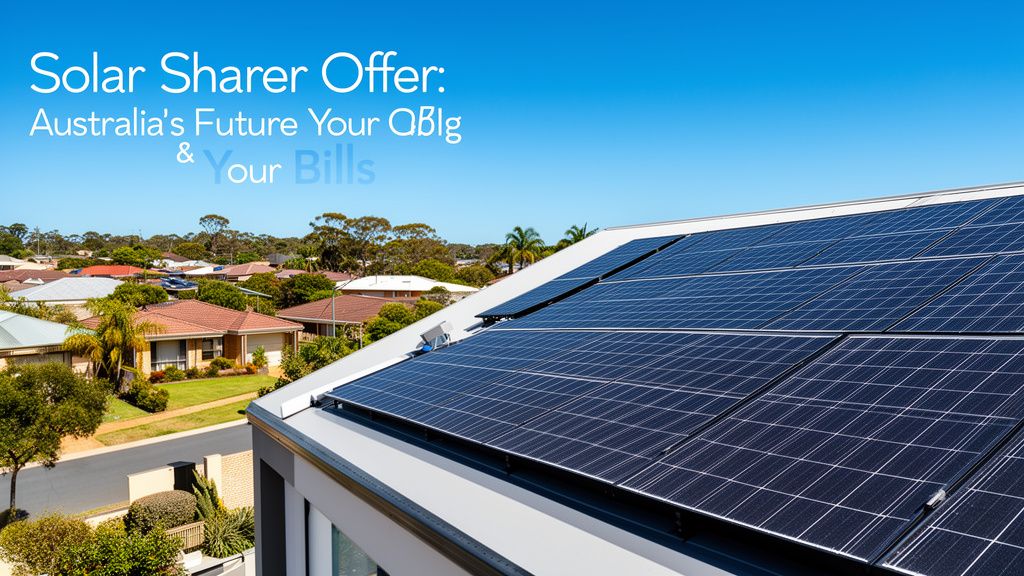
TL;DR: The Solar Sharer Offer is an innovative scheme allowing households to monetise surplus solar energy by selling it directly to neighbours or businesses, not just the grid. This initiative democratises solar access and is set to significantly accelerate Australia's transition to a decentralised, renewable energy future across all states by fostering local energy communities.
What exactly is the Solar Sharer Offer and how does it work?
The Solar Sharer Offer is a groundbreaking peer-to-peer (P2P) energy trading model that allows solar-equipped households to directly sell their excess renewable energy to other consumers within their local community, rather than solely exporting it back to the main grid. Unlike traditional feed-in tariffs (FiTs) where energy is sold to a retailer at a often low, fixed rate, the Solar Sharer Offer enables a direct financial transaction between a solar energy producer and an energy consumer – be it a neighbour, a local business, or even a community group. This model is facilitated by digital platforms, often using blockchain technology for secure and transparent transactions, coupled with smart meters that accurately track energy generation and consumption. Essentially, if you’re a household in Queensland with a 6.6kW solar system generating more power than you use on a sunny arvo, you can now offer that surplus directly to a nearby renter in a unit who might not have their own solar, at a mutually agreed price.
Moving Beyond Traditional Feed-in Tariffs
Traditional feed-in tariffs have been instrumental in encouraging solar adoption by offering a credit for exported energy, but these rates typically range from a modest 4-10 cents per kWh in most states, which can feel a bit stingy compared to the 25-40 cents per kWh you pay to buy power from the grid. The Solar Sharer Offer fundamentally changes this dynamic. Instead of being a passive recipient of the retailer's FiT, solar owners become active participants in a local energy market, able to set a more competitive price for their surplus energy – potentially earning 15-25 cents per kWh, which is a far better return on their investment. This shift not only empowers solar owners but also creates a more dynamic and responsive local energy economy, making solar ownership even more financially attractive.
The Role of Digital Platforms and Smart Meters
The backbone of the Solar Sharer Offer is sophisticated digital platforms and smart metering infrastructure. These platforms act as a marketplace, connecting sellers and buyers of local solar energy and managing the transactions. Smart meters, which are increasingly common across Australian homes, are crucial for accurately measuring the amount of energy being generated and consumed in real-time. This precision ensures that both the seller is credited correctly for their exported power and the buyer is charged accurately for their consumption. The platforms often integrate with existing grid infrastructure, ensuring energy flow is managed efficiently and reliably. For example, a family in Perth could use an app to see how much energy their system is exporting and set a price, while a small business down the road could use the same app to purchase that energy, all seamlessly managed by the platform.
How will the Solar Sharer Offer impact household energy bills across Australia?
The Solar Sharer Offer is poised to significantly reduce household energy bills for both solar-equipped homes and non-solar consumers across Australia. For solar owners, it means a substantial increase in the value of their excess energy, potentially turning a system that previously offered decent savings into a genuine income-generating asset. For non-solar households, particularly those who can't install their own panels like renters or apartment dwellers, it offers access to cheaper, locally sourced renewable energy, bypassing higher retail prices and reducing their carbon footprint without the upfront investment. The competitive nature of this localised market should drive down overall energy costs.
Increased Income for Solar Producers
For the millions of Australian households that have invested in solar panels, the Solar Sharer Offer represents a golden opportunity to maximise their return on investment. Instead of receiving a paltry 5-8 cents per kWh for exported energy from their retailer, they could potentially sell it to a neighbour for 15-25 cents per kWh. This could mean hundreds of extra dollars in their pocket each year, dramatically shortening the payback period for their solar system. For instance, a typical 6.6kW system might export 3,000-4,000 kWh annually. At a higher sharing rate, that's an extra $300-$680 each year compared to standard FiTs, making solar an even more compelling financial decision for families in Sydney, Melbourne, or any other regional centre.
Savings for Energy Consumers
The benefits aren't just for those with panels on their roofs. For households without solar, the Solar Sharer Offer provides access to cheaper, cleaner energy. Instead of paying the standard retail rates, which can climb as high as 40 cents per kWh during peak times, they can purchase energy directly from their neighbours at a significantly reduced rate – potentially saving 10-20 cents per kWh on their consumption. This is particularly beneficial for renters, apartment residents, or those in shaded properties who have previously been excluded from the direct financial benefits of solar power. Imagine a family in Adelaide buying their evening power from a local school's solar panels at a fraction of the cost, making sustainable living more affordable and accessible for everyone.
What are the broader benefits of decentralised energy sharing for all states?
Decentralised energy sharing, as enabled by the Solar Sharer Offer, delivers a cascade of broader benefits that extend far beyond individual household savings, impacting grid stability, environmental sustainability, and community resilience across every Australian state. By distributing energy generation and consumption closer to the point of use, it reduces the strain on national transmission infrastructure, enhances energy security, and significantly accelerates the nation's transition away from fossil fuels. It fosters a more robust and adaptable energy system, less susceptible to large-scale outages and price volatility.
Strengthening Local Energy Grids
One of the most significant benefits of the Solar Sharer Offer is its potential to strengthen and stabilise local energy grids. When energy is generated and consumed within a local area, it reduces the amount of power that needs to be transported over long distances via large-scale transmission lines. This alleviates congestion, lowers transmission losses, and reduces the need for costly upgrades to ageing infrastructure. For states like New South Wales and Victoria, which have vast networks, this means a more resilient and efficient system. In the event of an outage on the main grid, local energy communities with high levels of P2P trading could potentially maintain power within their microgrid, offering a level of energy independence and security previously unheard of.

Accelerating Australia's Renewable Transition
The Solar Sharer Offer is a powerful catalyst for Australia's transition to 100% renewable energy. By making solar more financially rewarding, it incentivises more households and businesses to install panels, significantly increasing the overall renewable energy capacity across the country. Every kWh traded locally means less reliance on coal and gas-fired power plants, leading to a substantial reduction in carbon emissions. This scheme empowers communities in Queensland, Western Australia, and all other states to actively participate in and profit from the clean energy revolution, driving down the nation's carbon footprint much faster than centralised grid developments alone could achieve. It's a genuine ground-up approach to tackling climate change.
What are the potential challenges and considerations for widespread adoption of the Solar Sharer Offer?
While the Solar Sharer Offer presents immense opportunities, its widespread adoption across all Australian states will not be without its challenges. Key hurdles include harmonising diverse state-based regulatory frameworks, ensuring equitable access to the necessary technology for all consumers, and building public trust and understanding in this new energy paradigm. Navigating these complexities will be crucial to unlocking the full potential of decentralised energy trading and ensuring it benefits everyone, not just early adopters.
Navigating Diverse State Regulations
Australia's energy market is complex, with each state and territory having its own specific regulations, network rules, and consumer protections. For the Solar Sharer Offer to truly thrive nationally, there needs to be a degree of standardisation or at least clear pathways for its operation across these diverse frameworks. Issues around network charges for shared energy, consumer rights, and dispute resolution will need careful consideration and policy development. For example, a scheme operating seamlessly in South Australia might face different legislative barriers in Tasmania. Regulators will need to work together to create an environment that encourages innovation while protecting consumers and ensuring grid stability, preventing a patchwork of rules that could stifle growth.
Ensuring Accessibility and User Confidence
Another significant challenge is ensuring that the Solar Sharer Offer is accessible to all Australians, regardless of their technical literacy or economic situation. The digital platforms must be intuitive and user-friendly, and the benefits clearly communicated. There’s also the question of trust: consumers need to be confident in the accuracy of metering, the security of transactions, and the reliability of their energy supply when relying on a decentralised model. Overcoming these hurdles will require robust public education campaigns, strong consumer protections, and potentially subsidised access to smart meters or platform fees for lower-income households, making sure no one is left behind in this energy revolution.
Key Takeaways
- The Solar Sharer Offer enables peer-to-peer solar energy trading, offering better financial returns for producers than traditional feed-in tariffs.
- It promises lower electricity costs for non-solar buyers and increased income for solar system owners across all states.
- This decentralised scheme significantly enhances local grid resilience and accelerates Australia's national transition to renewable energy.
- Successful widespread adoption hinges on developing harmonised regulatory frameworks and ensuring accessible, user-friendly technology for all Australians.
- All states stand to benefit from a more localised, community-driven energy system that empowers consumers and strengthens energy security.
Read More
For a comprehensive overview, check out our master guide: Read the Full Guide Here.