TL;DR: Solar energy in Australia is expanding rapidly, with more than 30% of households adopting rooftop PV and renewables now accounting for 43% of the nation's electricity. This guide details how solar technologies work, the transition of domestic energy systems, system design principles, and the economic landscape of modern home solar.
Understanding the Core Technologies of Solar Power
To understand the viability of residential solar, one must first explore the physical technologies that capture sunlight and convert it into usable energy. According to the Australian Renewable Energy Agency (ARENA), solar energy is generated from the light and heat of the sun. This solar resource is harnessed primarily through two distinct technologies: solar photovoltaic (PV) and solar thermal.
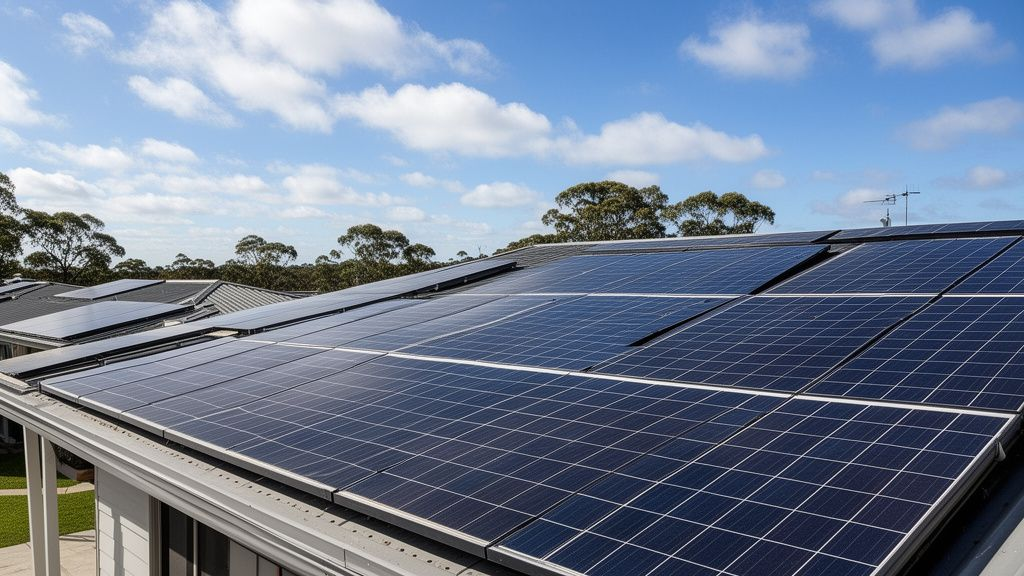
Solar photovoltaic technology converts sunlight directly into electricity using semiconductor cells, commonly known as solar PV cells. In a standard domestic application, these semiconductor cells are encased in protective glass and structured within an aluminium frame to form a durable solar panel. This technology is highly modular. A single panel can power an isolated device like a light, while larger configurations can cover a residential rooftop or be integrated into utility-scale solar farms generating hundreds of megawatts. Future innovations in solar PV are actively being developed for specialized applications, including building-integrated PV, flexible PV, and even PV paint.
Solar thermal technology takes a different approach by converting sunlight into heat (thermal energy). On a residential scale, solar thermal is utilized for domestic hot water systems or space heating. On a utility scale, concentrated solar thermal plants harvest the sun's heat using vast fields of mirrors to reflect sunlight onto a central receiver. This receiver transfers the heat to a thermal energy storage system, which can then release steam to drive electricity generators on demand. Interestingly, solar thermal energy can also drive a refrigeration cycle to provide solar-based cooling.
Global and Australian Solar Trends
The economic viability of solar energy has shifted dramatically over the past decade. Globally, more than 700 GW of solar PV was installed by the end of 2020, meeting approximately 3 percent of global electricity demand. This rapid scaling has been driven by massive cost reductions. Between 2010 and 2019, the global levelised cost of electricity (LCOE) for large-scale solar fell by 85 percent. As a result, more solar PV energy is added to the global grid each year than any other type of energy generation.
Australia has established itself as a world leader in residential solar adoption. Solar PV generated approximately 10 percent of Australia's electricity during the 2020-21 financial year, making it the nation's fastest-growing generation source. More than 30 percent of Australian households have now installed rooftop solar PV, representing a combined capacity that exceeds 11 GW. This decentralized rooftop network is supported by utility-scale generation, with almost 7 GW of large-scale solar farms connected to the Australian electricity grid. According to the Clean Energy Australia 2026 report, renewable energy has grown to account for 43 percent of Australia's total electricity, highlighting the rapid pace of the clean energy transition.
Sizing and Designing Your Residential Solar System
Designing a residential solar system requires an understanding of how components interact to meet a household's energy demand. A standard residential setup consists of solar panels, an inverter, and an optional battery storage unit. The solar panels capture sunlight and generate direct current (DC) electricity. Because households run on alternating current (AC) electricity, an inverter is required to transform the power into a usable form. A home battery system allows homeowners to store excess energy generated during peak daylight hours for use during the evening or periods of low sunlight.
System design is highly dependent on localized factors, such as a home's specific energy needs, roof space, and budget. To optimize system size and output, in-house engineers analyze site specifics and historical energy bills. Platforms like Solar Choice provide comparison services, having helped 575,265 Australian households compare solar and battery quotes online since 2008. These services allow consumers to review competitive tenders from pre-vetted networks of over 400 installers, helping secure optimal pricing and system configurations.
For residents in multi-unit developments, solar adoption has historically been more complex. However, targeted programs such as the Solar Apartment for Residents Grant Program are opening up pathways for apartment complexes and owners corporations. Feasibility studies, such as those conducted by Solar Choice, help body corporates understand their options for shared rooftop solar and electric vehicle (EV) charging infrastructure, showing how modern strata developments can transition to clean energy.

Government Support, Rebates, and Finance Initiatives
The Australian Government and state entities have implemented several programs to support residential clean energy adoption. The Department of Climate Change, Energy, the Environment and Water hosts energy.gov.au, providing tools like the Solar Consumer Guide to assist households in navigating rooftop solar and battery installations. On 1 July 2026, the government launched the Home Energy Rating tool to simplify residential energy ratings for consumers.
Financial assistance programs are available to ease the upfront costs of installing solar systems. The Household Energy Upgrades Fund offers discounted finance products to help households upgrade their properties with solar PV, modern energy-efficient appliances, and other sustainability improvements. Additionally, the Solar Sharer Offer provides eligible households with 3 hours of free electricity in the middle of the day, helping users maximize the benefits of daytime solar generation. State and territory programs also offer specific rebates, feed-in tariffs, and grants to lower the cost of solar panel and battery installations.
Beyond individual residential initiatives, the broader public sector is also transitioning. For instance, the Australian Government provided $40.5 million in funding to help Australia Post electrify its fleets and cut emissions, alongside broader initiatives to support electric trucks and heavy transport infrastructure.
The Role of Industry Standards and Community Trust
As renewable energy capacity expands, maintaining community trust and high industry standards is essential. The Clean Energy Council, representing about 1,000 member companies, drives change through policy advocacy, industry support programs, and professional education.
To ensure local communities benefit from large-scale renewable projects, the Clean Energy Council developed the Best Practice Charter for Renewable Energy Projects. More than 50 member companies have committed to this charter, pledging to engage respectfully with local communities, respect environmental and cultural values, and deliver positive regional contributions. The Best Practice Charter 2025 reports highlight over 400 examples of clean energy projects delivering tangible benefits to local communities, Traditional Owners, and regional landholders. To counter mis- and dis-information in the public sphere, resources like the Clean Energy Council's Energy Fact Check provide evidence-based, balanced answers to common questions about the energy transition.
Industry innovation is also supported by government-backed research and development. ARENA supports major pre-commercial projects, including the Fortescue Solar Innovation Hub, the Tindo Mawson Lakes Facility Upgrade, and SunDrive Technology Development. These investments aim to accelerate the pace of innovation to lower technology costs and benefit Australian consumers.
Key Takeaways
- Rapid Domestic Adoption: More than 30% of Australian households have rooftop solar, contributing over 11 GW of domestic capacity to the grid.
- Significant Cost Reductions: The global levelised cost of electricity (LCOE) for large-scale solar fell by 85% between 2010 and 2019, making solar the fastest-growing generation source globally.
- Key System Components: A standard household setup requires solar panels to collect energy, an inverter to convert DC to AC electricity, and optional battery storage.
- Broad Support Schemes: Programs like the Household Energy Upgrades Fund and the Solar Sharer Offer provide discounted finance and free midday electricity to ease household energy burdens.
- Strong Community Guidelines: The Clean Energy Council's Best Practice Charter ensures that renewable developments actively support and respect regional communities and Traditional Owners.