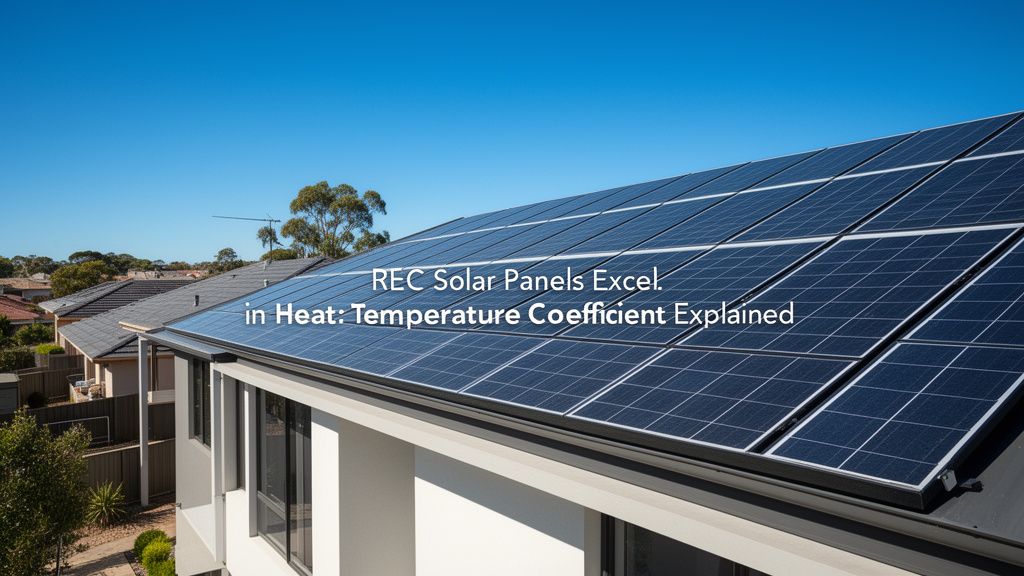
TL;DR: The temperature coefficient indicates how much a solar panel's power output drops for every degree Celsius it heats above 25°C. REC solar panels feature a superior (lower) temperature coefficient, meaning they maintain significantly higher efficiency and produce more electricity in Australia's blistering summer conditions compared to many other brands.
What Is a Temperature Coefficient and Why Does It Matter for Solar Panels?
The temperature coefficient quantifies how much a solar panel's power output decreases for every degree Celsius increase above its standard test conditions (STC) temperature of 25°C. This figure is expressed as a negative percentage per degree Celsius (%/°C), and it's a crucial specification often overlooked by Australian homeowners, despite its direct impact on real-world energy production. A typical solar panel might have a temperature coefficient of -0.35% to -0.45%/°C, meaning for every degree above 25°C, its power output drops by that percentage. Given that panel surface temperatures can easily reach 60-70°C, or even higher, on a scorching Aussie summer day, this seemingly small percentage can accumulate into substantial energy losses.
The Impact of Heat on Panel Performance
Australia's intense sunshine and high ambient temperatures mean that solar panels rarely operate at the optimal 25°C STC. Instead, they often run much hotter, leading to a significant reduction in their stated power output. For instance, if a 400W panel with a -0.40%/°C temperature coefficient heats up to 65°C (a 40°C rise), its power output could drop by 16% (40°C x 0.40%). This means that 400W panel is now effectively performing as a 336W panel. This direct loss in wattage translates to fewer kilowatt-hours (kWh) generated, ultimately impacting your electricity bill savings and the overall financial return of your solar investment, especially during peak generation times when the sun is hottest.
Standard Test Conditions (STC) vs. Real-World Performance
Solar panel specifications like wattage (e.g., 400W) are determined under idealised Standard Test Conditions (STC): 1000 W/m² irradiance, 25°C cell temperature, and an air mass of 1.5. While STC provides a consistent benchmark for comparing panels, it rarely reflects the operational environment of a solar system in Australia. On a typical 35°C summer day, the black surface of a solar panel can easily reach 60-70°C. This disparity between STC and real-world conditions makes the temperature coefficient a far more practical indicator of a panel's true performance potential in our harsh climate. A panel with a lower (closer to zero) temperature coefficient will consistently outperform a panel with a higher (more negative) coefficient when the mercury climbs, delivering more energy when you need it most.
How Do REC Solar Panels Achieve Superior Temperature Performance?
REC solar panels excel in heat due to their innovative half-cut cell technology, advanced cell interconnection, and superior wafer quality, which collectively minimise internal resistance and heat build-up. These engineering advancements are not just marketing jargon; they translate into tangible performance benefits, particularly evident in hot climates like Australia. By focusing on fundamental physics related to heat generation and dissipation at the cell level, REC has developed panels that maintain a remarkably low temperature coefficient, often in the range of -0.26% to -0.29%/°C for their premium series, which is significantly better than the industry average. This means less power degradation per degree of temperature increase.
Half-Cut Cell Technology and Its Benefits
A key innovation contributing to REC's excellent temperature performance is its pervasive use of half-cut cells. Traditional solar cells are typically full-sized, but REC panels divide each cell into two smaller, half-sized cells. This simple yet effective modification halves the current flowing through each cell and, by extension, through the interconnections. According to Joule's Law (P = I²R, where P is power loss, I is current, and R is resistance), reducing the current by half reduces power losses due to resistance by a factor of four. Less resistive power loss within the cells means less heat generated internally. With less self-generated heat, the panel's overall operating temperature remains lower, mitigating the negative effects of the temperature coefficient and ensuring higher power output under sunny, hot conditions.
Proprietary REC N-Peak and Alpha Series Design
REC's premium N-Peak and Alpha Series panels push the boundaries further with advanced cell structures like N-type monocrystalline cells and heterojunction technology (HJT). N-type cells generally exhibit superior performance in higher temperatures compared to traditional P-type cells due to their inherent material properties. The HJT design, used in the Alpha series, combines the benefits of crystalline silicon with amorphous thin-film layers, resulting in higher efficiency and an even lower temperature coefficient. Furthermore, REC's unique "twin panel" design, where the panel is essentially split into two halves that operate independently, further reduces internal resistance and shading losses, contributing to cooler operation and more consistent power generation, especially critical during those relentless Australian heatwaves.


What Does a Better Temperature Coefficient Mean for Your Australian Solar System?
A better (lower) temperature coefficient directly translates to higher energy production and greater financial returns for Australian homeowners, particularly during our hot summer months. While the upfront cost of premium panels like REC might be slightly higher than budget alternatives – perhaps an extra $0.10 to $0.20 per watt, translating to an additional $660 to $1,320 for a 6.6kW system – the long-term gains in energy yield often outweigh this initial difference. Over 25 years, the cumulative extra kWh generated by a system with a superior temperature coefficient can add up to thousands of dollars in savings and export credits, significantly improving the overall return on investment and shortening the payback period.
Real-World Energy Production in Australian Summers
Consider a 6.6kW solar system installed in Sydney, where summer temperatures frequently exceed 30°C and panel surface temperatures hit 60-70°C. Over a 40°C rise above STC (25°C to 65°C), a panel with a -0.40%/°C coefficient would lose 16% of its output. A comparable REC panel with a -0.26%/°C coefficient would lose only 10.4%. This 5.6% difference in efficiency might sound small, but when you multiply it across all panels, for all the sunny hours of summer, it becomes substantial. For a 6.6kW system, this could mean an extra 350-500 kWh of electricity generated annually in hot climates, which at an average export rate of $0.08/kWh and self-consumption savings of $0.25/kWh, quickly adds up to tangible financial benefits for the homeowner.
Long-Term Financial Benefits and Payback
The enhanced energy production from panels with a superior temperature coefficient doesn't just provide immediate savings; it compounds over the lifespan of your system. Over 25 years, that additional annual output can lead to thousands of dollars in extra bill reductions or feed-in tariff payments. This higher yield directly shortens your system's payback period, potentially by months or even a year, meaning you reach the point of pure profit faster. Furthermore, the robust performance in extreme conditions often correlates with better long-term reliability and a slower rate of degradation, reinforcing the value proposition of investing in panels designed to withstand and excel in Australia's unique climate challenges. Choosing REC panels, with their proven thermal performance, is an investment in consistent power generation and maximised returns for your Australian home.
Key Takeaways
- The temperature coefficient is a critical specification indicating how much a solar panel's output decreases as its temperature rises above 25°C.
- A lower (closer to zero) temperature coefficient means a solar panel loses less power in hot conditions, a significant advantage in Australia's climate.
- REC solar panels utilise advanced technologies like half-cut cells and N-type/HJT structures to minimise internal heating and achieve superior temperature coefficients.
- Investing in panels with a better temperature coefficient like REC leads to higher real-world energy production, especially in Australian summers.
- Over the lifespan of your system, this increased energy yield translates to greater financial savings, improved feed-in tariff earnings, and a faster return on your solar investment.
Read More
For a comprehensive overview, check out our master guide: Read the Full Guide Here.