TL;DR: South Australian households can secure cheaper electricity rates in 2026 by comparing plans like "Battery + Solar" and "WHOLESAVE Resi", which offer significant savings compared to the reference price. For solar owners, feed-in tariffs remain a key component of their savings, but these rates vary by retailer, making comparison crucial for maximising solar investment returns.
What Are the Cheapest Electricity Plans in South Australia for 2026?
South Australian households looking to cut power bills in 2026 have several competitive electricity plans available. Based on June 2026 data, some of the most budget-friendly options deliver notable savings against the Australian Energy Regulator's reference price. For instance, the "Battery + Solar" plan offers a 24% saving, while "WHOLESAVE Resi" comes in at 22% less. Another strong contender is "Home Energy Classic", providing a 21% reduction from the reference price. These plans represent some of the most competitive offers available, indicating a real opportunity for savings if you switch. Beyond these top-tier options, other plans like "Freedom Residential", "Residential Seniors Saver", and "HomeDeal Essential" are also in the market, though specific percentage discounts for these particular plans aren't always highlighted upfront. The key is to look past standard offerings and actively compare what retailers provide, as the cheapest electricity supplier can change from month to month.
How Supply and Usage Charges Factor In
When comparing plans, look closely at both usage and supply charges. In South Australia, how much you pay per kilowatt-hour (kWh) for your electricity usage varies by provider and the tariff type you're on. For those on a single rate tariff, the average charge sits around 43.14 cents per kWh, based on postcode 5000 data. This is what you pay for every unit of electricity you consume. The supply charge, a daily fee for simply being connected to the grid, averages about 121.54 cents per day. These two components make up the bulk of your bill. Gas charges also follow this structure, with average usage ranging from 3.52 to 7.19 cents per megajoule (MJ) and an average daily supply charge of 86.82 cents. Understanding these costs is important because a plan with a low usage rate might have a higher daily supply charge, and vice versa.
The Benefit of Comparing Energy Offers
Shopping around for energy plans saves you money. We see an annual price difference of up to $1,340 between the cheapest and most expensive single rate electricity plans in our database. This figure highlights the substantial financial impact of complacency when it comes to energy retail. South Australia's electricity and gas prices were deregulated on 1 February 2013, which introduced competition among providers. While the Australian Energy Regulator (AER) sets an annual reference price on 1 July to help consumers compare, retailers are free to offer plans above or below this benchmark. An 18% discount offered by a retailer usually means it's 18% less than this reference price. Regularly checking offers from providers like AGL, EnergyAustralia, Origin Energy, and Red Energy ensures you don't miss out on better deals.
How Do South Australia's Solar Feed-in Tariffs Work in 2026?
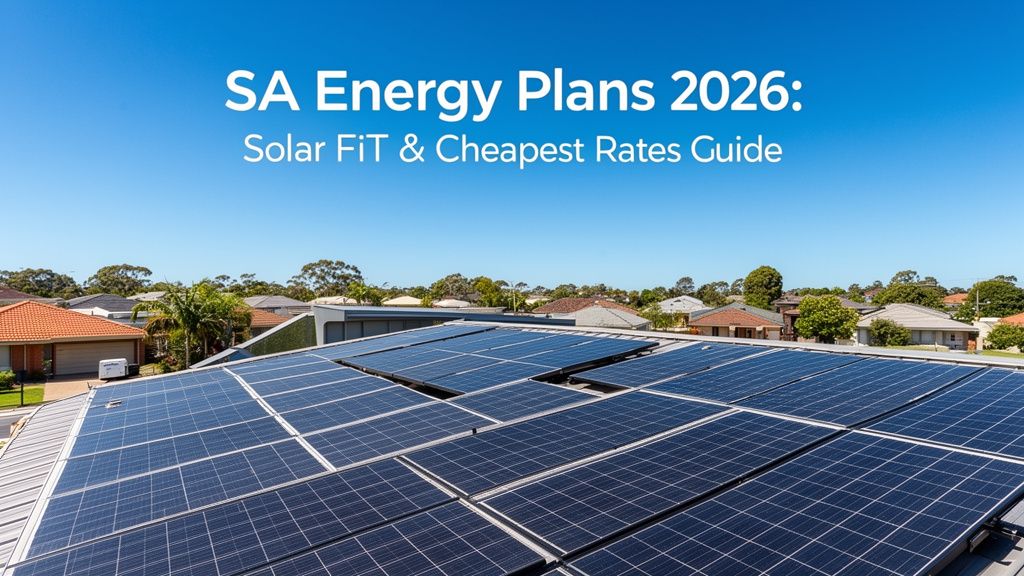
For South Australian solar owners, feed-in tariffs (FiTs) directly impact the financial return on a solar investment. A feed-in tariff provides a credit on your electricity bill for every kilowatt-hour (kWh) of surplus solar power your system exports back into the grid. These tariffs incentivise solar uptake by helping to offset the cost of grid electricity you still need to buy, particularly at night. However, the value of FiTs in 2026 varies significantly between different electricity retailers and specific energy plans. There isn't a single, mandated high rate across the board. Solar owners must actively compare these tariffs when choosing an energy provider, as a difference of even a few cents per kWh adds up over a year, especially for systems that export a lot of power.
Understanding Your Export Credit
Your solar system typically generates more electricity during peak sunshine hours than your home uses. This excess power then flows into the grid. Your energy retailer measures this export and applies the agreed-upon feed-in tariff rate to calculate your credit. If your system exports 10 kWh in a day at a FiT of, for example, 5 cents per kWh, you receive 50 cents credit for that day. This credit then reduces your overall electricity bill. The total amount you save or get credited depends on your system size, your household's consumption patterns, and the specific FiT rate offered by your chosen retailer. Maximising this credit requires selecting a retailer with a competitive FiT, alongside competitive usage and supply charges.
Beyond Just the Feed-in Tariff
While a strong feed-in tariff is appealing, it shouldn't be the sole factor in choosing an energy plan. A plan with a high FiT might have higher daily supply charges or expensive peak usage rates, which could erode your overall savings. Instead, look for a balanced plan that offers a respectable FiT while keeping your supply and usage charges competitive. Some retailers offer different FiT structures, such as flat rates or time-varying rates where you get more for exporting during peak demand periods. Solar households with batteries, for instance, can often benefit from time-of-use tariffs and higher FiTs if they can strategically export power when grid demand (and prices) are highest. Consider your total energy consumption and export profile when assessing the true value of any plan.
South Australia's Renewable Energy Push and Your Household
South Australia has made significant progress in renewable energy, and its ambitious targets directly influence the energy landscape for households. The state has fast-tracked its renewable energy target, aiming for electricity generation to be sourced from net 100% renewables by 2027. This forms part of SA's broader commitment to reduce net greenhouse gas emissions by at least 50% by 2030. This strong policy direction means a more stable, cleaner grid over time, and a continued emphasis on technologies like rooftop solar and battery storage. SA Power Network manages electricity distribution in the state, while Australian Gas Networks handles gas. These distributors play a key role in connecting renewable energy sources and ensuring grid reliability.
SA's Ambitious Clean Energy Goals
The push for 100% renewables by 2027 puts South Australia at the forefront of the clean energy transition globally. For homeowners with solar, this commitment underpins the long-term viability and value of their investment. As the grid integrates more renewables, there is a continued focus on managing supply and demand, which can influence future tariff structures and potentially the value placed on exported solar power. Even if you don't have solar, you can still support renewable energy. GreenPower is a government program allowing you to buy renewable energy certificates that match a portion of your usage, from 10% to 100%, for a small extra fee. Some energy plans also offer carbon neutral options, offsetting your electricity or gas emissions, sometimes at no additional cost.
Government Support and Concessions for Energy Users
The South Australian government provides various energy concessions to help residents manage their bills. These are typically available to eligible low-income households, seniors, pensioners, and those with specific medical needs. Examples of concessions include medical concessions, a general energy bill concession, and the cost of living concession. If you meet the eligibility criteria, these schemes can significantly reduce your annual energy expenditure. It's worth checking your eligibility, either through official government guides or by speaking directly with your energy retailer, as they can assist you in assessing if you qualify for these valuable rebates. These concessions, combined with actively comparing energy plans and optimising solar exports, provide multiple pathways for South Australians to keep their energy costs down.
Key Takeaways
- Compare energy plans regularly, as offers change monthly; some SA plans provide over 20% savings against the reference price in 2026.
- The difference between the cheapest and most expensive single rate electricity plans can be over $1,340 annually.
- Solar feed-in tariffs vary significantly between retailers; check the FiT alongside usage and supply charges for the best overall value.
- South Australia aims for 100% renewable electricity by 2027, supporting the long-term value of household solar.
- Eligible low-income households, seniors, and pensioners can access government energy concessions to further reduce bill costs.
Read More
For a comprehensive overview, check out our master guide: Read the Full Guide Here.