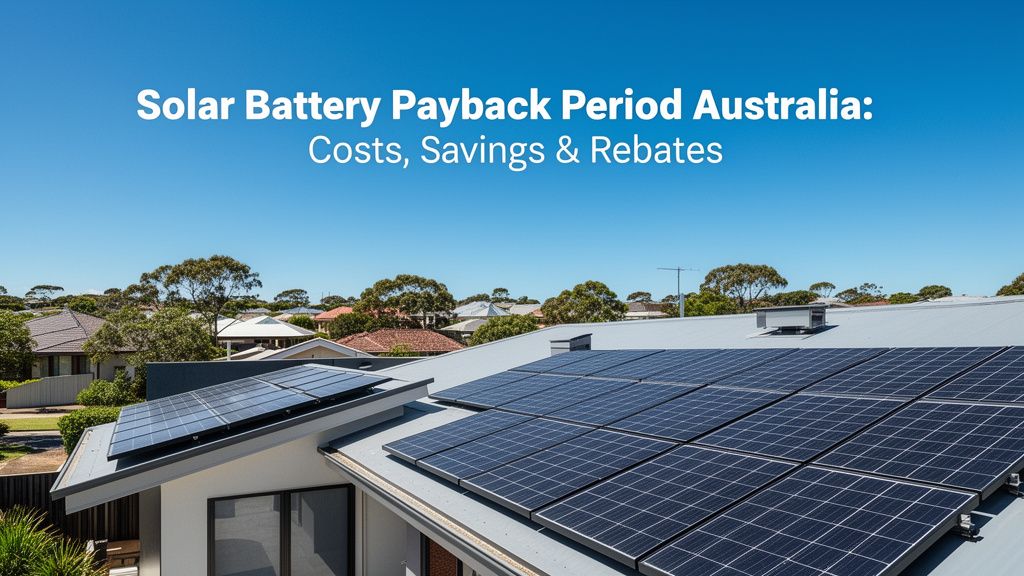
TL;DR: Solar battery payback periods in Australia typically range from 7 to 15 years, depending on factors like battery cost, household electricity consumption, and local electricity prices. Higher self-consumption of solar energy and state rebates can significantly shorten this timeframe, while low feed-in tariffs and lower base electricity rates can extend it.
What Factors Influence Solar Battery Payback Periods in Australia?
Payback periods for solar batteries in Australia depend heavily on your household's electricity consumption patterns, the initial cost of the battery, and local electricity prices and tariffs. Your decision to invest in a battery primarily relies on how much grid electricity you avoid buying and how much less you rely on low feed-in tariffs. The economic benefit largely comes from storing your excess solar power to use when the sun isn't shining, rather than exporting it for minimal return. This shift in behaviour directly influences how quickly your investment returns.
How Does Your Electricity Usage Shape Payback?
Your household's electricity usage profile plays a critical role in determining battery payback. If you use most of your electricity in the evenings or mornings when your solar panels aren't generating much, a battery allows you to power these loads with stored solar, avoiding peak-rate grid electricity. For example, a family that consistently uses 10-15kWh from 5 PM to 9 PM, currently paying 35-45c/kWh during these peak times, sees immediate savings by drawing from their battery. Conversely, a household that is out all day and returns home late might export most of their solar energy, making a battery less financially beneficial unless they significantly shift their consumption or participate in a Virtual Power Plant (VPP).
How Do Battery Costs and Rebates Impact Your Investment?
The upfront cost of a solar battery system is a major determinant of its payback period. A typical 10kWh home battery, like a Tesla Powerwall 2 or a BYD Battery-Box Premium, costs around $10,000 to $15,000 installed, varying by installer and complexity. These prices are before any potential government incentives. States like Victoria, through the Solar Homes Program, offer rebates of up to $2,950 for eligible battery installations, reducing the initial outlay and, consequently, shortening the payback period. South Australia's Home Battery Scheme also provides subsidies based on battery size. Without such rebates, the full cost must be recouped from electricity savings, extending the time it takes to break even.
What Are Typical Solar Battery Payback Periods in Australian Households?
Typical solar battery payback periods in Australia often fall between 7 and 15 years, though some scenarios can extend this to over 15 years without subsidies. This range reflects the diverse conditions across different states and individual household behaviours. The key calculation involves comparing the annual savings from avoided electricity purchases and reduced reliance on low feed-in tariffs against the total installed cost of the battery. As electricity prices continue to climb, the value of storing your own solar power increases, positively impacting payback times.
Payback Scenarios with High Electricity Usage and Time-of-Use Tariffs
For households with high evening electricity consumption on time-of-use (TOU) tariffs, a solar battery can deliver a quicker payback. Consider a Sydney family paying 40c/kWh during peak evening hours (4 PM - 8 PM) and exporting excess solar for only 5c/kWh during the day. If a 10kWh battery allows them to avoid purchasing 10kWh of peak power daily, that's $4.00 in savings each day, or around $1,460 annually. With a $12,000 installed battery, their payback period calculates to roughly 8.2 years. These savings compound as electricity prices inevitably rise, potentially shortening the actual payback further.
The Effect of Low Electricity Prices and Feed-in Tariffs
In areas with lower electricity prices or high feed-in tariffs (which are becoming rare), the financial case for a battery becomes weaker, extending the payback period. If your peak electricity rate is only 25c/kWh, your daily savings from a 10kWh battery drop to $2.50, pushing the payback for a $12,000 battery out to 13.1 years. Most Australian retailers cut feed-in tariffs below 5c/kWh in 2024, making exporting power less attractive. This low export value strongly encourages self-consumption, strengthening the argument for a battery, but the base electricity price you avoid buying remains the dominant factor in the financial calculation.


Are Solar Batteries a Good Investment for Australian Homes Right Now?
Solar batteries are a good investment for many Australian homes looking for energy independence and long-term savings, especially with rising electricity prices and decreasing feed-in tariffs. While the financial payback period is a critical consideration, the broader benefits of energy security, reduced carbon footprint, and participation in future energy markets also weigh heavily in the decision. The current energy landscape, characterised by volatile grid prices and a push towards renewable energy, makes storing your own generated power increasingly valuable.
Beyond Financial Payback: Energy Security and Independence
Investing in a solar battery offers significant benefits beyond just the financial return. It provides crucial energy security, protecting your home from blackouts and grid outages. During a power cut, a properly installed battery system can keep essential appliances running, offering peace of mind. Many homeowners also value the sense of energy independence and self-sufficiency that comes from powering their homes with their own stored solar energy. This reduces reliance on the centralised grid and contributes to a more sustainable lifestyle, aligning with Australia's broader renewable energy goals.
Future Trends: Cost Reductions and Grid Services
The long-term outlook for solar batteries suggests they will become even more attractive. Battery technology continues to improve, and manufacturing scale drives costs down. Analysts predict further significant price reductions in the coming years, which will shorten payback periods. Additionally, participation in Virtual Power Plant (VPP) programs offers another revenue stream. In a VPP, your battery can discharge small amounts of power to support the grid during peak demand, and you receive a payment for this service, further enhancing the financial return and potentially accelerating payback. This dual benefit of self-consumption and grid services makes batteries a forward-looking investment.