TL;DR: Building massive solar projects in remote Australian environments requires moving away from labor-intensive manual construction. ARENA-backed innovations, including Luminous Robotics' autonomous Lumis, Built Robotics' piling automation, and 5B's prefabricated modular arrays, are modernizing construction to improve safety, speed, and precision.
Beyond Manual Labor: The Challenge of Remote Installations
Installing a small array of solar panels on a suburban rooftop is a relatively straightforward task. However, deploying millions of heavy modules across the vast, remote expanses of regions like the Pilbara is a fundamentally different logistical challenge. Historically, these massive utility-scale projects have relied on teams of itinerant workers who must be recruited, transported, and housed in remote locations.
This manual approach faces severe limitations. The physical work is incredibly demanding; workers are required to repeatedly lift solar modules that weigh more than 30 kilograms. This heavy lifting must be done in extreme outback conditions, where temperatures regularly exceed 40 degrees Celsius. Given the acute shortage of skilled workers willing to work in these remote areas, the solar industry has been forced to look toward technology to streamline the installation process.
Meet the Robots: Automated Construction and Assembly
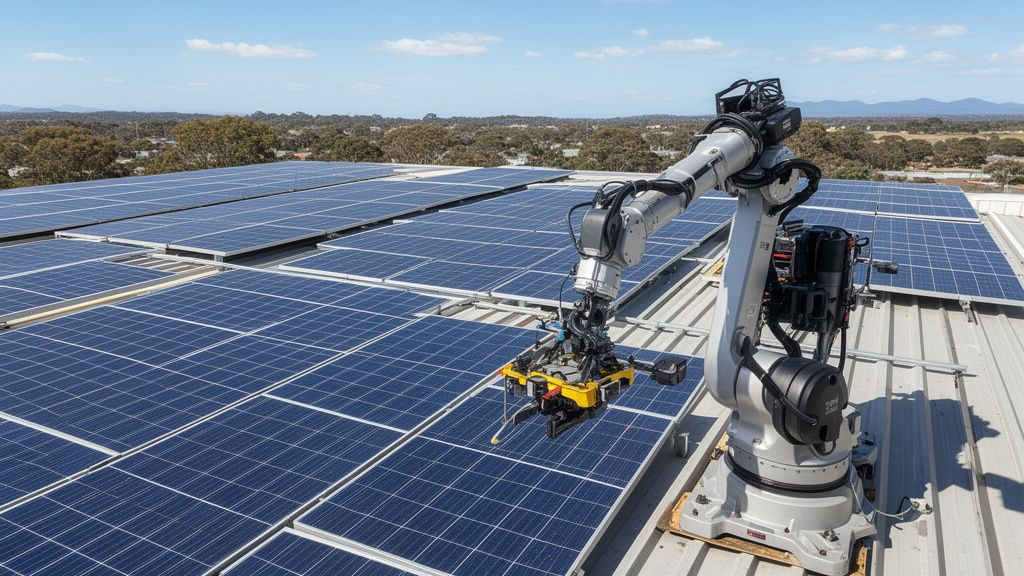
To address workforce constraints and protect human workers from extreme heat, companies are developing specialized automated systems for field construction. Luminous Robotics has designed autonomous, self-moving machines called "Lumis" to handle the physical placement of solar modules.
These Lumis robots move independently around a active solar field, transporting individual modules to their exact design coordinates. Once in position, the robots lift and place the heavy panels onto the pre-erected mounting racks without requiring human physical intervention. This automates one of the most physically exhausting and dangerous parts of the construction cycle.
In addition to panel placement, other key elements of the structural build are being automated:


- Automated Piling: Built Robotics has developed automated piling systems designed to drill holes and drive steel support pilings into the earth with minimal human oversight, speeding up the foundation phase of solar farms.
- Deployment Logistics: Nextpower is developing and testing advanced deployment technologies to optimize the flow of materials and hardware across sprawling construction sites.
- Automated Monitoring: Large-scale projects are increasingly utilizing aerial drones to conduct automated structural monitoring, tracking construction progress and identifying technical faults over vast geographical areas.
Prefabricated and Modular Systems: The 5B and Zenith Energy Approach
Another highly effective strategy for reducing on-site construction costs is prefabrication. Rather than assembling individual structural components in the harsh conditions of the field, companies are manufacturing pre-wired, pre-assembled systems in controlled factory settings.
An australian pioneer in this space is 5B, which produces modular solar systems that can be folded up, loaded onto transport vehicles, and then quickly unfolded and anchored to the ground once they arrive at the project site. This modular approach dramatically reduces the amount of civil engineering, concrete pouring, and manual cabling required on-site.
Zenith Energy has successfully integrated this technology, using prefabricated 5B solar arrays to supply rapid, clean energy to its industrial operations. By combining prefabrication with site-level automation, developers can deliver large volumes of renewable power in a fraction of the time required by traditional building methods.
Key Takeaways
- Brutal Working Conditions: Remote solar construction requires laborers to repeatedly lift panels weighing over 30kg in temperatures exceeding 40 degrees Celsius.
- Luminous Robotics: The company's autonomous "Lumis" robots place solar modules onto structural racks without human lifting, resolving local skilled labor shortages.
- Comprehensive Site Automation: Built Robotics automated piling systems and Nextpower deployment technologies are streamlining site preparation and material logistics.
- Factory Prefabrication: 5B's modular, foldable solar arrays, utilized by companies like Zenith Energy, dramatically decrease the need for complex, manual, on-site civil works.
- Drone Inspections: Aerial drone systems are being deployed to automate the ongoing monitoring and inspection of massive utility-scale installations.