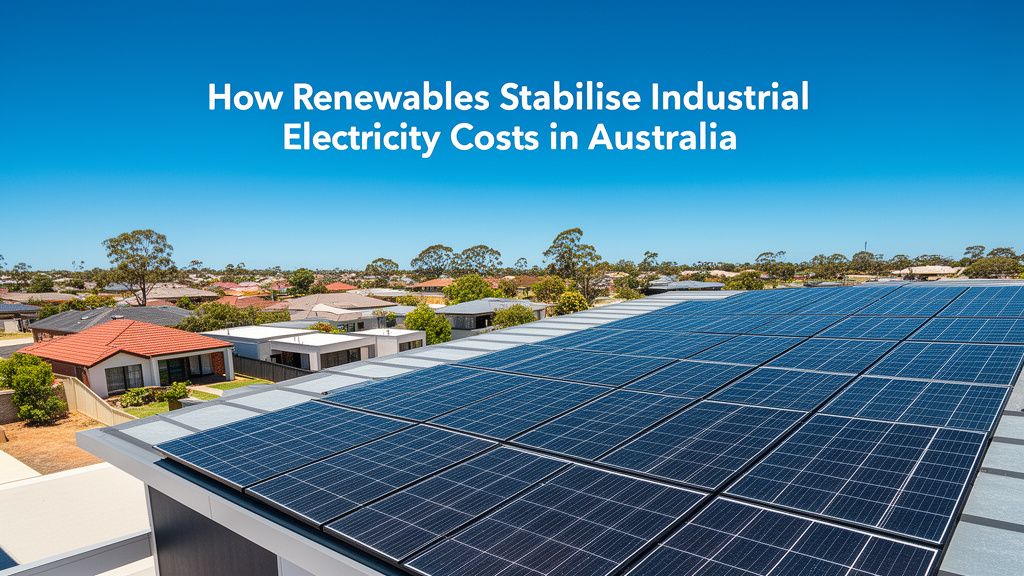
Renewables Stabilise Industrial Electricity Costs for Australian Businesses
TL;DR: Australian industries face unpredictable and rising electricity costs. Adopting commercial solar offers long-term cost stability, allowing businesses to fix a significant portion of their energy expenses and protect against future market volatility. This shift improves budgeting and reduces operational risk.
Why Are Australian Industrial Electricity Costs So Unpredictable?
Australian industrial electricity costs fluctuate widely due to several market factors. Businesses on the National Electricity Market (NEM) experience a pricing environment heavily influenced by fossil fuel availability, global commodity prices, and grid infrastructure limitations. Wholesale electricity prices have risen significantly, with average annual increases of 20-30% in some states over the past few years, according to the Australian Energy Market Operator (AEMO) data from 2022-2023. These price swings create major challenges for industrial budgeting and operational planning. Companies cannot accurately forecast their energy expenses for more than a few months, impacting profit margins and investment decisions.
The Impact of Fossil Fuel Dependency
Australia's electricity grid still relies heavily on coal and gas. These fuels are subject to global commodity markets. International events, like the war in Ukraine, directly affect the cost of gas and, subsequently, the wholesale price of electricity across the NEM. When gas prices spike, businesses often see their electricity bills follow suit within the next billing cycle. This dependency on external factors outside Australia's control makes long-term energy cost forecasting impossible for energy-intensive industries such as manufacturing, mining, and food processing.
Grid Congestion and Wholesale Market Dynamics
The current transmission network, particularly in regions with high industrial demand, experiences congestion. This limits the flow of cheaper power from some generation sources. During peak demand periods, often in the late afternoons or heatwaves, the grid becomes strained. This forces AEMO to dispatch more expensive peaker plants, driving up wholesale prices for everyone. Industrial users on variable tariffs bear the brunt of these price spikes, sometimes seeing prices jump from cents per kilowatt-hour to dollars per kilowatt-hour for short durations, significantly inflating their overall energy expenditure.
How Do Commercial Solar Systems Offer Cost Certainty?
Commercial solar systems provide a stable, predictable electricity source for Australian businesses. Once installed, the primary fuel cost — sunlight — is free and guaranteed for the system's operational lifespan, typically 25 years or more. This removes the business's direct exposure to volatile wholesale energy prices for the portion of electricity generated on-site. For example, a medium-sized factory in Brisbane installing a 250kW solar array can expect to offset 40-60% of its daily power consumption. The levelised cost of electricity (LCOE) from such a system typically sits between 5-8 cents per kilowatt-hour over its lifetime, significantly below current grid prices of 20-35 cents/kWh for commercial users.
Fixed Costs and Reduced Exposure to Spot Markets
Investing in commercial solar shifts a variable operational expense into a fixed capital asset. Businesses finance the system installation through a purchase or lease, establishing a predictable repayment schedule. This means the cost per kilowatt-hour for solar-generated power remains consistent over the system's lifespan. During periods of high wholesale grid prices, the business continues to produce its own power at its fixed, low cost. This dramatically stabilises the energy budget. A transport depot in Western Sydney, running a 100kW solar system, reported reducing its monthly grid electricity purchases by an average of $2,500 during daylight hours, making their operational costs much more predictable.


Long-Term Power Purchase Agreements (PPAs)
Many businesses prefer a Power Purchase Agreement (PPA) for solar. Here, a third-party developer installs, owns, and maintains the solar system on the business's roof or property. The business then buys the electricity generated at a pre-agreed, fixed rate, typically with a small annual escalator (e.g., 1-2%). This PPA rate is usually well below grid prices and fixed for 10-15 years. This arrangement provides long-term price certainty without an upfront capital outlay. A large cold storage facility in Melbourne might sign a 12-year PPA at 12 cents/kWh, knowing their electricity costs for that portion of their usage will not exceed this rate, regardless of grid price fluctuations.
What Are the Financial Benefits for Australian Businesses?
Renewable energy adoption delivers clear financial advantages for Australian industries beyond just stabilising costs. It improves long-term financial planning, unlocks government incentives, and builds brand reputation. The upfront investment in solar often yields a strong return on investment (ROI), with many systems achieving payback periods of 3-6 years depending on system size, local energy prices, and consumption patterns. Post-payback, the electricity generated is effectively free, providing a substantial competitive edge.
Improved Budgeting and Financial Planning
Businesses operating with solar power gain the ability to forecast a significant portion of their energy costs years in advance. This clarity allows for more accurate budgeting and reduces financial risk associated with market volatility. Finance departments can allocate capital more effectively when a major operational expense like electricity becomes predictable. A manufacturing company in Adelaide, for instance, can confidently budget its energy spend for the next decade, knowing their 750kW rooftop solar system covers a large percentage of their daily demand at a fixed, low cost. This stability enables better strategic planning for growth and investment.
Government Incentives and Accelerated Depreciation
Australian businesses benefit from government incentives that reduce the upfront cost of commercial solar. The Small-scale Renewable Energy Scheme (SRES) provides Small-scale Technology Certificates (STCs) for systems up to 100kW. Larger systems often qualify for the Large-scale Renewable Energy Target (LRET) through Large-scale Generation Certificates (LGCs), which can be sold or used to offset compliance costs. Furthermore, businesses can claim depreciation on solar assets, reducing their taxable income. Under current tax rules, the immediate expensing of eligible depreciating assets can further accelerate the financial benefits, allowing businesses to write off the full cost of a new solar system in the year it is installed and ready for use.
Key Takeaways
- Australian industrial electricity costs are highly volatile due to fossil fuel prices and grid issues.
- Commercial solar provides predictable, fixed-price electricity for 25+ years, insulating businesses from market swings.
- Long-term Power Purchase Agreements (PPAs) offer price certainty without upfront capital.
- Solar adoption enables better financial planning and leverages government incentives like STCs/LGCs and depreciation.
- Businesses improve their bottom line and reduce operational risk by stabilising energy expenses.
Read More
For a comprehensive overview, check out our master guide: Read the Full Guide Here.


