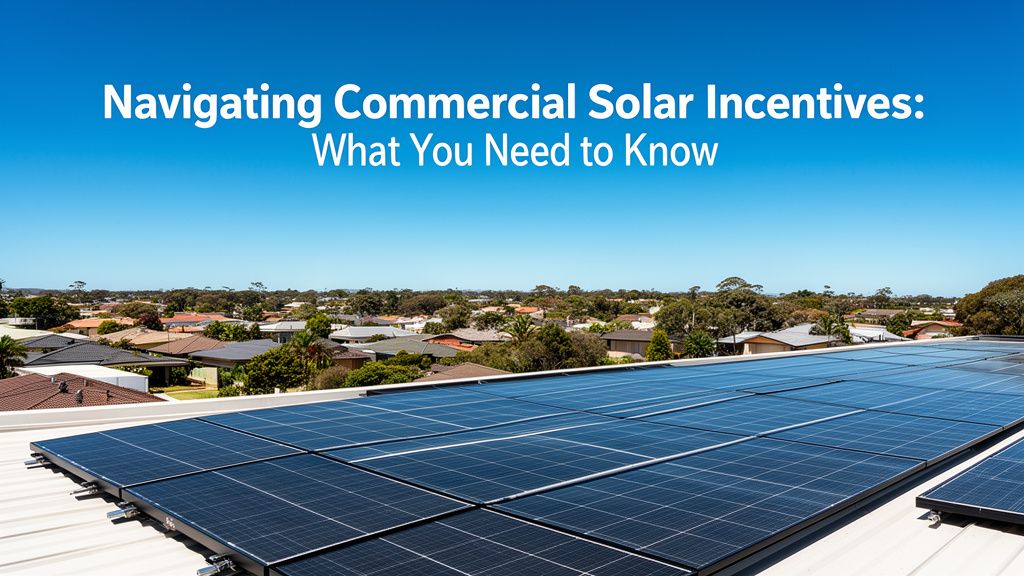
Navigating Commercial Solar Incentives: What You Need to Know
In the dynamic landscape of Australian energy, businesses are increasingly turning to commercial solar solutions to manage escalating power costs and meet their sustainability goals. The decision to invest in solar isn't just about reducing your carbon footprint; it's a savvy financial move that can significantly impact your bottom line. However, the path to maximising your return on investment (ROI) is often paved with various incentives and schemes that can be complex to navigate. Understanding these commercial solar incentives is crucial for any Australian business looking to make a smart, profitable transition to renewable energy.
Why Commercial Solar Makes Sense
Beyond the obvious environmental benefits, commercial solar offers a compelling proposition for Australian businesses. Imagine significantly reducing your operating expenses by generating your own electricity, gaining energy independence from fluctuating grid prices, and showcasing a strong commitment to sustainability that resonates with customers and stakeholders alike. From small retail outfits to large industrial facilities, the advantages are clear: lower energy bills, a reduced carbon footprint, enhanced brand reputation, and increased asset value. But how do you make this investment even more attractive? Through smart leveraging of available incentives.
Key Australian Commercial Solar Incentives
Australia boasts a robust framework of federal and state-based incentives designed to encourage businesses to embrace solar power. These schemes can significantly offset the upfront capital expenditure, making solar a more accessible and financially viable option.
Small-scale Technology Certificates (STCs) and Large-scale Generation Certificates (LGCs)
This is the cornerstone of Australia's federal renewable energy scheme. Depending on the size of your solar installation, your business will be eligible for either STCs or LGCs.
- Small-scale Technology Certificates (STCs): If your system size is under 100 kilowatts (kW) – typically suitable for small to medium-sized businesses – you'll generate STCs. These certificates represent the estimated amount of renewable electricity your system will generate over its lifetime (up to 10 years). The value of STCs fluctuates based on market demand but can provide a significant upfront discount on the cost of your solar system. Your solar installer usually handles the creation and sale of these certificates, passing the discount directly onto your invoice. For example, a 30kW system in Sydney might generate hundreds of STCs, each valued at around $35-40, translating to a substantial saving of thousands of dollars.
- Large-scale Generation Certificates (LGCs): For commercial systems larger than 100kW – common for factories, large warehouses, and big agricultural operations – LGCs come into play. Unlike STCs, LGCs are created annually for every megawatt-hour (MWh) of eligible renewable electricity generated. These certificates are then sold on a market, providing an ongoing revenue stream for the business over the system's operational life. This makes larger installations particularly attractive, offering a consistent financial benefit year after year.
Instant Asset Write-Off
The Australian Government's Instant Asset Write-Off scheme allows eligible businesses to immediately deduct the full cost of eligible depreciating assets, including new solar power systems. While its parameters have changed over time (notably after the Temporary Full Expensing initiative ended), it remains a powerful tool for eligible small businesses. As of July 2023, businesses with an aggregated turnover of less than $10 million can immediately deduct the full cost of eligible assets costing less than $20,000. For a modest commercial solar system, this can significantly reduce your taxable income in the year of purchase, further improving your project's financial viability. Always consult with your accountant to understand how this applies to your specific business.
State and Territory-Specific Programs
Beyond federal incentives, various state and territory governments offer their own schemes to encourage solar uptake and energy efficiency. These programs often complement the federal ones and can add another layer of savings:
- NSW Energy Savings Scheme (ESS): In New South Wales, the ESS creates Energy Saving Certificates (ESCs) for activities that save energy, including installing solar or energy-efficient equipment. Businesses can earn ESCs and sell them to obliged energy retailers, providing a financial incentive for energy-saving projects.
- Victorian Energy Upgrades (VEU) Program: Similar to NSW, Victoria's VEU program offers incentives for installing energy-efficient products and services, including solar power. These incentives come in the form of Victorian Energy Efficiency Certificates (VEECs), which can reduce the upfront cost of your system.
- Queensland and Other States: While less common for direct solar rebates for commercial operations compared to residential, other states and territories often run grants or programs focused on energy efficiency upgrades or specific industry support that might include solar components. It's always worth checking the respective state government websites for the latest information.
Navigating the Fine Print and Eligibility
To successfully leverage these incentives, it's vital to understand the eligibility criteria and application processes. Generally, all solar equipment must be installed by Clean Energy Council (CEC) accredited installers using CEC-approved products. There are often specific system size limitations, grid connection requirements, and reporting obligations to consider. Missing a deadline or failing to meet compliance standards can result in forfeited incentives, making professional guidance indispensable.
Maximising Your Incentive Benefits
The key to unlocking the full potential of commercial solar incentives lies in careful planning and expert advice.
- Engage Accredited Professionals: Work with CEC-accredited solar installers and energy consultants who specialise in commercial projects. They possess the expertise to navigate the complex incentive landscape, ensure compliance, and apply for all eligible schemes on your behalf.
- Conduct a Comprehensive Feasibility Study: Before committing, get a detailed analysis of your energy consumption, roof space, and potential solar generation. This will help determine the optimal system size and the specific incentives you'll qualify for.
- Understand the Financials: Look beyond the upfront cost. Factor in the long-term energy savings, the value of STCs/LGCs, the tax benefits of Instant Asset Write-Off, and any state-based rebates to calculate a realistic payback period and ROI.
- Stay Informed: Incentives can change, often with little notice. Work with a provider who keeps abreast of the latest government policies and market conditions.
- Consider Combining Incentives: Where possible and permissible, strategise to stack eligible incentives to maximise your financial benefit.
The Future of Commercial Solar Incentives
The trend towards renewable energy in Australia is undeniable. While specific schemes may evolve, the overarching commitment to reducing emissions means that support for commercial solar is likely to continue in various forms. We might see further incentives for battery storage integration, smart grid technologies, and long-term carbon reduction schemes. Staying agile and working with forward-thinking solar providers will ensure your business remains at the forefront of these opportunities.
Conclusion
Investing in commercial solar is a strategic decision that offers substantial long-term benefits for Australian businesses. By diligently navigating the array of federal and state incentives – from STCs and LGCs to the Instant Asset Write-Off and various state-specific programs – you can significantly reduce your initial outlay and accelerate your return on investment. Don't let the complexity deter you. With the right planning and expert guidance, your business can harness the power of the Australian sun, secure your energy future, and enjoy a healthier bottom line. It's time to explore how commercial solar, amplified by savvy incentive utilisation, can transform your business today.
Read More
For a comprehensive overview, check out our master guide: Read the Full Guide Here.