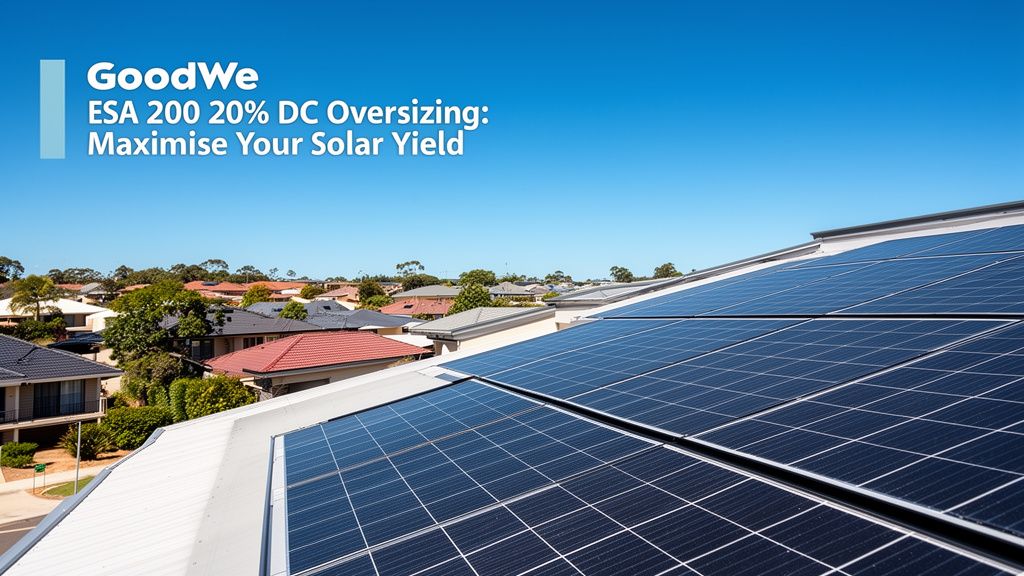
TL;DR: The GoodWe ESA inverter's 200% DC oversizing capability allows you to connect twice as many solar panels (DC power) as the inverter's AC output rating, significantly boosting energy production, especially during shoulder periods and lower light conditions. This maximises your solar system's output and improves financial returns by capturing more available sunlight throughout the day.
What Is DC Oversizing and Why Is 200% Significant for Solar Systems?
DC oversizing means installing greater DC panel capacity than the inverter's AC output. This practice, crucial for optimising energy harvest, takes a significant leap with the GoodWe ESA's 200% DC oversizing capability, allowing a panel array twice the inverter's nominal AC output. While traditional oversizing up to 150% is common to offset losses and extend peak operation, 200% profoundly impacts yield maximisation in Australia. It enables systems to produce more power earlier, later, and on cloudy days, extending the daily "peak" production window and delivering higher total annual kWh.
The Benefits of a Higher DC-to-AC Ratio
A higher DC-to-AC ratio, like 200%, offers distinct advantages for Australian households. It allows the system to reach and maintain maximum AC output for longer, even with non-optimal sun angles or partial shading, generating more usable electricity and reducing grid reliance. It also improves performance on overcast days, as the larger array captures enough energy for meaningful output. For systems with battery storage, increased DC input charges batteries efficiently, ensuring ample stored energy for evening use and further cutting electricity bills.
How Does the GoodWe ESA Achieve 200% DC Oversizing and What Are Its Benefits?
The GoodWe ESA (Energy Storage & AC-coupled) series inverters are engineered with robust components and advanced thermal management to safely handle up to double their rated AC power in DC input from solar panels. This high oversizing is achieved through sophisticated design optimising power conversion and dissipation. A GoodWe ESA 5kW inverter can manage 10kW of solar panels, while many standard 5kW inverters limit DC input to 6.6kW. This allows installing a significantly larger array without needing a proportionally larger, more expensive inverter, leading to a more cost-effective solar installation per watt of DC capacity.
Maximising Energy Harvest and Self-Consumption
The primary benefit of 200% DC oversizing is a dramatic increase in overall energy harvest. With 10kW of panels feeding a 5kW inverter, the system can almost always operate near its full 5kW AC output during daylight hours. This extended maximum output directly translates into more kWh daily, boosting self-consumption. Australian homes consume most power mornings and evenings; enhanced production means more power for appliances and battery charging during these shoulder periods, reducing grid reliance and saving more on bills, especially with average feed-in tariffs around 5-10 cents per kWh.
What Practical Advantages Does 200% DC Oversizing Offer Australian Homeowners?
For Australian homeowners, 200% DC oversizing with a GoodWe ESA inverter delivers tangible financial and practical advantages, boosting solar system ROI. Given Australia's abundant sunshine, this capability efficiently utilises roof space and solar resources. A typical 5kW GoodWe ESA inverter costs around $2,500 - $3,500. Pairing it with 10kW of panels instead of 6.6kW means significantly more panel capacity without a proportional jump in inverter cost. While extra panels add to the total price (e.g., an additional 3.4kW of panels might cost $3,000 - $4,000 installed), the exponential increase in energy production often leads to quicker payback and greater long-term savings. A 5kW inverter with 10kW panels might total $8,000 - $11,000, offering excellent value.
Enhanced Performance in Sub-Optimal Conditions
A key practical advantage is enhanced performance in sub-optimal conditions. Australia experiences cloudy days, low sun angles, and late afternoons. With a 200% DC oversized system, the larger panel array generates substantial power even when sunlight is weaker. This ensures consistent contribution to your home's energy needs or battery charging, even when a conventionally sized system struggles. This resilience against varying weather conditions guarantees more consistent power generation year-round, maximising self-consumption and reducing overall grid dependence, directly saving money on your quarterly power bill.

Are There Any Considerations or Optimal Setups for Maximising Yield with 200% DC Oversizing?
While 200% DC oversizing offers immense benefits, specific considerations and optimal setup strategies are vital for maximising your yield. The primary concern is ensuring sufficient suitable roof space; a 10kW system typically needs 50-60 square metres of unobstructed area, limiting some urban properties. Crucially, select a reputable installer who understands inverter sizing, stringing, and potential clipping effects to design a system best suited to your energy consumption and roof orientation. The goal is to maximise total annual kWh production, not just peak instantaneous power.
Strategic Panel Placement and Shading Mitigation
For 200% DC oversizing, strategic panel placement and effective shading mitigation are critical. If multiple roof facets are available, splitting your panel array across east and west orientations can be highly effective. This allows the system to generate significant power earlier (east-facing) and continue later (west-facing), extending the high-production window and leveraging the 200% oversizing for consistent daily output. While north-facing is optimal for overall annual production in Australia, combined orientations with significant oversizing can capture more of the daily solar curve. Any shading should be assessed, with optimisers on affected panels considered to ensure your investment performs optimally.
Key Takeaways
- The GoodWe ESA inverter's 200% DC oversizing allows for double the panel capacity compared to its AC output, significantly boosting energy production.
- This technology extends daily peak production, enhancing generation during mornings, evenings, and cloudy conditions, thereby increasing self-consumption.
- Australian homeowners can achieve a more cost-effective system per watt and a faster return on investment by installing more panels without a proportionally larger inverter.
- Optimal setup involves sufficient roof space and careful panel placement, potentially across multiple orientations, to fully leverage the increased DC input.
- Consult with a qualified solar installer to design a system that maximises the benefits of 200% DC oversizing for your specific energy needs and property.
Read More
For a comprehensive overview, check out our master guide: Read the Full Guide Here.