TL;DR: The Bungaban hybrid project in Queensland represents a massive leap forward in utility-scale renewable deployment. Jointly owned by Andrew Forrest's Squadron Energy and Federation Asset Management, the project is seeking EPBC approval to integrate 500 MW of solar and 500 MW of battery storage alongside its planned 1.4 GW wind farm, primarily supporting heavy industrial decarbonization.
The Scope and Scale of the Bungaban Hybrid Project
The Bungaban renewable energy project, located in Queensland, is positioned to become one of the largest hybrid clean energy installations in Australia. Originally developed by Windlab, the massive project is now owned by a joint venture consisting of Andrew Forrest’s Squadron Energy and Federation Asset Management, which owns Windlab.
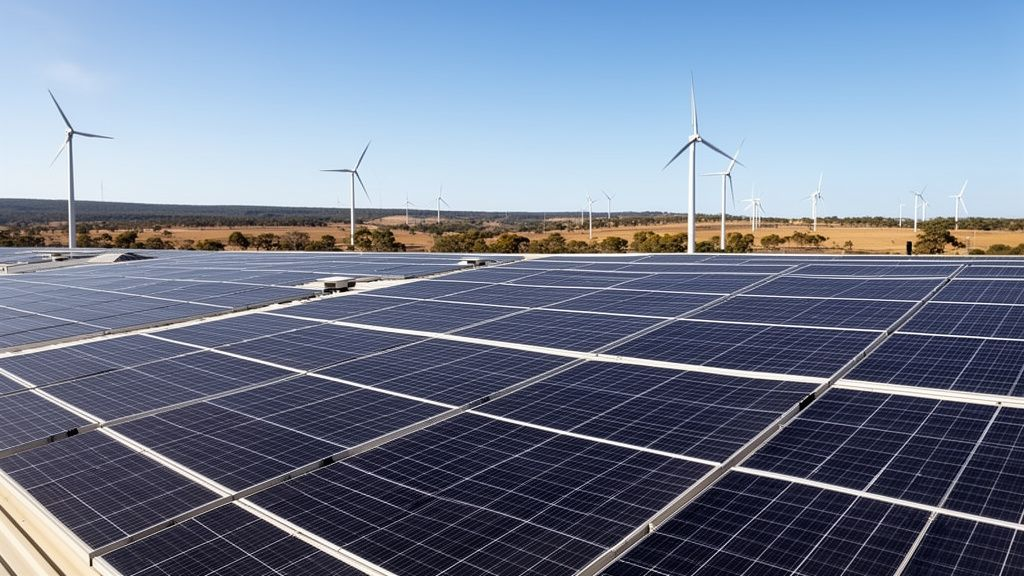
While the developers have already finalized plans to construct a 1.4 gigawatt (GW) wind farm consisting of up to 204 wind turbines, they have recently submitted official documentation under the federal government's Environment Protection and Biodiversity Conservation (EPBC) Act to significantly expand the project’s scope. The joint venture is seeking environmental approval to add a 500 megawatt (MW) solar farm and a 500 MW battery energy storage system (BESS) directly alongside the wind assets.
This decision to develop a co-located solar and battery project was made after close engagement with the local community and key stakeholders during the initial planning phases of the wind farm. The wind portion of the project is already in the final stages of its own EPBC environmental assessment program, which it entered in March.
Co-Locating Solar Farms with Livestock
One of the notable design preferences expressed by the Bungaban joint venture developers is the co-location of the 500 MW solar project with agricultural activities. Specifically, the developers plan to design the solar farm to allow livestock, such as sheep, to graze among the solar arrays. This approach, often referred to as agrivoltaics, helps maximize land-use efficiency by maintaining agricultural production while generating massive amounts of clean energy.
Additionally, the integrated 500 MW battery energy storage system is expected to have a storage duration of approximately four hours. This capacity aligns with modern market evolutions and battery technology advancements, allowing the project to store excess daytime solar energy and discharge it when wind generation is low or during periods of peak electricity demand.


Powering Heavy Industry: The Rio Tinto Boyne Island Smelter PPA
The massive scale of the Bungaban project is directly linked to the commercial decarbonization of Australia's heavy industry. In early 2024, the developers signed a major power purchase agreement (PPA) with global mining giant Rio Tinto. Under the terms of this agreement, Rio Tinto has contracted 80 percent of the Bungaban wind farm’s total electricity output.
This supply contract is part of a broader suite of renewable energy projects assembled to assist in transitioning Rio Tinto's Boyne Island smelter away from fossil-fuel reliance. The smelter's transition is timed to coincide with the scheduled closure of the Gladstone coal-fired power station in 2029. By securing long-term renewable PPAs, heavy industrial operators can ensure a reliable, lower-cost energy supply while meeting their emissions reduction targets.
Market Impact: How Utility Batteries Lower System Costs
The expansion of projects like Bungaban reflects a wider structural shift in the Australian National Electricity Market. According to market analysis published on August 20, 2026, a near-tripling of installed battery capacity across Australia, combined with increasingly diverse ownership of solar and wind generators, is actively putting downward pressure on wholesale electricity prices. High-capacity battery storage systems cap electricity price spikes and boost competitive dynamics, helping to break up historic energy market cartels and stabilize the broader grid.
Key Takeaways
- Massive Scale Expansion: The Bungaban joint venture seeks to add 500 MW of solar and a 500 MW battery to its proposed 1.4 GW wind project in Queensland.
- Dual Land Use: Developers prefer co-locating the solar arrays with livestock grazing to optimize land productivity.
- Industrial Transition Support: Rio Tinto has contracted 80% of the wind farm's output to power the Boyne Island smelter ahead of the Gladstone coal plant's closure in 2029.
- Wholesale Price Control: Rising utility-scale battery deployment is actively dampening extreme price volatility and improving wholesale market competition.